Graphene oxide reducing agent comprising a reducing agent containing a halogen element, method for manufacturing a reduced graphene oxide using same, and use of the reduced graphene oxide manufactured by the method
a technology of reducing agent and graphene oxide, which is applied in the direction of pressure gas generation, inorganic chemistry, explosives, etc., can solve the problems of reduced graphene oxide production methods, impurities included, and restrictions on the use of reducers, and achieve excellent electrical conductor characteristics and high purity
- Summary
- Abstract
- Description
- Claims
- Application Information
AI Technical Summary
Benefits of technology
Problems solved by technology
Method used
Image

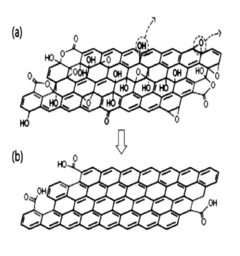
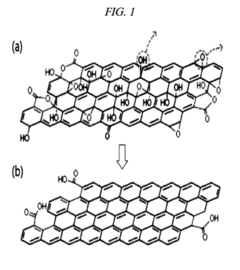
Examples
example 1-1
Production of Reduced Graphene Oxide Through Hydroiodic Acid (HI) and Acetic Acid
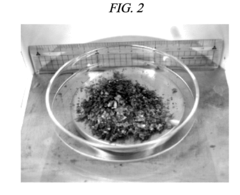
[0037]4 g of graphene oxide was put into 4 l of acetic acid. Thereafter, in order to disperse the solution, the solution was put into an ultrasonic wave system and dispersed until the solution became clear. 0.8 l of hydroiodic acid (HI) was added thereto, and stirring was performed at 40° C. for 48 hours. Thereafter, the mixture was filtered by using a filter paper and washed with a sodium bicarbonate solution, water, and acetone. The filtered powders are reduced graphene oxide in a gray metallic color, which is identified from FIG. 2.
example 1-2
Production of Reduced Graphene Oxide by Using Only Hydroiodic Acid (HI)
[0038]4 g of graphene oxide was put into 4 l of distilled water. Thereafter, in order to disperse the solution, the solution was put into an ultrasonic wave system and dispersed until the solution became clear. 0.8 l of hydroiodic acid (HI) was added thereto, and stirring was performed at 40° C. for 48 hours. Thereafter, the mixture was filtered by using a filter paper and washed with a sodium bicarbonate solution, water, and acetone. The filtered powders are reduced graphene oxide in a gray metallic color.
experimental example 1
Element Analysis of the Reduced Graphene Oxides Produced by Examples 1-1 and 1-2 and Comparative Example 1
[0041]In order to perform element analysis for the reduced graphene oxides produced by Examples 1-1 and 1-2 and Comparative Example 1, each of the samples was burned at a high temperature so that a burned product was obtained. Contents of carbons, hydrogen, nitrogen, sulfur, and oxygen in the burned product were analyzed. This method is widely used in deciding the purity of the reduced graphene oxide, in particular, a composition ratio of carbon and oxygen.
[0042]Graphene oxide and the reduced graphene oxides produced in Examples 1-1 and 1-2 and Comparative Example 1 were dried in a vacuum oven at 80° C. for 24 hours. Thereafter, about 10 mg of a sample was taken to perform element analysis. The results of the element analysis are provided in Table 1 below.
[0043]
TABLE 1SamplesCOHNC / OC / (N + O)Graphene oxide44.5646.432.1301.281.13RGO produced82.637.210.64015.2715.27by Example 1-1RG...
PUM
| Property | Measurement | Unit |
|---|---|---|
| temperature | aaaaa | aaaaa |
| temperature | aaaaa | aaaaa |
| diameter | aaaaa | aaaaa |
Abstract
Description
Claims
Application Information
 Login to View More