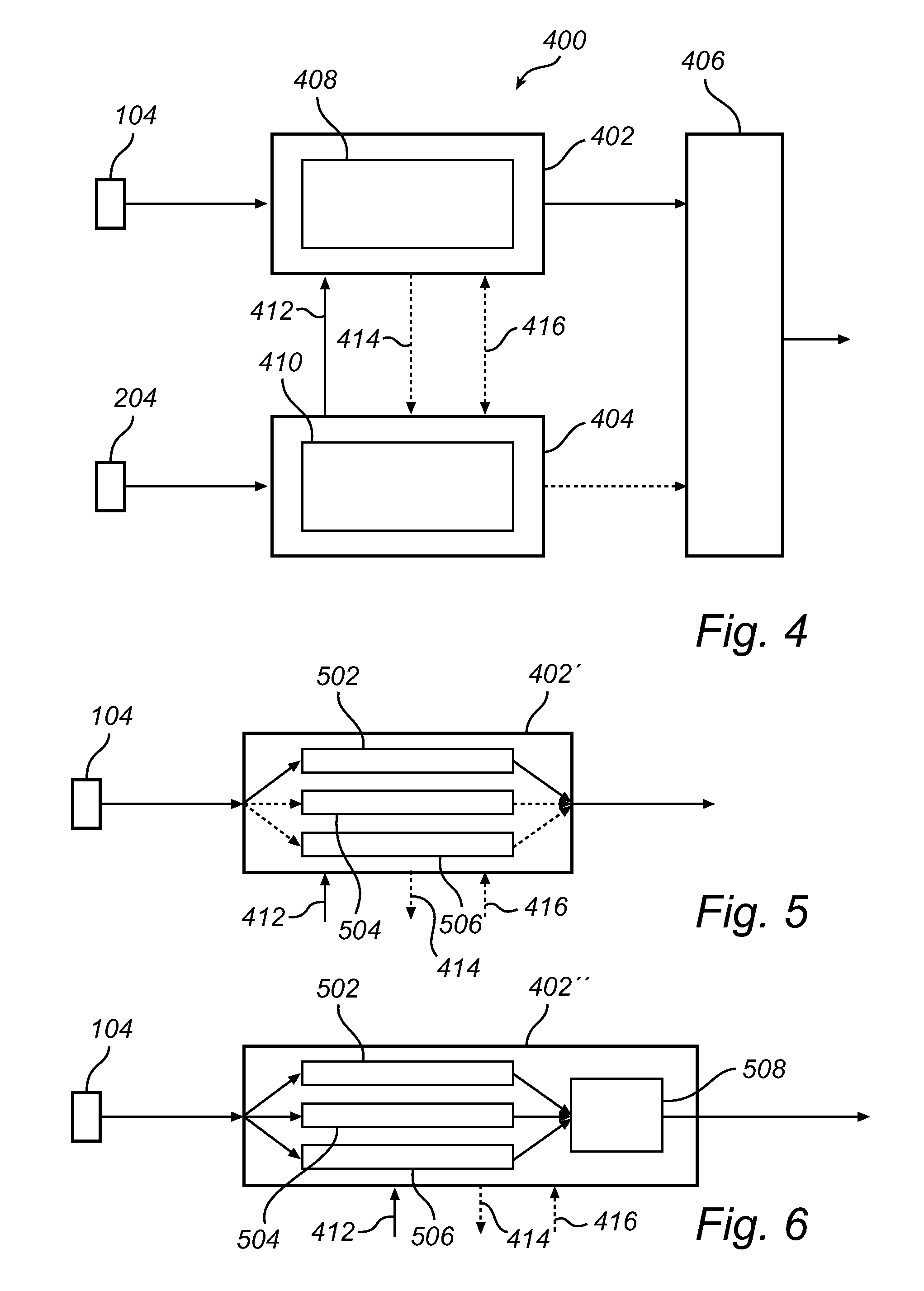
[0008]According to an aspect of the invention, the above may at least partly be met by a system for improving a performance estimation of an operator of a vehicle, comprising a first module implementing a first method for estimating a performance state of vehicle operation, a second module implementing a second method for estimating at least one of a physiological and behavioural state of the operator, and means for sharing an estimated state between one of the first and the second module and the other one of the first and the second module, wherein the implemented estimation method of one of the first and the second module is adjusted based on the state of the other one of the first and the second module, thereby improving the estimation of at least one of the performance state of vehicle operation and the physiological and / or behavioural state of the operator.
[0009]The invention is based on the understanding that by sharing e.g. an estimated state between the modules, the method executed by one or both of the modules may be adjusted to better perform its estimation. For example, the first module may only detect that an impaired driving performance takes place, which may be provided by currently known systems for detecting e.g. lane keeping, etc. The actual reason(s) and / or cause(s) of the impaired driving performance may not be discriminated well by solely the first module. However, by sharing, to the first module from the second module, an estimated state of the physiological and / or behavioural state of the operator, the first module may be given such information that a classification of the reason(s) and / or cause(s) of the impaired driving performance may be determined. It should be noted that the shared estimated state may also comprise sharing at least an intermediate estimated state between the modules, i.e. one of the modules may not necessarily share a “complete / full state estimation”, but rather an intermediate state estimation, provided by for example one of the functional blocks of one of the state estimation methods. Hereby, when the first module has been provided with an indication from the second module of the causes of the impaired driving performance, an adjustment of the first method may be executed in order to improve its estimation. The system may, of course, also function the other way around, i.e. that the second module estimates a physiological and / or behavioural state of the operator and that the shared estimation from the first module provides the second module with such information that the second module may determine the actual factor(s) for the estimated physiological and / or behavioural state. Accordingly, it may, with the system according to the present invention, be possible to classify and determine a performance estimation of the operator. Moreover, to classify the estimation of one of the first and the second methods based on the estimation of the other one of the first and the second methods may provide a robust system which may be improved, compared to prior art systems, in order to estimate the cause(s) of an impaired driving performance. Hence, if the first method estimates a specific driving performance, the second method may provide its estimation as an input to the first module such that a classification of the estimation of the first method may be achieved. This is of course also possible the other way around as described above, i.e. that the estimation of the first method is provided as an input to the second module for classifying the detection of the second method.
[0010]According to a further example, drowsy driving performance is a slow process, on the minute-scale, while distracted driving is a fast process, on the second-scale. The algorithm of the first method may therefore, based on the received estimation from the second module, be adapted to work on the minute-scale or on the second-scale. This may be advantageous when, for example, the second module detects distracted driving. Hereby, the algorithm of the first module may be arranged to work on the second-scale and filter out driving behaviour which may be typical for e.g. drowsy driving behaviour, which works on the minute scale as described above. Hence, when the second module provides its estimation to the first module, the first method of the first module may adjust the time horizon of its algorithm.



 Login to View More
  Login to View More