
Amide or urea containing benzothiazole inhibitors of endothelial lipase
a technology of endothelial lipase and amide or urea, which is applied in the field of amide or urea containing benzothiazole compounds and analogues, can solve the problems of a major health risk of cardiovascular diseas
- Summary
- Abstract
- Description
- Claims
- Application Information
AI Technical Summary
Benefits of technology
Problems solved by technology
Method used
Image

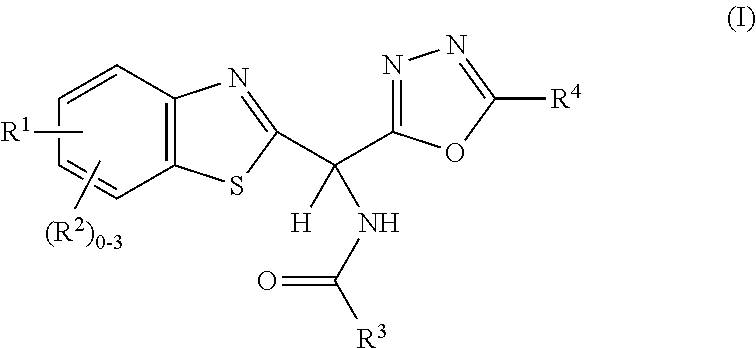
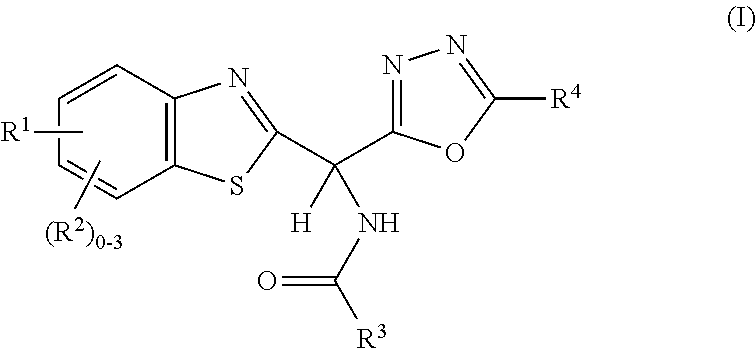
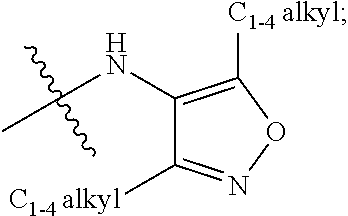
Examples
example 1a
5-((5-((6-bromobenzo[d]thiazol-2-yl)methyl)-1,3,4-oxadiazol-2-yl)methyl)thiazolidine-2,4-dione
[0344]
[0345]To a mixture of 2-(2,4-dioxothiazolidin-5-yl)acetic acid (1.0 g, 5.7 mmol) and 2-(6-bromobenzo[d]thiazol-2-yl)acetohydrazide (1.63 g, 5.71 mmol) (prepared as described in WO 2011 / 074560) in dioxane (8 mL) was added T3P (8.50 mL, 14.3 mmol, 50% in ethyl acetate) and DIEA (2.5 mL, 14.3 mmol) was added and the mixture was heated at 70° C. for 1 h. T3P (8.50 mL, 14.3 mmol, 50% in ethyl acetate) and DIEA (2.5 mL, 14.3 mmol) were added, and the reaction was heated at 105° C. for 12 h. The reaction mixture was concentrated under reduced pressure. The residue was purified by ISCO silica gel chromatography using 0-100% hexane / EtOAc to afford Example 1A (580 mg, 1.36 mmol, 24% yield). LCMS (method B) Rt=1.7 min, (M+H)+=426.8. 1H NMR (400 MHz, CDCl3 containing CD3OD) δ 8.09 (d, J=2.0 Hz, 1H), 7.87 (d, J=8.5 Hz, 1H), 7.63 (dd, J=8.8, 2.0 Hz, 1H), 4.83 (dd, J=8.8, 4.5 Hz, 1H), 4.77 (s, 2H), ...
example 1b
5-((5-((6-(6-fluoropyridin-3-yl)benzo[d]thiazol-2-yl)methyl)-1,3,4-oxadiazol-2-yl)methyl)thiazolidine-2,4-dione
[0346]
[0347]To a solution of Example 1A (400 mg, 0.94 mmol) in dioxane (6 mL) was added (6-fluoropyridin-3-yl)boronic acid (199 mg, 1.41 mmol), K3PO4 (499 mg, 2.35 mmol), and tetrakis(triphenylphosphine)palladium(0) (54 mg, 0.047 mmol). The mixture was degassed with argon and heated at 120° C. for 0.5 h in a microwave reactor. The reaction mixture was diluted with EtOAc and filtered through celite. The filtrate was concentrated under reduced pressure and the residue was diluted with EtOAc, the solution washed with 1.5 M K3PO4 solution and brine, dried over MgSO4, filtered and concentrated under reduced pressure. The residue was purified by reverse phase preparative HPLC (Method G) to afford Example 1B (120 mg, 0.26 mmol, 28% yield). LCMS (method B) Rt=1.6 min, (M+H)+=442.0. 1H NMR (400 MHz, CD3OD) δ 8.53 (d, J=2.5 Hz, 1H), 8.32 (d, J=1.8 Hz, 1H), 8.27 (ddd, J=8.5, 7.5, 2.8 ...
example 1c
(E)-5-((5-((6-(6-fluoropyridin-3-yl)benzo[d]thiazol-2-yl)(hydroxyimino)methyl)-1,3,4-oxadiazol-2-yl)methyl)thiazolidine-2,4-dione
[0348]
[0349]To a solution of Example 1B (65 mg, 0.15 mmol) in acetic acid (2 mL) and water (0.2 mL) was added sodium nitrite (12 mg, 0.18 mmol). The mixture was stirred at rt for 2 h. The reaction mixture was diluted with water. The solid was collected by filtration and dried under reduced pressure to give Example 1C (72 mg, 0.15 mmol, 100% yield) as a light brown solid. LCMS (Method B) Rt=1.8 min, (M+H)+=470.9. 1H NMR (400 MHz, DMSO-d6) δ 8.81-8.52 (m, 1H), 8.57 (s, 1H), 8.48-8.36 (m, 1H), 8.27-8.09 (m, 1H), 8.04-7.89 (m, 1H), 7.36 (dd, J=8.6, 3.1 Hz, 1H), 5.23-4.94 (m, 1H), 3.96-3.77 (m, 2H).
PUM
| Property | Measurement | Unit |
|---|---|---|
| pH | aaaaa | aaaaa |
| volume | aaaaa | aaaaa |
| excitation wavelength | aaaaa | aaaaa |
Abstract
Description
Claims
Application Information
 Login to View More