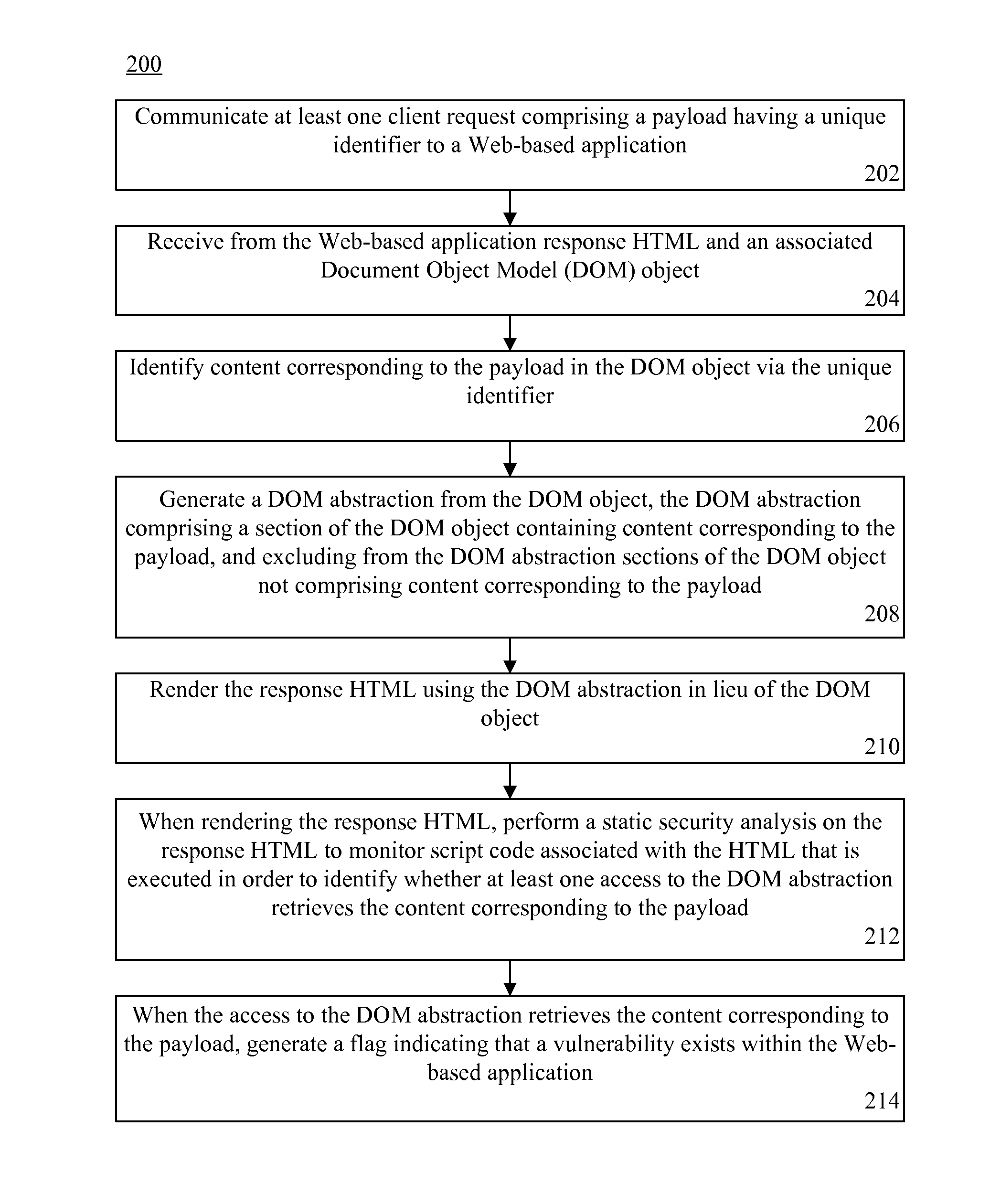
Detection of DOM-based cross-site scripting vulnerabilities

a cross-site scripting and document object model technology, applied in the field of detection of dom-based cross-site scripting vulnerabilities, can solve the problems of web application vulnerability, web application vulnerability, and easy to find exploits

Inactive Publication Date: 2015-12-29
INT BUSINESS MASCH CORP
View PDF18 Cites 2 Cited by
  • Summary
  • Abstract
  • Description
  • Claims
  • Application Information

AI Technical Summary

Benefits of technology

Efficiently and accurately detects DOM-based XSS attacks by isolating and analyzing payload access within the DOM abstraction, providing a scalable and precise method for identifying vulnerabilities in Web applications.

Problems solved by technology

As these technologies become more sophisticated, they also become vulnerable to exploits by unscrupulous users who access the Web-based applications (hereinafter “Web applications”).
These exploits often are notoriously hard to find, in particular when a user provides a malicious payload to a server of a Web application, for instance in a user request.
The Web application may be especially vulnerable if the Web application uses a template for responses, such as an HTML response template, which is instantiated using dynamic values, such as request parameters, provided by a user.
For example, a malicious payload can cause an undesired response to be rendered into a HTML's DOM response provided from the Web application to a client-side application, such as a web browser.

Method used

the structure of the environmentally friendly knitted fabric provided by the present invention; figure 2 Flow chart of the yarn wrapping machine for environmentally friendly knitted fabrics and storage devices; image 3 Is the parameter map of the yarn covering machine
View more

Image

Smart Image Click on the blue labels to locate them in the text.
Viewing Examples
Smart Image
  • Detection of DOM-based cross-site scripting vulnerabilities
  • Detection of DOM-based cross-site scripting vulnerabilities
  • Detection of DOM-based cross-site scripting vulnerabilities

Examples

Experimental program
Comparison scheme
Effect test

Embodiment Construction

[0013]As will be appreciated by one skilled in the art, aspects of the present invention may be embodied as a system, method or computer program product. Accordingly, aspects of the present invention may take the form of an entirely hardware embodiment, an entirely software embodiment (including firmware, resident software, micro-code, etc.) or an embodiment combining software and hardware aspects that may all generally be referred to herein as a “circuit,”“module” or “system.” Furthermore, aspects of the present invention may take the form of a computer program product embodied in one or more computer-readable medium(s) having computer-readable program code embodied, e.g., stored, thereon.

[0014]Any combination of one or more computer-readable medium(s) may be utilized. The computer-readable medium may be a computer-readable signal medium or a computer-readable storage medium. A computer-readable storage medium may be, for example, but not limited to, an electronic, magnetic, optica...

the structure of the environmentally friendly knitted fabric provided by the present invention; figure 2 Flow chart of the yarn wrapping machine for environmentally friendly knitted fabrics and storage devices; image 3 Is the parameter map of the yarn covering machine
Login to View More

PUM

No PUM Login to View More

Abstract

Testing a Web-based application for security vulnerabilities. At least one client request including a payload having a unique identifier can be communicated to the Web-based application. Response HTML and an associated Document Object Model (DOM) object can be received from the Web-based application. Content corresponding to the payload can be identified in the DOM object via the unique identifier. A section of the DOM object including the payload can be identified as un-trusted.

Description

CROSS-REFERENCE TO RELATED APPLICATIONS[0001]This application is a continuation of U.S. application Ser. No. 13 / 283,989, entitled DETECTION OF DOM-BASED CROSS-SITE SCRIPTING VULNERABILITIES, and filed Oct. 28, 2011, the entirety of which is fully incorporated herein by reference.BACKGROUND[0002]One or more embodiments disclosed within this specification relate detection of Document Object Model (DOM) based cross-site scripting vulnerabilities.[0003]With the advent of Internet based technologies, Web applications are increasingly becoming more sophisticated. As these technologies become more sophisticated, they also become vulnerable to exploits by unscrupulous users who access the Web-based applications (hereinafter “Web applications”). These exploits often are notoriously hard to find, in particular when a user provides a malicious payload to a server of a Web application, for instance in a user request. The Web application may be especially vulnerable if the Web application uses a...

Claims

the structure of the environmentally friendly knitted fabric provided by the present invention; figure 2 Flow chart of the yarn wrapping machine for environmentally friendly knitted fabrics and storage devices; image 3 Is the parameter map of the yarn covering machine
Login to View More

Application Information

Patent Timeline
no application Login to View More
Patent Type & AuthorityPatents(United States)
IPC IPC(8): G06F21/55G06F21/57G06F21/56G06F21/52
CPCG06F21/566G06F21/577G06F21/52G06F21/56H04L63/1433G06F2221/2119
InventorAMIT, YAIRHAVIV, YINNON A.KALMAN, DANIELTRIPP, OMERWEISMAN, OMRI
OwnerINT BUSINESS MASCH CORP