Two-input uninterruptible voltage converting device and method thereof
a voltage conversion device and uninterruptible technology, applied in emergency power supply arrangements, process and machine control, instruments, etc., can solve the problems of 1% to 3% energy loss in low-voltage dc circuits during high-voltage operation, energy consumption and resource waste in methods, etc., to achieve more reliable power-off protection, simple circuits, and energy saving
- Summary
- Abstract
- Description
- Claims
- Application Information
AI Technical Summary
Benefits of technology
Problems solved by technology
Method used
Image



Examples
embodiment 1
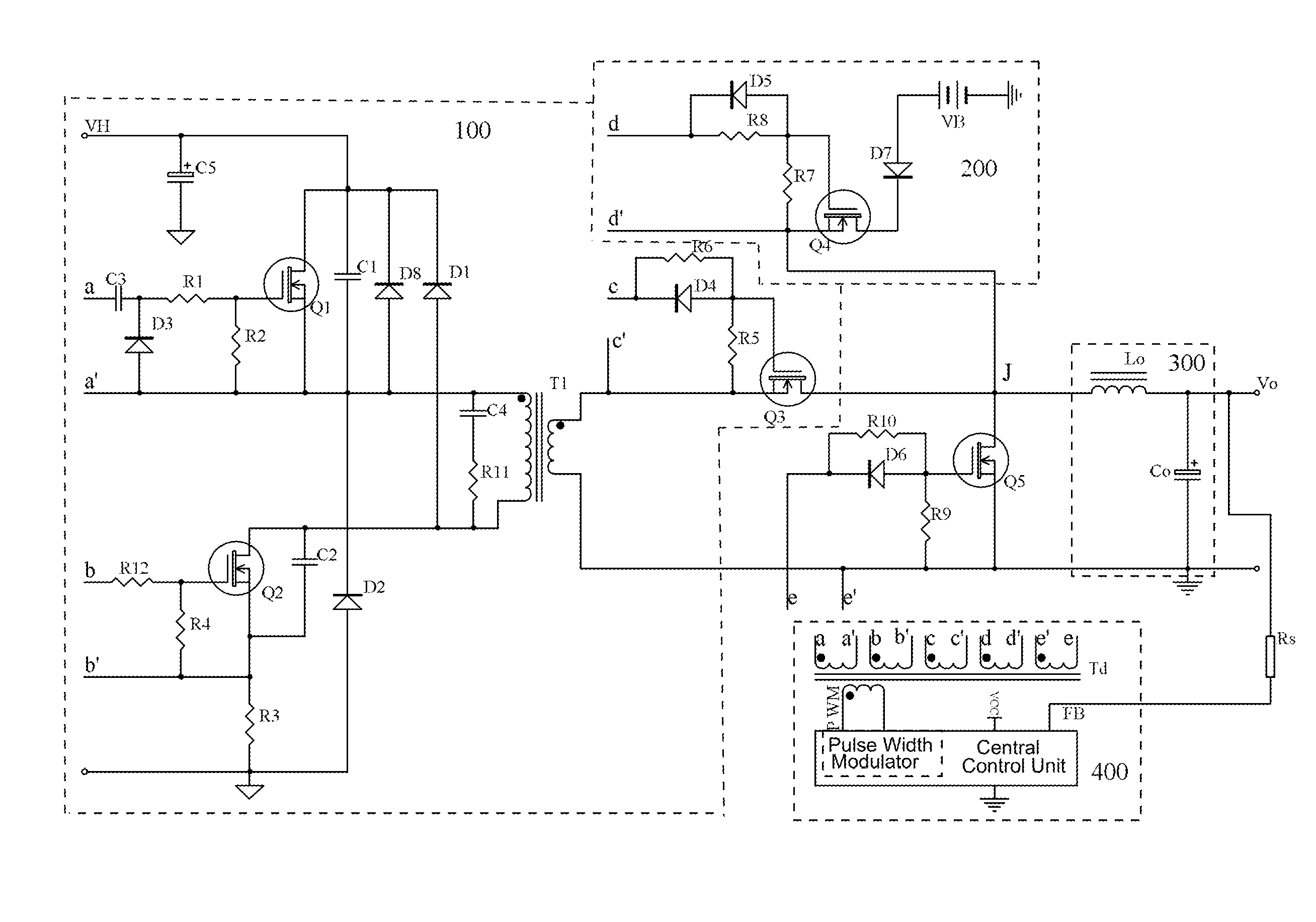
[0033]As illustrated in FIG. 1, the two-input uninterruptible voltage converting device comprises a first conversion circuit 100, a second conversion circuit 200, an energy storage unit 300 and a control unit 400.
[0034]The first conversion circuit 100 has a high-voltage DC (Direct Current) source VH, a main power transformer T1, an upper switch tube Q1 and a lower switch tube Q2 connected to a primary winding of the main power transformer T1, and a switch-type rectifying tube Q3 connected to a secondary winding of the main power transformer T1; and an output end of the switch-type rectifying tube Q3 is taken as an intersection J.
[0035]The second conversion circuit 200 is formed by a low-voltage DC source VB, an isolating diode D7 and a low-voltage switch tube Q4 connected with each other in series in turn; an output end of the second conversion circuit 200 is connected to the intersection J; the minimum allowable voltage of the low-voltage DC source VB is more than the rated output ...
embodiment 2
[0047]As illustrated in FIG. 2, the two-input uninterruptible voltage converting device of the embodiment 2 is basically the same with that of the embodiment 1, with the difference as follows: in the embodiment 1, the switch-type rectifying tube Q3 is driven by the secondary winding cc′ of the pulse transformer Td and synchronously switched on or off with the upper switch tube Q1, the lower switch tube Q2 and the low-voltage switch tube Q4.
[0048]But in the embodiment 2, the switch-type rectifying tube Q3 adopts the bootstrap driving means, namely the switch-type rectifying tube Q3 is driven by a pulse voltage outputted by another secondary winding (namely a bootstrap winding) of the main power transformer T1 and synchronously switched on or off with the upper switch tube Q1, the lower switch tube Q2 and the low-voltage switch tube Q4. In actual application, the amplitude of the pulse voltage generated by the bootstrap winding must be controlled to be within the range specified by a ...
embodiment 3
[0049]As illustrated in FIG. 3, the two-input uninterruptible voltage converting device of the embodiment 3 is basically the same with that of the embodiment 1, with the difference as follows: in the embodiment 1, the switch-type rectifying tube Q3 adopts an MOSFET and is synchronously switched on or off with the upper switch tube Q1 and the lower switch tube Q2, namely adopting the synchronous rectification technology. But in the embodiment 3, the rectifying tube Q3 adopts a Schottky diode (SBD), so that the two-input uninterruptible voltage converting device of the embodiment 3 has the advantages of simpler lines and lower cost. The embodiment 3 is adapted to the case of low power and no need of inverse high-voltage output.
PUM
 Login to View More
 Abstract
Description
Claims
Application Information
 Login to View More