Check patentability & draft patents in minutes with Patsnap Eureka AI!

Process for resourcing municipal solid waste

a municipal solid waste and processing technology, applied in the field of new technologies, can solve the problems of waste organic materials, waste of organic materials, and excess spending costs, and achieve the effect of cost-effectiveness

Active Publication Date: 2017-04-11
ZHU ZUOLIN +1
View PDF7 Cites 0 Cited by
  • Summary
  • Abstract
  • Description
  • Claims
  • Application Information

AI Technical Summary

Benefits of technology

The process achieves a high percentage conversion of MSW into liquid fuels and organic acids with nearly quantitative yield, reducing manufacturing costs and environmental impact, making it economically practical and environmentally friendly.

Problems solved by technology

There are no cost-effective technologies available for refining organic MSW.
Current methods for MSW treatment, such as landfill or combustion, not only waste organic materials, but also require excess spending costs.
The combustion method for organic MSW will generate toxic volatile gases such as nitrogen oxides and sulfur oxides, due to the existence of proteins and other organic sulfurs and nitrogen chemicals.
Complete removal of these toxic gases from emission is expensive.
MSW combustion cannot produce any organic chemical products, and the electricity price from MSW combustion is much higher than that from coal combustion.
Many chemicals that exist in MSW are poisons for all known conventional catalysts, resulting in a lack of a method for selectively converting organic MSW into a few chemical products.
Due to the complexity of MSW, sorting all of its organic components is too expensive and difficult.
Thus, the majority of components of organic MSW are still being wasted.
All methods that have been developed from the modification of petro-chemical processes or coal chemical processes are commercially impractical due to their high costs of operation.
For example, the pyrolysis of organic MSW shows no selectivity for any product, and the process is highly corrosive.
The formation of black tar and gasification is always observed in large amounts, thus the process gives very low yields of liquid products.
In summary, all the existing methods for treating municipal solid waste are not only unprofitable, but also wasteful of one of the most important resources of organic materials.

Method used

the structure of the environmentally friendly knitted fabric provided by the present invention; figure 2 Flow chart of the yarn wrapping machine for environmentally friendly knitted fabrics and storage devices; image 3 Is the parameter map of the yarn covering machine
View more

Image

Smart Image Click on the blue labels to locate them in the text.
Viewing Examples
Smart Image
  • Process for resourcing municipal solid waste
  • Process for resourcing municipal solid waste
  • Process for resourcing municipal solid waste

Examples

Experimental program
Comparison scheme
Effect test

example 1

[0035]Samples of organic MSW are prepared according to EPA data as shown in Table 1. All components are calculated as dried materials. Through the variation of the quantities of brown paperboard, pine needles, and wood, two kinds of organic MSW are prepared. One of them contains 10% lignin (Organic MSW A), and another contains 30% lignin (Organic MSW B).

[0036]

Component namePercentage (%)Paper, Paperboard34Bread, noodle, fat and vegetable oil, rice, tomato, and17potatoWild grass, tree branches, pine needles, and flowers16.5Polyester and polyether plastic14.8Leather, cotton cloths10Wood7.8

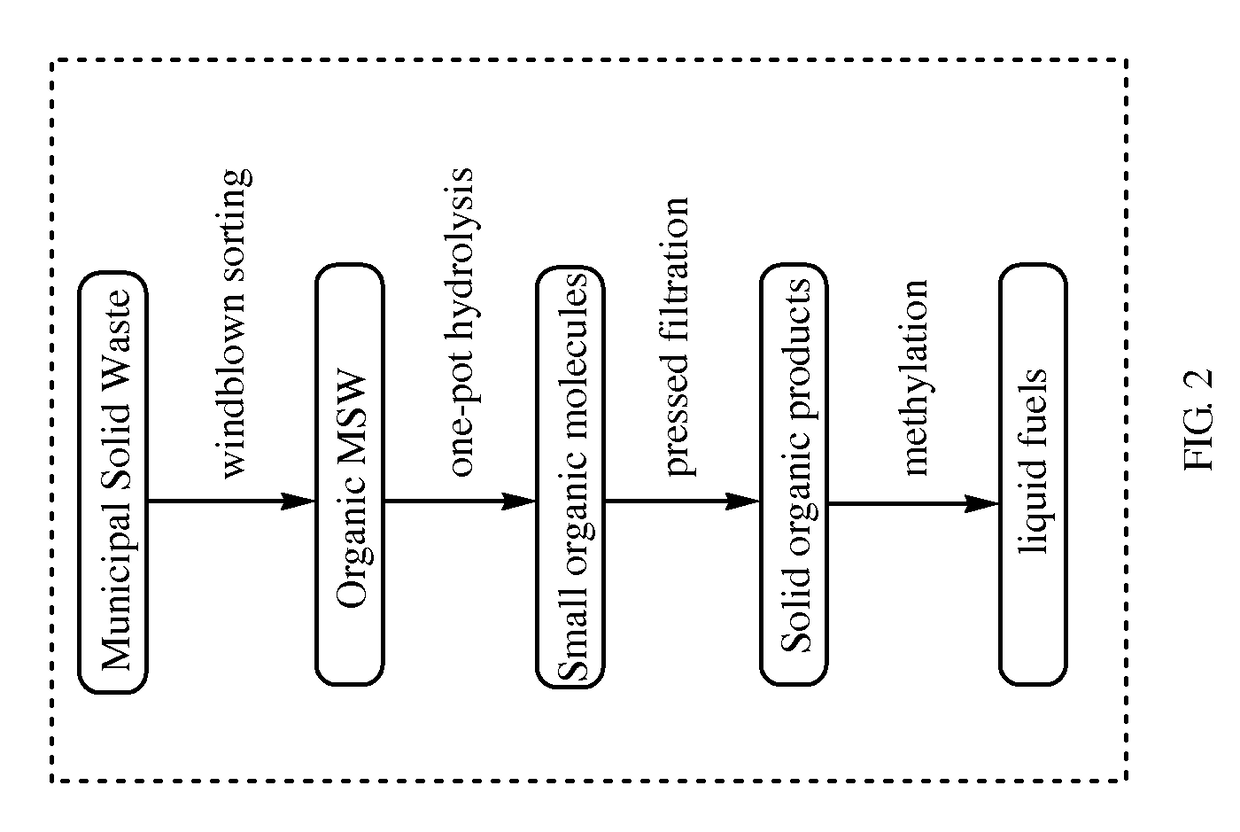
[0037]To a 1 liter stainless steel autoclave equipped with mechanical stirrer, add 750 ml of distilled water, 112 g of dried organic MSW B, 42 g of calcium oxide, and 1 g of 9,10-dihydroxyanthracene. The autoclave is sealed, purged with nitrogen three times, then filled with nitrogen at a pressure of 0.2-1 MPa, heated to 180° C. and maintain at this temperature for ten minutes. The temperature is the...

example 2

[0039]To a 1 liter stainless steel autoclave equipped with mechanical stirrer, add 750 ml of distilled water, 112 g of dried organic MSW B, 42 g of calcium oxide, and 1 g of anthraquinone. The autoclave is sealed, purged with nitrogen three times, then filled with nitrogen at a pressure of 0.2-1 MPa, heated to 180° C. and maintain at this temperature for ten minutes. The temperature is then increased to 250° C. and stirred at this temperature for 50 min. After cooling to a temperature below 50° C., a brown color liquid mixture is obtained (the color slowly turns deeper after the mixture is exposed to air). The liquid mixture is then cooled down to a temperature below 10 degrees Celsius with stirring. Pressed filtration is carried out with the temperature controlled below 10 degrees Celsius. A brown color solid product obtained is 218 grams with 28% of water content. The yield is 101% based on the organic MSW.

[0040]The brown color solid is dried under a vacuum with the temperature co...

example 3

[0042]To a 1 liter stainless steel autoclave equipped with mechanical stirrer, add 750 ml of distilled water, 112 g of dried organic MSW B, and 42 g of calcium oxide. The autoclave is sealed, purged with nitrogen three times, then filled with nitrogen at a pressure of 0.2-1 MPa, heated to 180° C. and maintain at this temperature for ten minutes. The temperature is then increased to 250° C. and stirred at this temperature for 50 min. After cooling to a temperature below 50° C., a black color sticky mixture is obtained. The mixture is then cooled down to a temperature below 10 degrees Celsius with stirring. Pressed filtration is carried out with the temperature controlled below 10 degrees Celsius. The black color solid product obtained is 120 grams with 35% of water content. The yield is 32% based on the organic MSW.

[0043]The result shows that the yield of liquid product is very low without catalyst.

the structure of the environmentally friendly knitted fabric provided by the present invention; figure 2 Flow chart of the yarn wrapping machine for environmentally friendly knitted fabrics and storage devices; image 3 Is the parameter map of the yarn covering machine
Login to View More

PUM

PropertyMeasurementUnit
temperatureaaaaaaaaaa
Login to View More

Abstract

A process for converting organic MSW into liquid fuels or chemical products in almost quantitative yield via catalytic one-pot hydrolytic depolymerization of organic MSW. The organic MSW comprises all organic materials that exists in municipal solid waste, such as paper and paperboard, food scraps, yard trimmings, rubber, leather, textiles, wood, plastics, etc. The process is the first one over the world for resourcing municipal solid waste.

Description

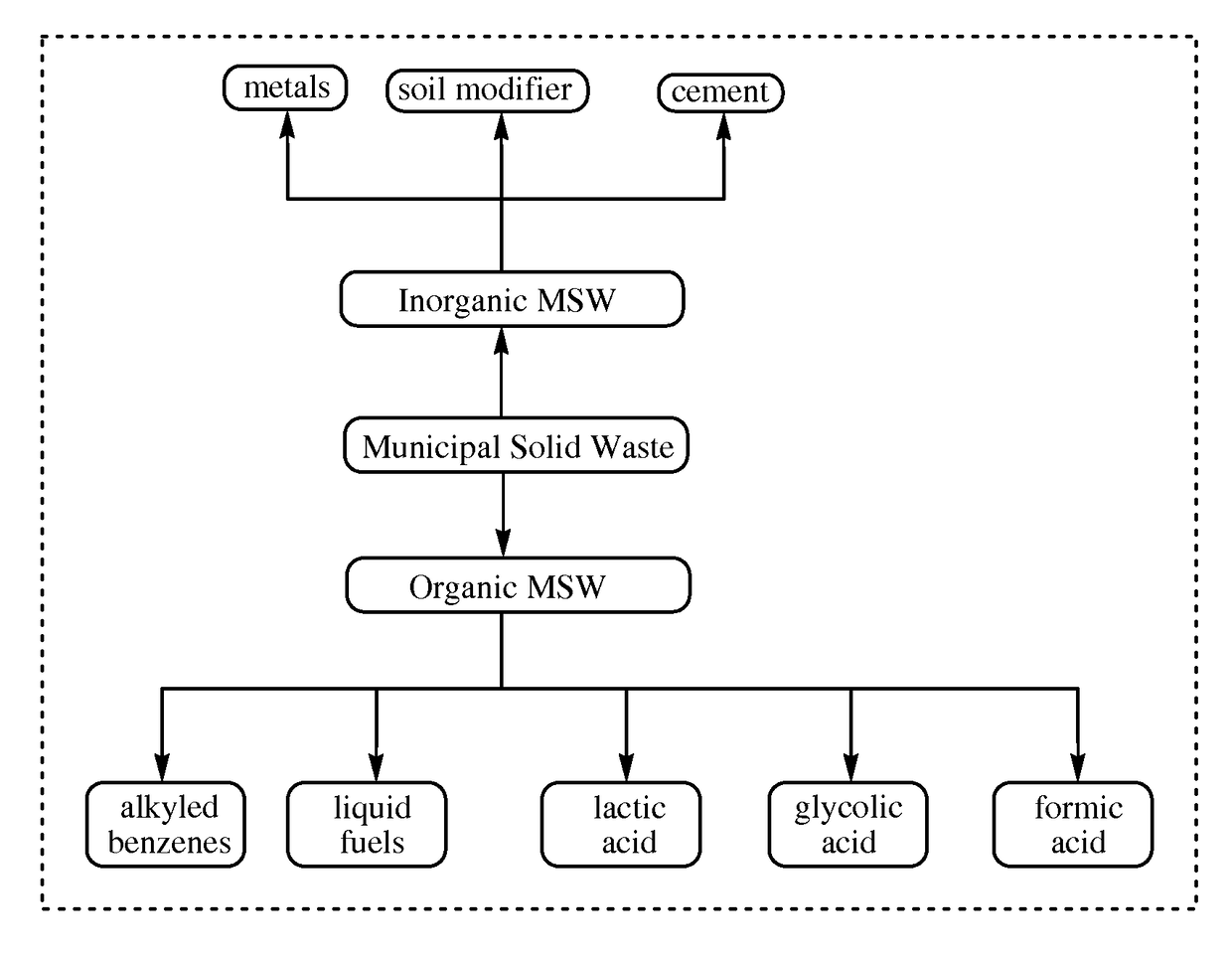
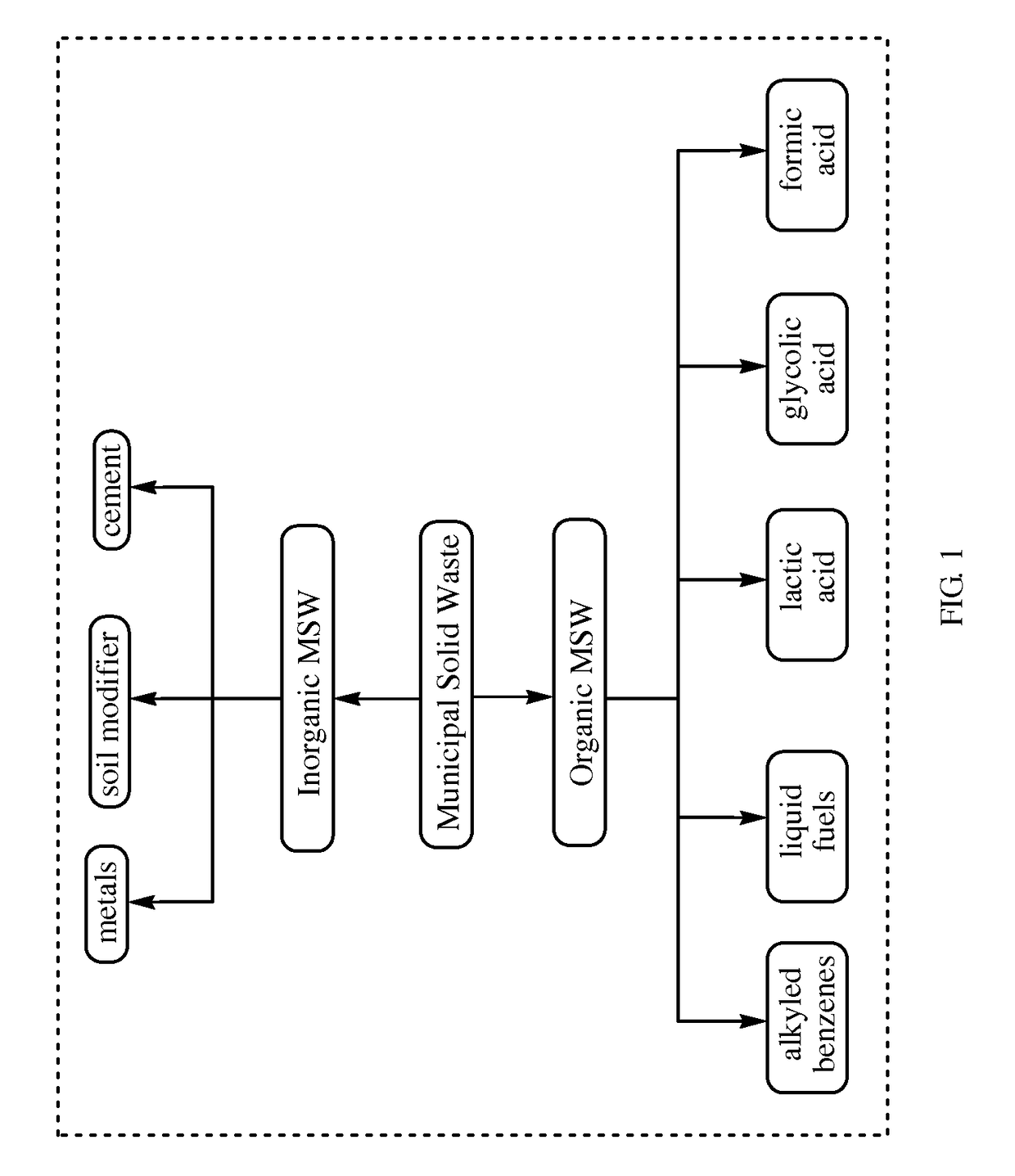
FIELD OF THE INVENTION[0001]The present invention is related to a novel process for resourcing municipal solid waste. More specifically, the present invention is related to a process for refining organic components of municipal solid waste into liquid fuels or organic chemical products in an almost quantitative yield.DESCRIPTION OF RELATED ART[0002]The percentage of organic components in municipal solid waste (MSW) is high in developed countries: generally above 60% and even higher than 80% (83% for USA, 2009 EPA data, Table 1). The composition materials of MSW, such as paper and paperboard, food scraps, yard trimmings, plastics, rubber, leather, textiles, and wood, are organic materials. In developing countries, the percentage of organic components in MSW is about 50%. Thus, MSW is a potentially important resource of organic carbons.[0003]TABLE 1MSW Composition, USA, 2009Per-centageComponent name(%)RemarksPaper and28.2Cellulose, with little lignin and hemicellulosePaperboardFood Sc...

Claims

the structure of the environmentally friendly knitted fabric provided by the present invention; figure 2 Flow chart of the yarn wrapping machine for environmentally friendly knitted fabrics and storage devices; image 3 Is the parameter map of the yarn covering machine
Login to View More

Application Information

Patent Timeline
no application Login to View More
Patent Type & Authority Patents(United States)
IPC IPC(8): C10L1/00C10L1/02C10G57/00C07C67/00C07C27/00C10G29/20C07C51/09C10G31/09C10G1/00C10G1/10C10G1/08
CPCC10L1/02C07C27/00C07C51/09C07C67/00C10G1/002C10G1/08C10G1/086C10G1/10C10G29/205C10G31/09C10G57/005C07C69/06C07C69/14C07C69/675C07C69/68C07C59/08C07C59/06C07C53/02C10L2200/0469C10L2290/02C10L2290/547
Inventor ZHU, ZUOLINZHU, JONATHAN
Owner ZHU ZUOLIN
Features
  • R&D
  • Intellectual Property
  • Life Sciences
  • Materials
  • Tech Scout
Why Patsnap Eureka
  • Unparalleled Data Quality
  • Higher Quality Content
  • 60% Fewer Hallucinations
Social media
Patsnap Eureka Blog
Learn More