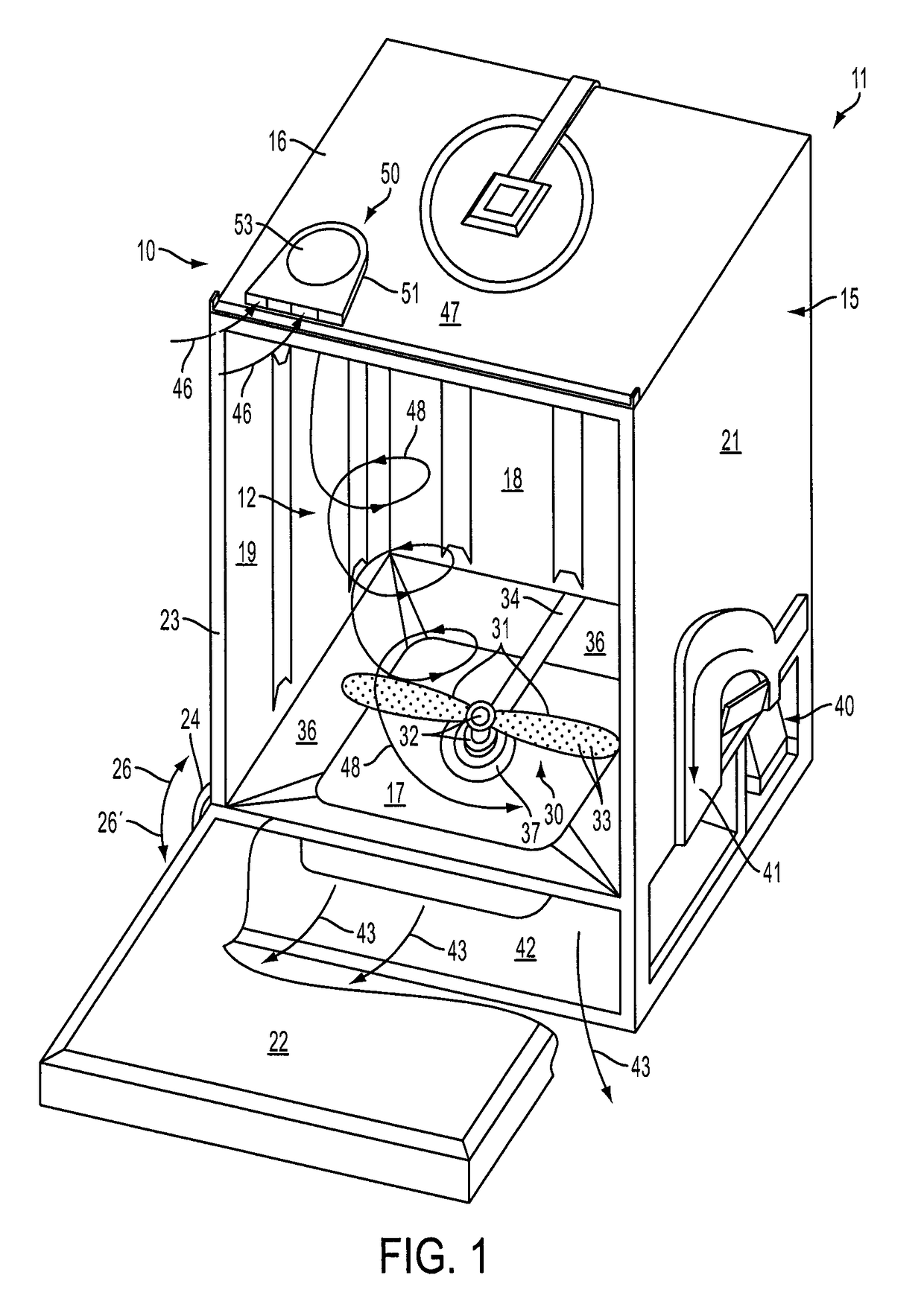
[0005]Briefly described, the present invention generally relates to a drying system for facilitating the rapid and efficient drying of dishes within a dishwasher while reducing incidence of spotting or flash drying of the dishes, and without requiring additional power for its operation. The drying system generally includes a passive vent assembly including a passive vent structure that is sandwiched between a moisture trap hood or cover and a diffuser mounted on opposite sides thereof.
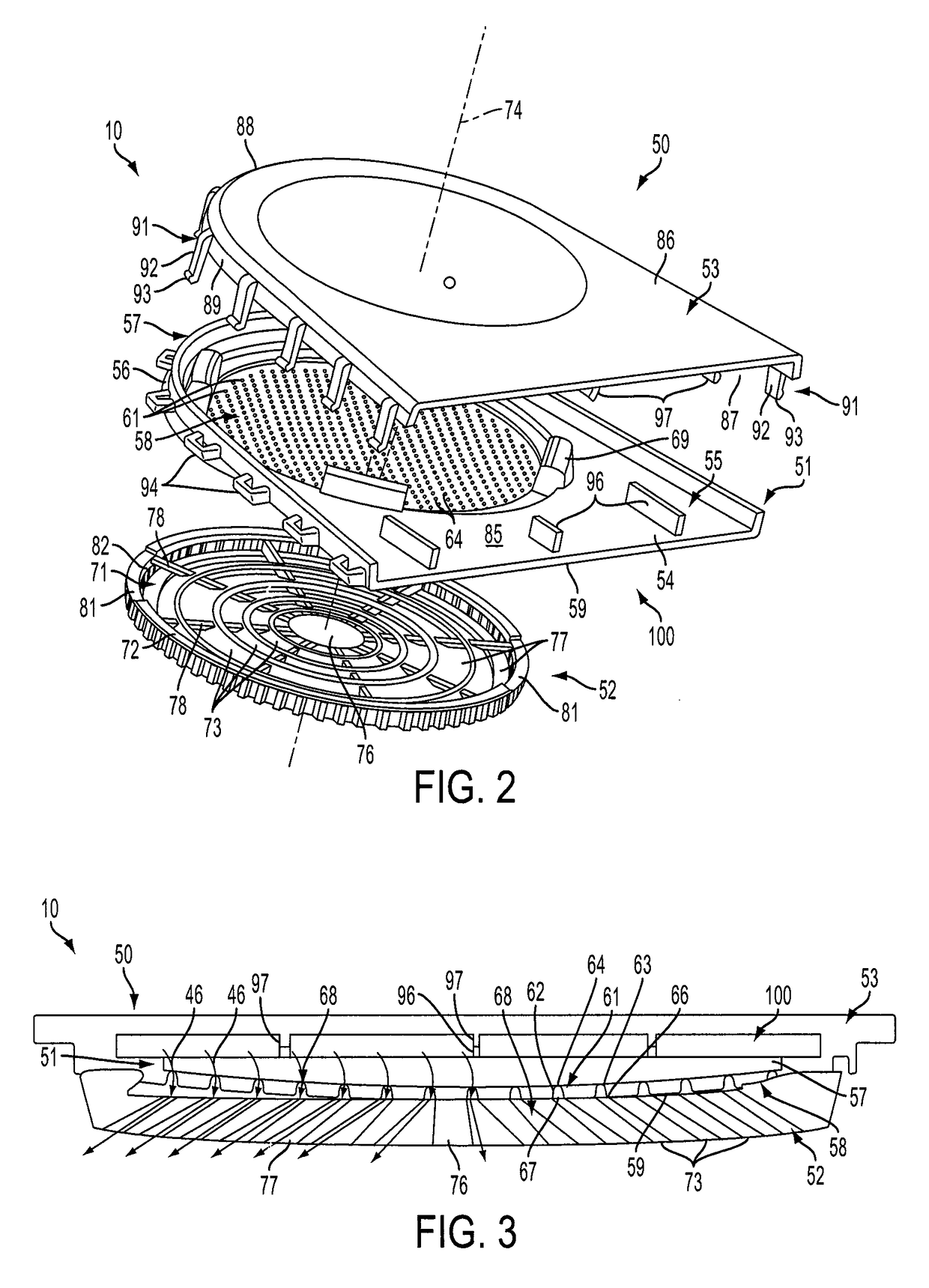
[0008]The diffuser is mounted to the lower surface of the passive vent structure body, typically by snap connectors or other similar connectors or fasteners. The diffuser generally includes a series of fins or baffles that define openings therebetween and typically are arranged at varying angles of between approximately 10° to 80° with respect to a vertically aligned central axis extending through the center of the diffuser and vent section of the passive vent structure. It will also be understood that greater or lesser angles of the fins or baffles also can be used, so as to vary the angle(s) at which the airflows are received from the air inlets or vents of the vent section of the passive vent structure and are directed into the wash chamber. As a result, the incoming drying airflows are spread or diffused over a wider area of coverage within the wash chamber, thus promoting more turbulence and faster condensation of moisture and drying of the dishes therein.
[0009]The moisture trap hood is received over the upper surface of the passive vent structure, covering the upper surface and being spaced therefrom. As a result, an airflow opening or inlet is defined / formed at the front end of the passive vent assembly for guiding the incoming drying airflows into the vent section of the passive vent structure. The moisture trap hood further generally helps hold in moist, heated air from the wash chamber of the dishwasher, facilitating more rapid condensation of the water therein, which water is collected and flows back into the air vents to help in the creation or formation of a moisture barrier or substantial seal across the openings of the vents of the passive vent structure.
[0010]During the washing and rinse cycles of a cleaning operation as a higher pressure is maintained within the wash chamber of the dishwasher, the use of the low surface energy plastic or coated materials for the passive vent structure, in combination with the construction of the air vents thereof, facilitates the formation of water beads or bubbles covering the lower vent openings thereof so as to create a substantial moisture seal or barrier across the air vents or inlets. The air vents thus will be effectively sealed against both the ingress of ambient air from outside the dishwasher, as well as the release or escape of hot, moist air or water vapor from inside the wash chamber of the dishwasher.
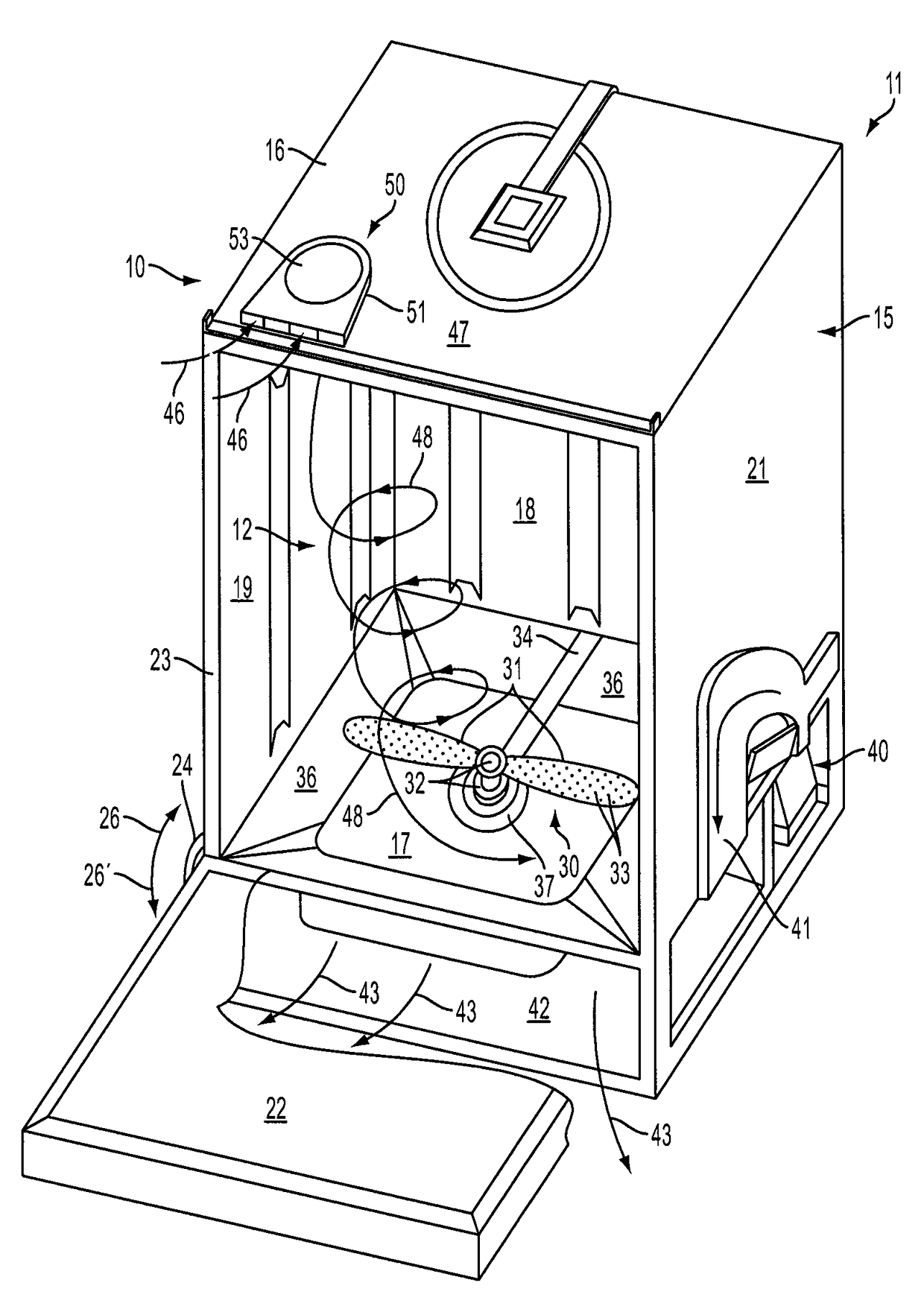
[0011]Thereafter, during a drying cycle, when the blower of the dishwasher is engaged, and the pressure within the wash chamber is lowered, the water bubbles will be broken or otherwise disturbed, causing the drying airflows to be drawn into and through the air vents of the passive vent assembly and into the wash chamber. As the drying airflows pass through the air vents of the vent section of the passive vent structure, they strike the fins or baffles of the diffuser, which cause the incoming airflows to be diffused and spread out across the wash chamber. The system thus enables the cold air to enter into the wash chamber from the top of the wash chamber through the vent using forced suction created at the bottom of the wash chamber using a blower. Based on the principle that hot air rises, when the drying cycle starts, the hot and moist air in the tub or wash chamber will tend to try to rise and stay at the top and will urge the incoming cold, drier air toward the bottom of the wash chamber. This movement of air will create turbulence of the air flow in the wash chamber, and the diffuser will spread the incoming cold air so that the turbulence of the air flow within the wash chamber in the system generally is further amplified. This creates greater turbulence and a wider flow of air throughout the wash chamber, which can help facilitate the rapid condensation and removal of water and water vapor from the dishes so as to provide enhanced and greater efficiency in the drying cycle for the dishes.



 Login to View More
  Login to View More