[0038]In the invention of the cushion body 1 described in the first aspect, the polyurethane foam used generally and conventionally can be substituted by the synthetic resin foam, which results in the weight reduction and the improvement in recyclability. Further, in spite of the use of the synthetic resin foam that is relatively hard and inferior in cushioning properties, fitting properties, and creep resistance properties, it is possible to provide the synthetic resin foam with high cushioning properties, high fitting properties, and high degree of freedom of design. The body of the seated person and the supine posture person can be therefore supported appropriately, and the high comfort can be obtained. The favorable creep resistance properties equivalent to those of the conventional polyurethane foam are exerted even with long-time use, thereby exerting the effect of high marketability.
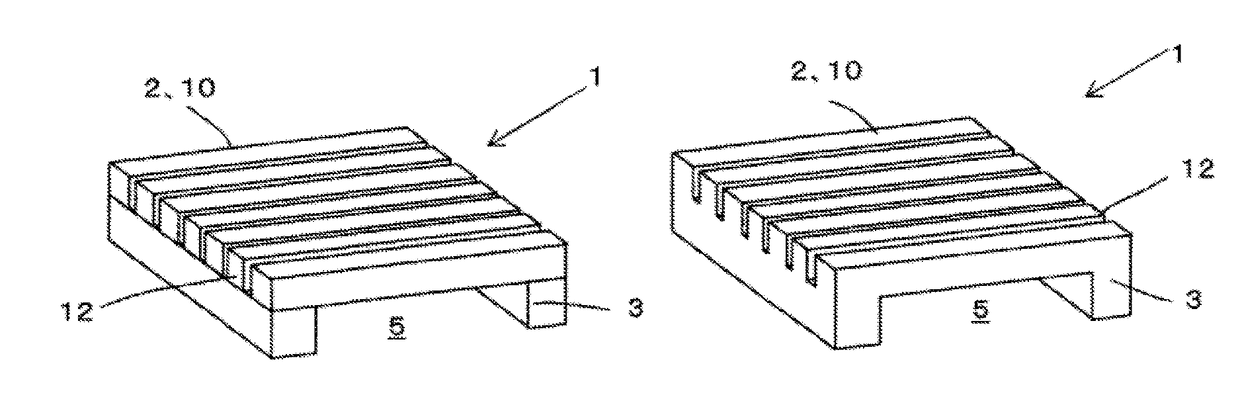
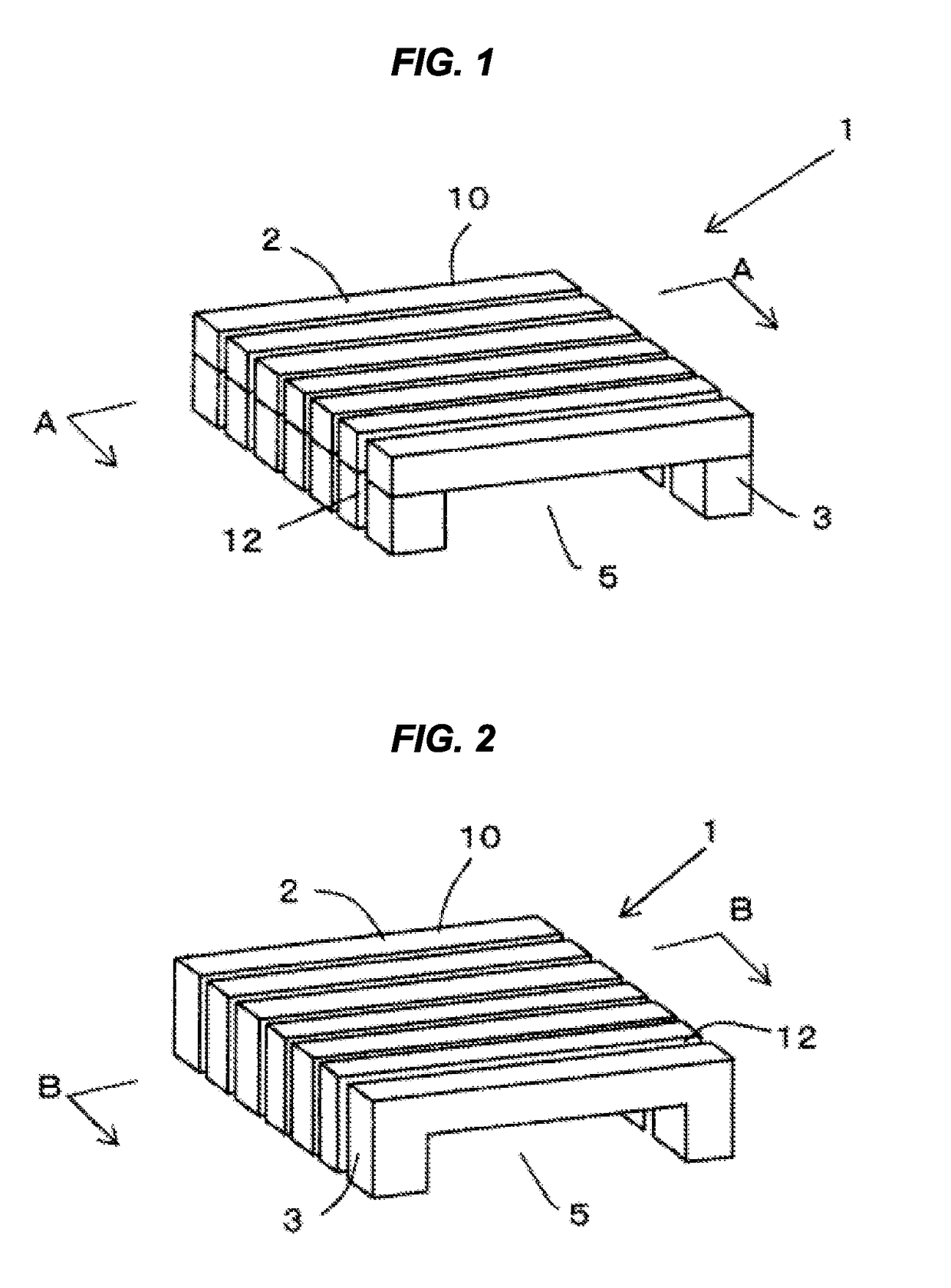
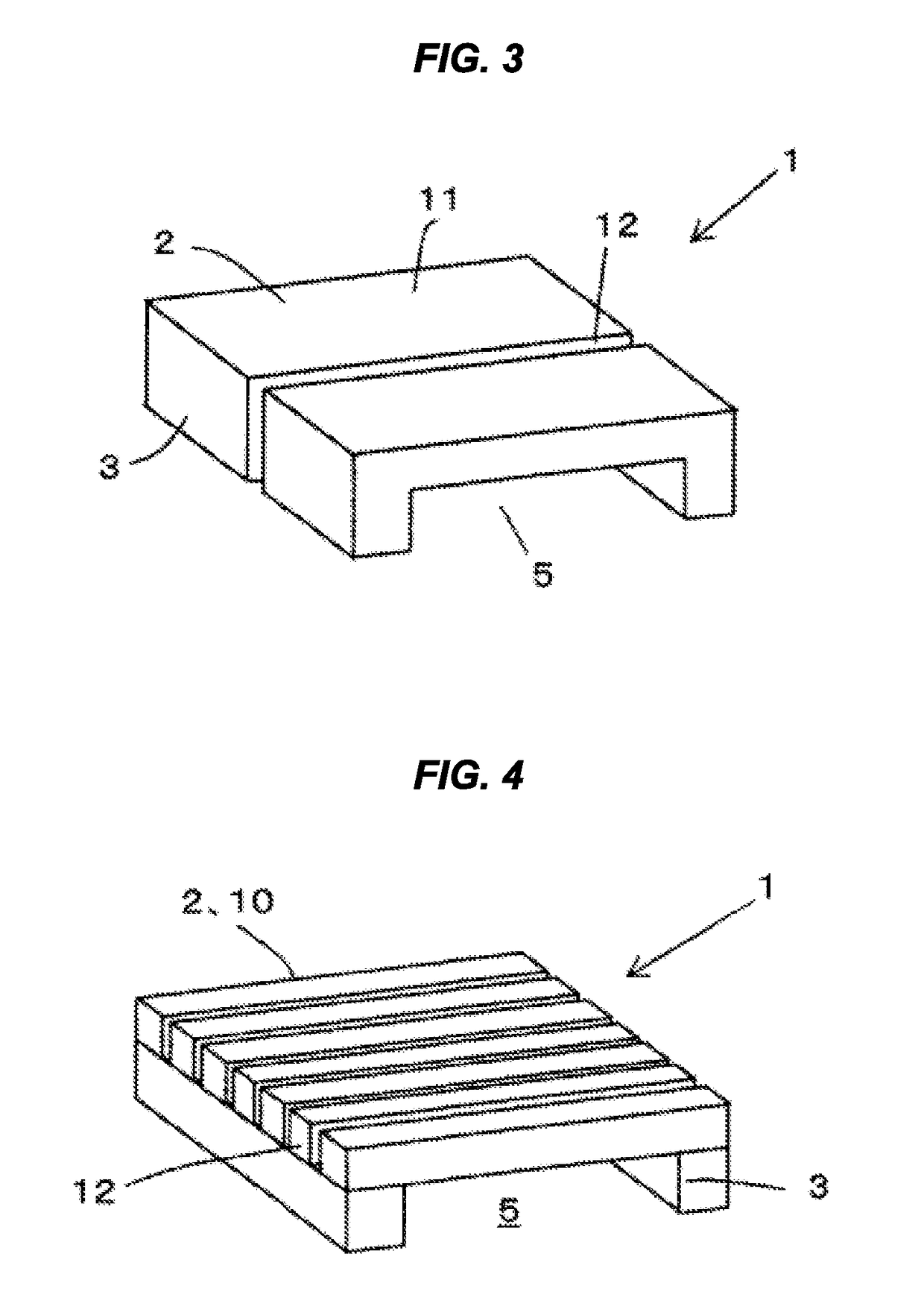
[0039]The cushion body 1 described in the second aspect achieves an effect of forming a space which can deforms by bending downward in the supporting body 2 by the leg body 3 since the supporting body 2 is supported by the leg body 3 extended from the supporting body 2, as well as achieving the same effects as those of the invention described in the first aspect.
[0040]The cushion body 1 described in the third aspect achieves an effect of forming a space which can deforms by bending downward in the supporting body 2 by the frame 50 since the supporting body 2 is supported by the frame 50, as well as achieving the same effects as those of the invention described in the first aspect.
[0041]The cushion body 1 described in the fourth aspect achieves the same effects as those of any one of the first to third aspects 3. Further, in the case that the distance between both ends of the supporting body 2 can not be sufficiently secured by the compact cushion body, and a sufficient deflection can not be obtained by the load caused by the seated person or the supine posture person, it is possible to enlarge the substantial distance between both ends of the supporting body 2 at the bending deformation receiving time and obtain the sufficient deflection, by forming the supporting body 2 into the circular arc shape or the bent shape constructed by the combination of the straight line portions obtained by bending the straight lines at the optional angle, instead of the linear shape. As a result, it is possible to enhance the degree of freedom of the design.
[0042]The cushion body 1 described in the fifth aspect achieves the same effects as those of any one of the first to fourth aspects. Further, in the case that the supporting body 2 is constructed by the laminated structure, it is possible to enhance the cushioning properties in the side with which the seated person or the supine posture person comes into contact, by making the supporting body 2 in the seated person side or the supine posture person side with the material having more flexibility. The supporting body 2 can be fitted to an outer shape of the body at the seating time or the supine posture time by conforming the shape of the supporting body 2 in the seated person side or the supine posture side to the shape of the body.
[0043]Further, in the case that the supporting body 2 is the integrated structure which is constructed by the combination of the different kinds of materials set every position, for example, in the case that the supporting body 2 has the strongly pressed position and the weakly pressed position applied by the seated person or the supine posture person, the deflection amount of the supporting body 2 can be uniformized over an entire region by using the synthetic resin foam having a higher density at the strongly pressed position of the supporting body 2 and using the synthetic resin foam having a lower density at the weakly pressed position. As a result, it is possible to support the body of the seated person or the supine posture person at a preferable position.


 Login to View More
  Login to View More