Signal processing method of laser radar based on empirical mode decomposition
An empirical mode decomposition and lidar technology, which is applied in the field of lidar signal processing, can solve the problems such as the sudden change of the signal characteristic scale, the inability to clearly show the intrinsic properties of the signal in the frequency process of the signal, and the effect of affecting the filtering effect of the EMD method.
- Summary
- Abstract
- Description
- Claims
- Application Information
AI Technical Summary
Problems solved by technology
Method used
Image



Examples
Embodiment Construction
[0095] See attached picture.
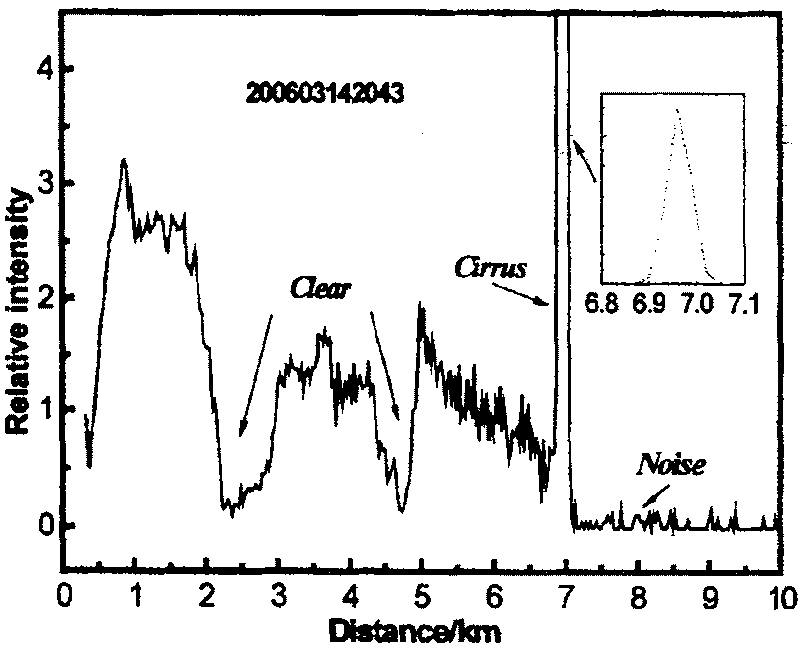
[0096] Such as figure 1 As shown, the signal intensity distribution is obvious, the echo signal of the boundary layer is strong, the fluctuation is small, and the signal-to-noise ratio is high; there is a clean layer between 2-3km and 4-5km, and a thin layer appears at 7km Cirrus clouds; due to the effect of cirrus clouds, the area after 7km is basically noise.
[0097] Such as Figure 4 As shown, in the Hilbert time spectrum, the local and global characteristics of the signal can be investigated in the time domain and frequency domain at the same time. It can be seen from the figure that the lidar signal is a low-frequency signal. figure 2 The energy of the signal shown is mainly distributed in the range from the boundary layer to 6 km.
[0098] Figure 7 Figure (a) in the figure shows the effect of the signal filtered by the EMD method. It can be seen from the figure that due to the existence of cirrus clouds, when the signal is decompose...
PUM
 Login to View More
 Abstract
Description
Claims
Application Information
 Login to View More