
Particle filter method based on multiple advice distribution
A proposed distribution and particle filter technology, applied in special data processing applications, instruments, electrical digital data processing, etc., can solve problems affecting particle filter estimation accuracy, estimation accuracy impact, high time consumption, etc.
Patent Information
- Authority / Receiving Office
- CN · China
- Patent Type
- Applications(China)
- Current Assignee / Owner
- Publication Date
- 2007-10-17
- Estimated Expiration
- Not applicable · inactive patent
Smart Images
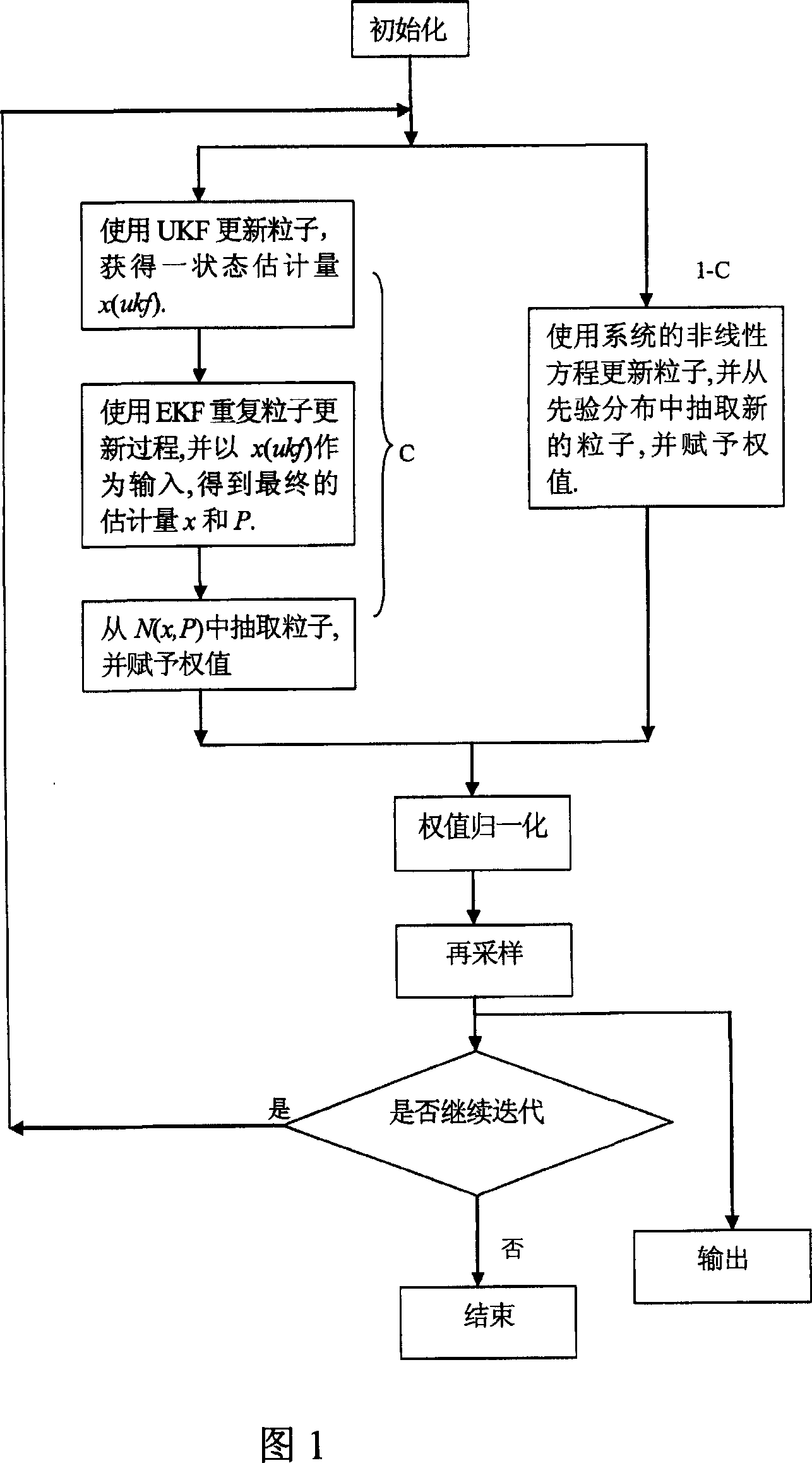
Figure 1 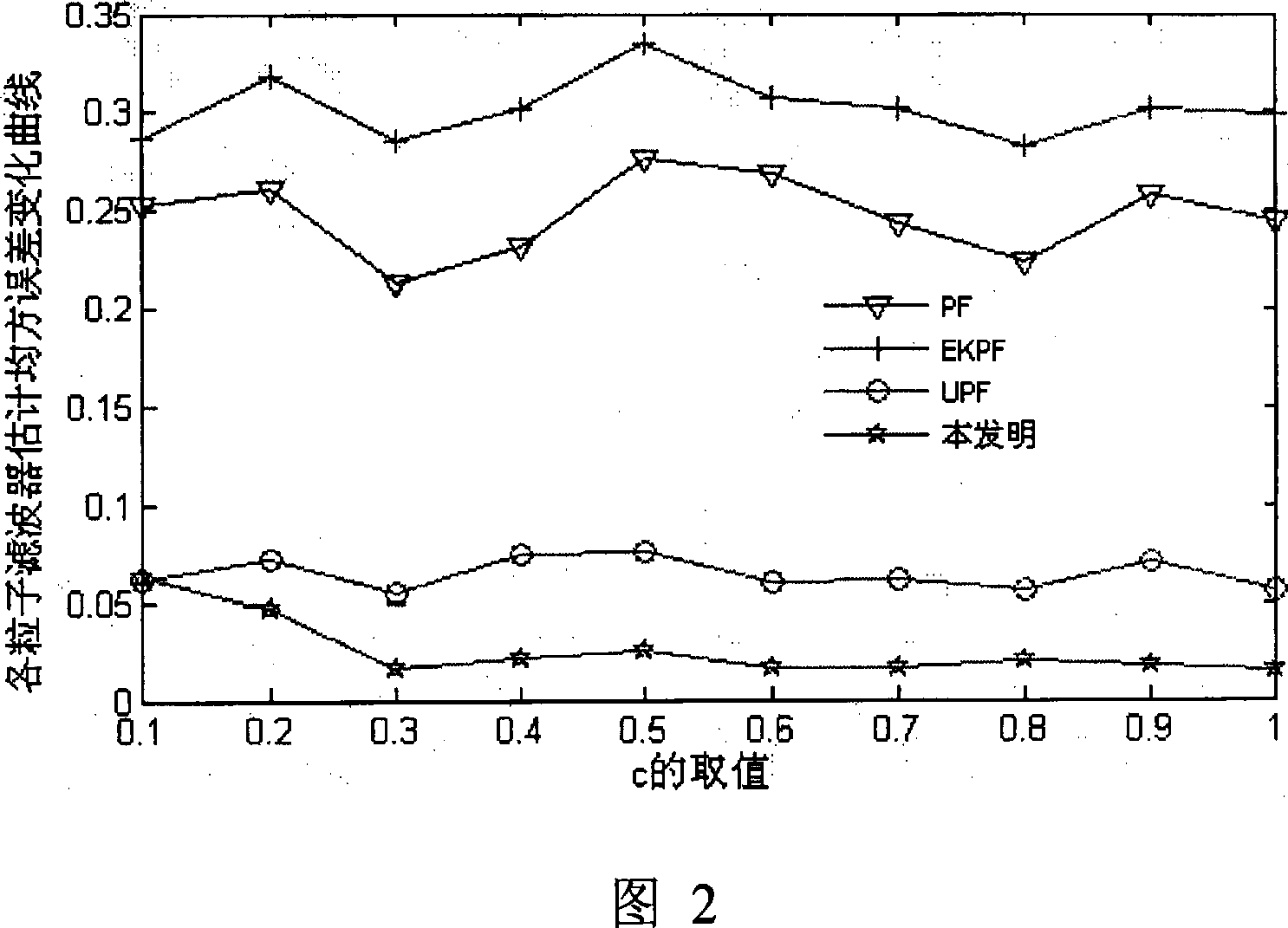
Figure 2 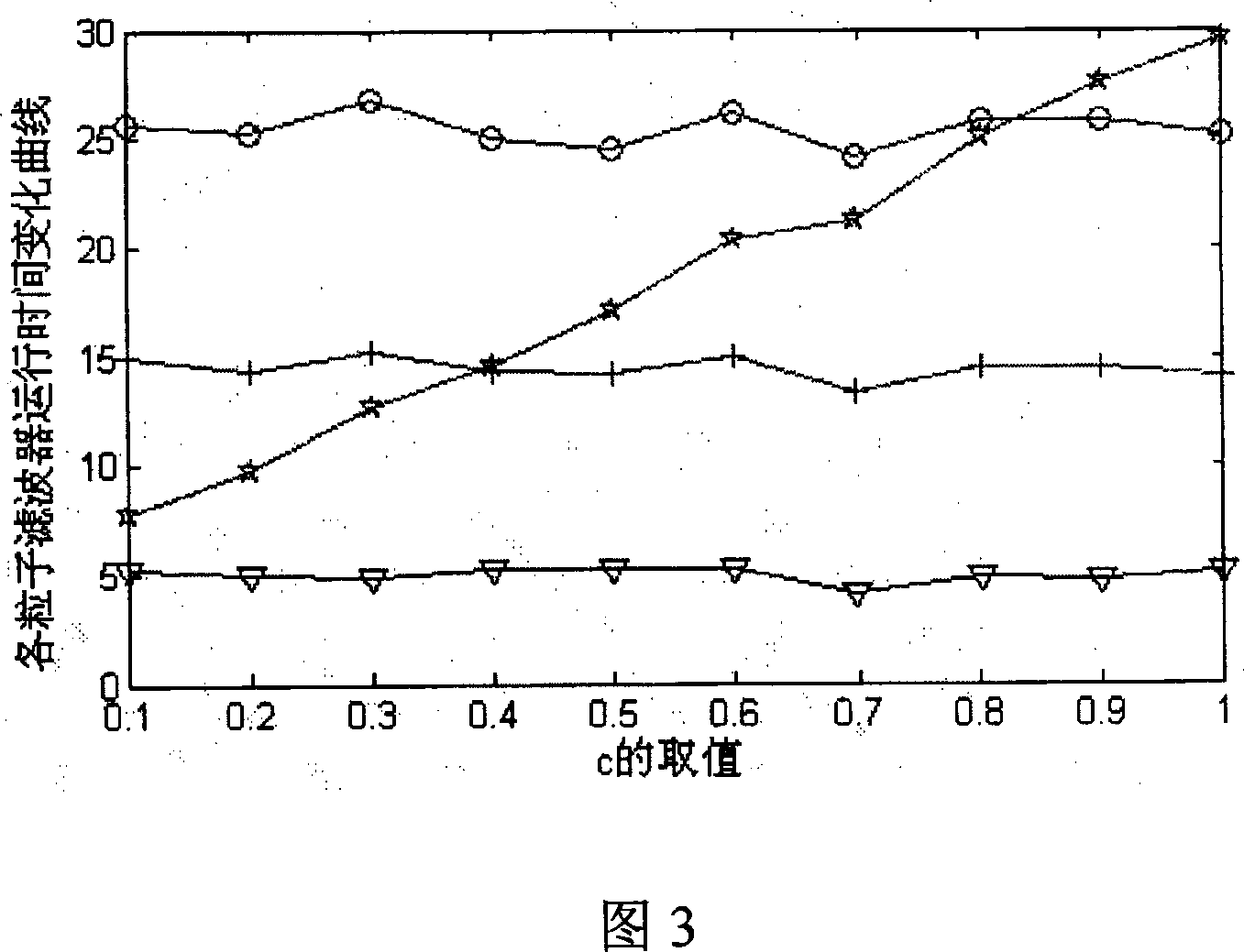
Figure 3
Abstract
Description
technical field
[0001] The invention relates to a particle filter method based on multi-suggestion distribution, and the claimed technical solution belongs to the fields of signal processing, artificial intelligence and computer vision. Background technique
[0002] Nonlinear filtering problems are involved in problems in many fields, including signal processing, finance, artificial intelligence, and computer vision, among others. One of the most common methods to solve nonlinear filtering problems is to use Extended Kalman Filter (EKF), but EKF is only suitable for weak nonlinear systems, and it is easy to cause divergence for strong nonlinear systems. Another solution to the nonlinear filtering problem is the Unscented Kalman Filter (UKF). Unlike EKF, UKF does not use local linearization technology, but directly uses the nonlinear equation of the system for calculation, so as to avoid the error introduced by local linearization and avoid divergence in strong nonlinear sys...
Examples
Embodiment 1
[0083] Embodiment 1. is as follows by the state-space model of a nonlinear dynamical system:
[0084] x k =1+sin(0.04π(k-1))+0.5x k-1 +v k-1 (state transition model)
[0085] z k = 0.2 x k 2 + u k k ≤ 30 0.5 x k - 2 + u k k > 30 (measurement model)
[0086] The present inven...
Embodiment 2
[0091] Embodiment 2. Implement the present invention in a logging-while-drilling tool in a drilling system. The LWD instrument is divided into an uphole part and a downhole part. The measurement signal of the downhole part is transmitted to the surface through the mud. The uphole part first needs to filter the received downhole signal, and then decode and calculate the physical parameter value. The function of the invention is to filter the coded signal with noise to obtain the denoised signal. The invention is implemented in the uphole portion of the instrument. The present invention can obtain an ideal filtering effect (Fig. 4, Fig. 5), which provides a basis for subsequent data processing.