Portable device for pulmonary cancer diagnosis

A portable device, lung cancer diagnosis technology, applied in the field of medical equipment, can solve the problems of inconvenient operation, bulky, expensive, etc., and achieve the effects of easy expansion, simple operation, and load reduction

CN101334399BInactive Publication Date: 2012-06-27CHONGQING UNIV
1 Cites 2 Cited by

Patent Information

Authority / Receiving Office
CN · China
Patent Type
Patents(China)
Current Assignee / Owner
Publication Date
2012-06-27
Estimated Expiration
Not applicable · inactive patent

Smart Images

  • Figure 1
    Figure 1
  • Figure 2
    Figure 2
  • Figure 3
    Figure 3
Patent Text Reader

Abstract

The invention provides a portable device for diagnosis of lung cancer, which comprises a balloon, a gas pump, a buffer gas chamber, a reaction gas chamber, an image collection and processing system and a control system; the balloon collects exhaled gas of a patient with suspected lung cancer to carry out the reaction with a pre-designed porphyrin sensor array (the sensor array for detecting lung cancer markers, if the lung cancer markers exist, the color of the sensor array is changed before and after the reaction) in the reaction gas chamber, the collection of images before and after the reaction is realized by controlling the image collection and processing system through the control system, the images are compared, the collected images are carried out with the pretreatment to obtain the differential images before and after the reaction, the differential images are further compared with data in an expert lesion database to obtain the detection result, and the detection result is finally displayed through a liquid crystal screen or a micro-printer, thereby judging whether the patient suffers from the lung cancer or not.
Need to check novelty before this filing date? Find Prior Art

Description

technical field

[0001] The invention relates to medical device technology, in particular to a portable device for diagnosing lung cancer through exhaled gas of a patient. technical background

[0002] Primary bronchial lung cancer, referred to as lung cancer, is one of the most common malignant tumors in the world and a serious threat to human health and life. The World Health Organization (WHO) reported in 2000 that a total of 7.065 million people died of malignant tumors in the world in 1997, accounting for 12.6% of the death toll. Among them, lung cancer accounted for 19% of malignant tumor deaths, ranking first in the cause of malignant tumor deaths. It is estimated that there are about 600,000 new lung cancer patients every year in the world, and the incidence rate is obviously increasing in most countries. At present, clinically, common diagnostic methods for lung cancer include: X-ray detection, computerized tomography (CT), magnetic resonance tomography (MRI), sputu...

Examples

Embodiment Construction

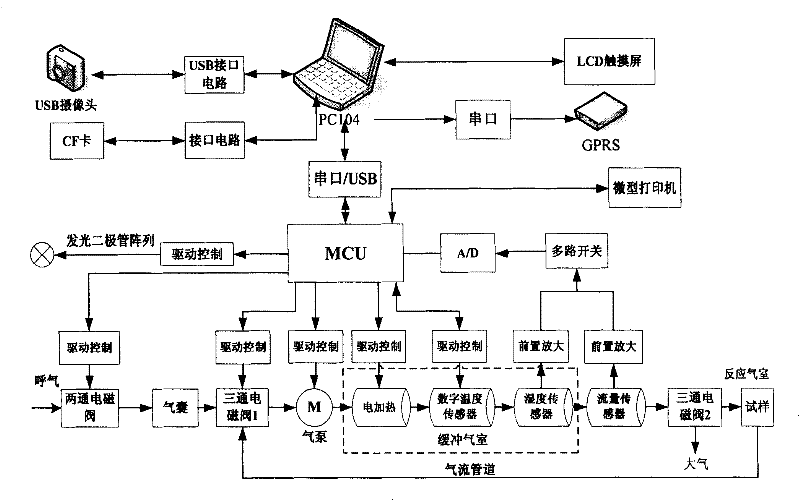
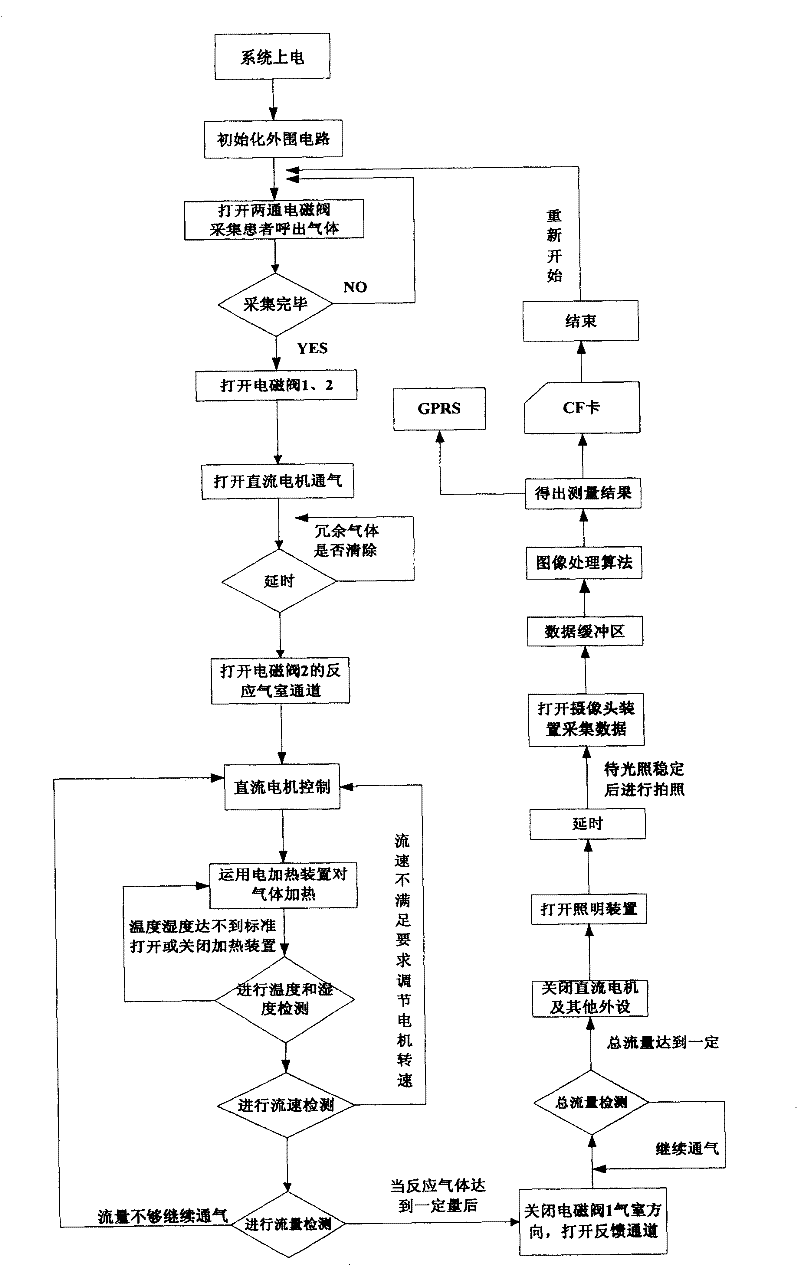
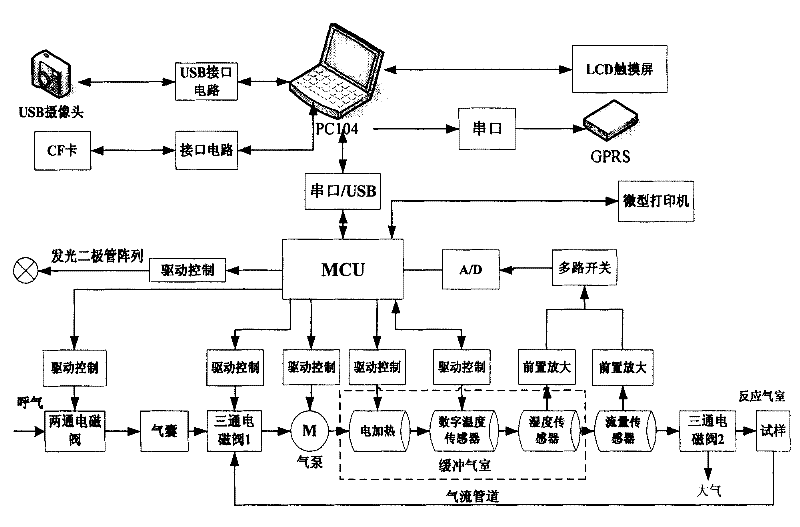
[0026] Such as figure 1 As shown, a portable device for lung cancer diagnosis includes a casing, a hardware and software circuit and an optical system placed in the casing; it also has an air bag, an air pump, a buffer gas chamber, a reaction gas chamber, an image acquisition and processing system and a control system. System; air bag, air pump, buffer gas chamber and reaction gas chamber are connected in series through solenoid valve; the buffer gas chamber is equipped with humidity sensor, temperature sensor and electric heating device; reaction gas chamber is equipped with porphyrin sensor; the control system includes an embedded development board PC104 module, MCU microcontroller, LCD touch screen, GPRS module, solenoid valve driver module, air pump driver module, electric heating module, temperature acquisition module, humidity acquisition module, flow acquisition module and controllable lighting device;

[0027] Among them, the embedded development board PC104 module is ...