High-efficiency dc/dc voltage converter including down inductive switching pre-regulator and capacitive switching post-converter

A technology of voltage converters and regulators, applied in the direction of regulating electrical variables, control/regulating systems, output power conversion devices, etc., can solve the problems of not being a voltage regulator, affecting transient regulation, stability and noise, etc.

A technology of voltage converters and regulators, applied in the direction of regulating electrical variables, control/regulating systems, output power conversion devices, etc., can solve the problems of not being a voltage regulator, affecting transient regulation, stability and noise, etc.

CN101647181AActive Publication Date: 2010-02-10ADVANCED ANALOGIC TECHNOLOGIES INCORPORATED

Image

Smart Image Click on the blue labels to locate them in the text.
Viewing Examples
Smart Image
  • High-efficiency dc/dc voltage converter including down inductive switching pre-regulator and capacitive switching post-converter
  • High-efficiency dc/dc voltage converter including down inductive switching pre-regulator and capacitive switching post-converter
  • High-efficiency dc/dc voltage converter including down inductive switching pre-regulator and capacitive switching post-converter

Examples

Experimental program
Comparison scheme
Effect test

Embodiment Construction

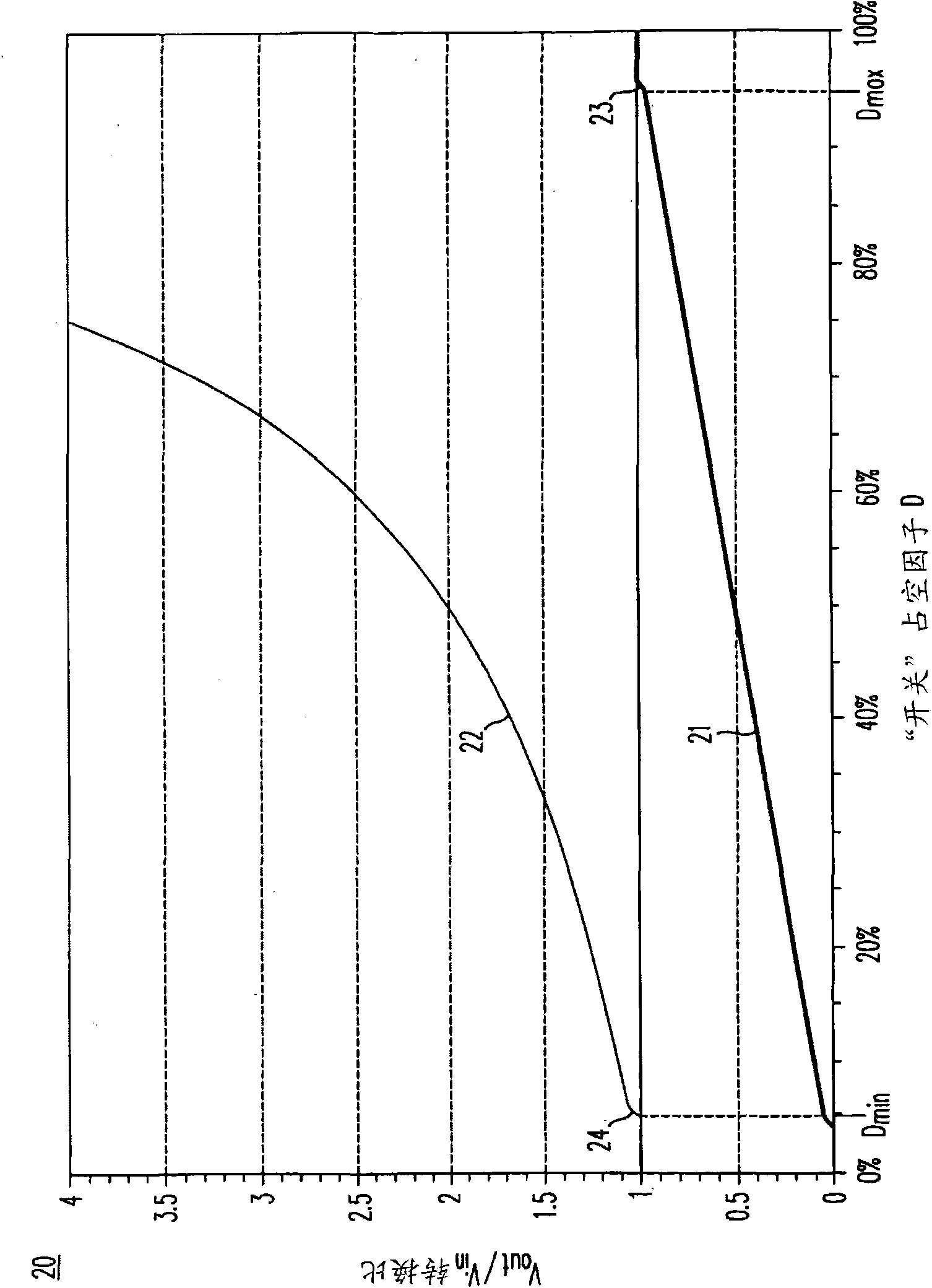
[0219] Figure 13 Graphically illustrates the required voltage conversion ratio V of a DC / DC converter operating at multiple output voltages for various input voltages ranging from 1.8V to 6.6V out / V in . For example, curve 361 illustrates that for an input range of 4.5V to 5.5V, regulating a 5V output to ±1% accuracy requires operation above or below the unity conversion ratio, which means that a buck-boost regulation is required The converter maintains tighter tolerances than the typically guaranteed ±5% or ±10% accuracy of low cost AC / DC wall adapters.

[0220] Another need for a boost-buck converter arises when a LiIon battery is used to generate voltages in the middle of its wide voltage range. For example, Figure 13 Curves 362, 363, and 364 in , illustrate outputs of 4V, 3.6V, and 3.3V, respectively. Since these load voltages fall within the normal discharge voltage range of 4.2V to 3V for LiIon batteries, the converter must regulate in buck mode with a voltage co...

the structure of the environmentally friendly knitted fabric provided by the present invention; figure 2 Flow chart of the yarn wrapping machine for environmentally friendly knitted fabrics and storage devices; image 3 Is the parameter map of the yarn covering machine
Login to View More

PUM

No PUM Login to View More

Abstract

A DC / DC converter includes a pre-converter stage, which may include a charge pump, and a post-regulator stage, which may include a boost converter. The duty factor of the post-regulator stage is controlled by a feedback path that extends from the output terminal of the DC / DC converter to an input terminal in the post-regulator stage. The pre-converter steps the input DC voltage up or down by a positive or negative integral or fractional value, and the post-regulator steps the voltage up by a variable amount depending on the duty factor at which the post-regulator is driven. The converter overcomes the problems of noise glitches, poor regulation, and instability, even near unity input-to-output voltage conversion ratios.

Description

[0001] Cross References to Related Applications [0002] This application claims priority to Provisional Application Nos. 60 / 877952 and 60877720, both titled "High-Efficiency Down-Up And Related DC / DC Converters," filed December 30, 2006, which are hereby incorporated by reference in their entirety Each of them is incorporated herein. technical field [0003] The present invention relates to the design, operation and performance of switching power supplies used in DC / DC conversion and voltage regulation, and to the semiconductor components used in such converters. Background technique [0004] In order to prevent changes in the power supply voltage for powering various microelectronic components such as digital ICs, semiconductor memories, display modules, hard disk drives, RF circuits, microprocessors, digital signal processors, and analog ICs, especially battery-powered Variations in applications such as cellular phones, notebook computers, and consumer products often req...

Claims

the structure of the environmentally friendly knitted fabric provided by the present invention; figure 2 Flow chart of the yarn wrapping machine for environmentally friendly knitted fabrics and storage devices; image 3 Is the parameter map of the yarn covering machine
Login to View More

Application Information

Patent Timeline
10 Feb 2010
Publication
CN101647181A
IPC
H02M3/155
Inventors
理查德·K·威廉斯