
Construction method and application of three-dimensional quantitative structure-activity relationship model of bcl-2 protein inhibitor
A protein inhibitor and three-dimensional quantitative technology, applied in the field of bioinformatics, can solve problems such as side effects, lack of targeting, and difficulty in penetration, and achieve the effect of improving screening efficiency and reducing costs
- Summary
- Abstract
- Description
- Claims
- Application Information
AI Technical Summary
Problems solved by technology
Method used
Image

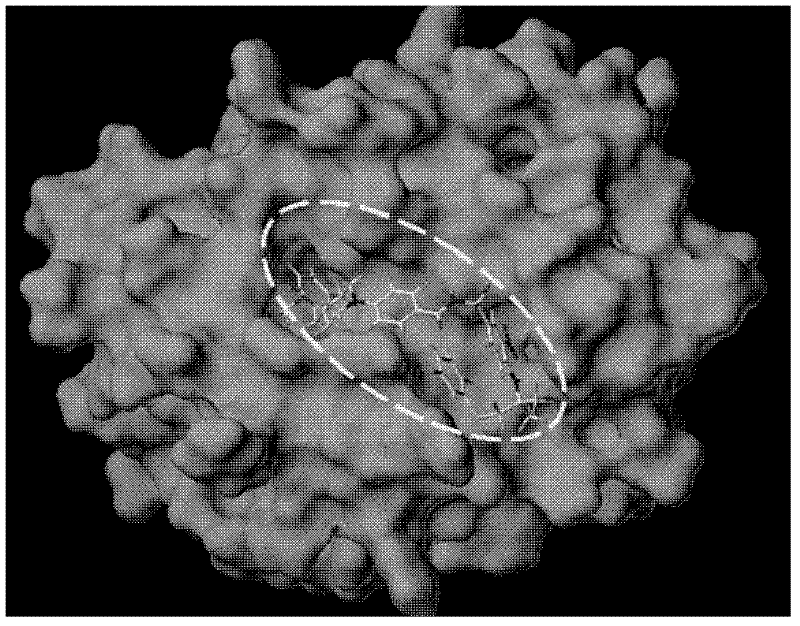
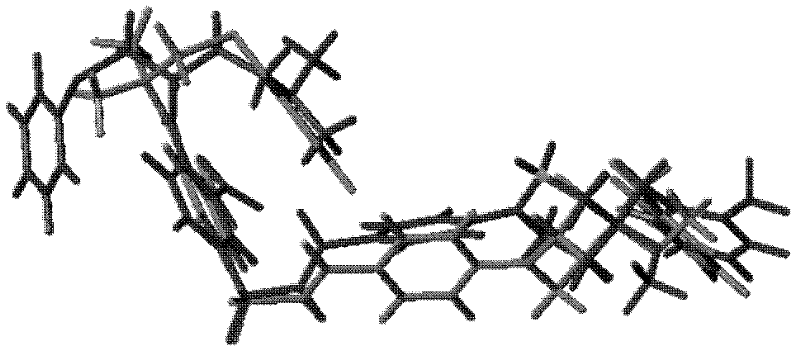
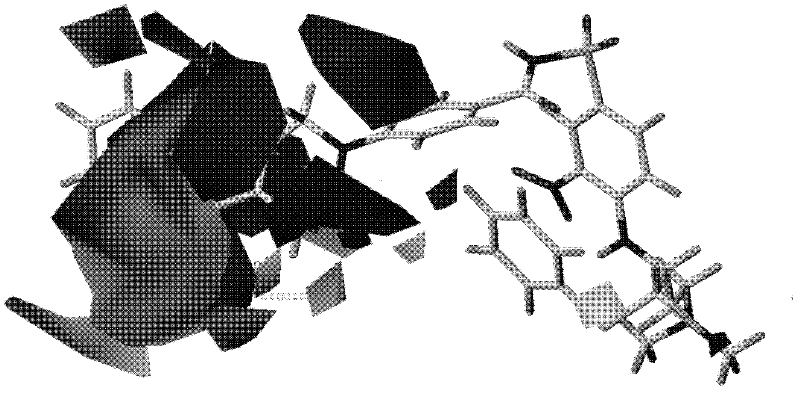
Examples
Embodiment 1
[0034] The present invention involves the use of known small molecule inhibitors (see Studies Leading to Potent, Dual Inhibitors of Bcl-2 and Bcl-xL, Brucko, M., et al. J. Med. Chem., 2007, 50, 641) A method for constructing a three-dimensional quantitative structure-activity relationship model for Bcl-2 protein inhibitors.
[0035] The method includes the following steps:
[0036] (1) According to a total of 31 known small-molecule inhibitors involved in the report, their biological activities are determined by the binding constant K i express. with the binding constant K i The negative logarithm pK of i (pK i =log K i ), this class of inhibitors is divided into three categories, where pK i i i >8, representing weak binding ability, medium binding ability, and strong binding ability to Bcl-2 protein, respectively. Twenty-six known small-molecule inhibitors were selected from the three categories as the training set to build the prediction model, and the remaining 5 kno...
Embodiment 2
[0043] A method for constructing a three-dimensional quantitative structure-activity relationship model of Bcl-2 protein inhibitors described in Example 1 was used to analyze the activity of different Bcl-2 protein inhibitors in the mother nucleus.
[0044] 1. WL-276 is a known small molecule inhibitor recently reported, it can effectively inhibit Bcl-2 protein, and its core structure is 2-thio-4-thiazolidinone, which is established in Example 1. The known small molecule inhibitors used in the model have different core structures;
[0045] 2. Accelrys Draw 4.0 (Accelrys Inc.) was used to construct the two-dimensional structure of WL-276, and Concord (SYBYL7.3, Tripos Inc.) was used to convert the two-dimensional structure into three-dimensional structure;
[0046] 3. Because the structure of WL-276 is quite different from the positive compounds with existing three-dimensional structures, in order to obtain the three-dimensional structure of WL-276 that is closer to the real va...
PUM
 Login to View More
 Abstract
Description
Claims
Application Information
 Login to View More