Saccharomyces cerevisiae bacterial strain capable of producing baker yeast characterized by osmotic pressure resistance and internal tolerance with respect to weak organic acid, preparation method thereof and application
What is AI technical title?
AI technical title is built by Patsnap AI team. It summarizes the technical point description of the patent document.
This helps you quickly interpret patents by identifying the three key elements:
Problems solved by technology
Method used
Benefits of technology
Problems solved by technology
[0009] These prior art efforts have sought to adapt strains from the more recent art to improve the tolerance of baker's yeast to weak acid mold inhibitors in either sugar-containing or sugar-free doughs, with the well-known disadvantage of only rendering the yeast temporarily resistant to weak acids. / Temporary and non-permanent tolerance
Method used
the structure of the environmentally friendly knitted fabric provided by the present invention; figure 2 Flow chart of the yarn wrapping machine for environmentally friendly knitted fabrics and storage devices; image 3 Is the parameter map of the yarn covering machine
View more
Image
Smart Image Click on the blue labels to locate them in the text.
Viewing Examples
Smart Image
Click on the blue label to locate the original text in one second.
Reading with bidirectional positioning of images and text.
Smart Image
Examples
Experimental program
Comparison scheme
Effect test
Embodiment 1
[0049] Embodiment 1: the preparation of hybrid
[0050] The object hybrid strains I-4312 and I-4313 of the present invention are produced by systematic hybridization between strains of Saccharomyces cerevisiae collected internally by the applicant, the strains collected internally are osmotic pressure resistant and / or osmotic pressure resistant and Weak organic acids used as mold inhibitors or their salts with poor sensitivity, which were deposited at the Collection Nationale de Culture de Micro-organismes de l' on July 8, 2010 and February 9, 2011 Institut Pasteur, 25 rue du Docteur Roux, 75724 Paris Cedex 15, France), deposit numbers I-4341 and I-4448.
[0051] The hybridization plan is as described in "Methods in Yeast Genetics, A Cold Spring Harbor Laboratory Course Manual, 2000 Edition", pages 21-23, by D. Burke, D. Dawson and T. Stearns, Cold Spring Harbor Laboratory Press (ISBN 0-87969 -588-9) by traditional means described in chapters 21-23 of "Techniques et Protocols...
Embodiment 2
[0052] Embodiment 2: prepare the yeast of the present invention with the hybrid of embodiment 1
[0053] In order to produce baker's yeast according to the invention, the hybrid strain obtained in Example 1 is cultivated in a known medium, but without weak acid, in a flask or a fermenter.
[0054] In the flask, YPD medium such as "Methods in Yeast Genetics, A Cold Spring Harbor Laboratory Course Manual, 2000 edition", author D.Burke, D.Dawson and T.Stearns, Cold Spring Harbor Laboratory Press can be used (ISBN 0-87969-588-9) described in Appendix A of the book, is a commonly used culture medium.
[0055] In fermentors, typically, culture conditions are such that the metabolism of the yeast strain is substantially respiration and / or substantially non-ethanol production.
[0056] The term "essentially" indicates that these conditions were checked throughout the culture period, but it is possible that these conditions would not be checked on time in a semi-continuous mode, e.g. ...
Embodiment 3
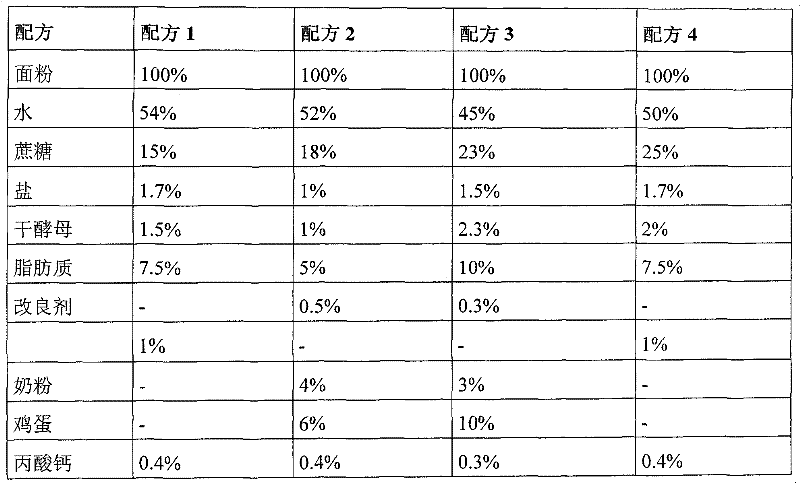
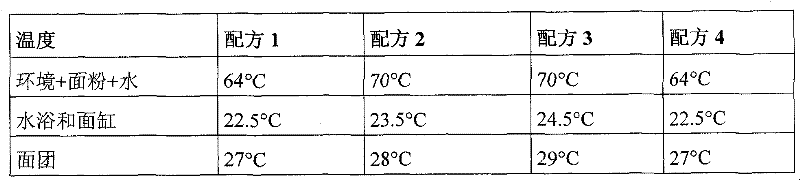
[0087] Example 3: Comparison of performance of non-adapted yeast and adapted strain samples according to the invention
the structure of the environmentally friendly knitted fabric provided by the present invention; figure 2 Flow chart of the yarn wrapping machine for environmentally friendly knitted fabrics and storage devices; image 3 Is the parameter map of the yarn covering machine
Login to View More
PUM
Login to View More
Abstract
The invention relates to a saccharomyces cerevisiae bacterial strain, and is particularly suitable for producing a baker yeast characterized by osmotic pressure resistance and internal tolerance with respect to a weak organic acid. The bacterial strain can be obtained by an industrial S. cerevisiae bacterial strain with the number of I-4341 and preserved in CNCM in Jul. 8th, 2010, or an industrial bacterial strain with the Ty spectrum and / or the Quantitative Trait Locus atlas (QTL atlas) similar to those of the industrial S. cerevisiae bacterial strain with the number of I-4341 via the method of hybridization or mutation.
Description
[0001] related application [0002] This application claims the priority of French application No. FR1151354 filed on February 18, 2011, the contents of which are incorporated herein by reference. technical field [0003] The present invention relates to the field of Saccharomyces cerevisiae strains for the production of baker's yeast, a method for preparing the Saccharomyces cerevisiae strain, baker's yeast produced by the strain, bread dough containing the yeast, and bakery products that can be processed from these doughs methods and products. More specifically, the present invention relates more generally in its field to industrial Saccharomyces cerevisiae strains that can be used to produce baker's yeast resistant to osmotic stress and intrinsically tolerant to weak organic acids. Background technique [0004] Document WO 96 / 38538 teaches production yeast derived from an improved strain of Saccharomyces cerevisiae S. cerevisiae, which exhibits a higher resistance to osm...
Claims
the structure of the environmentally friendly knitted fabric provided by the present invention; figure 2 Flow chart of the yarn wrapping machine for environmentally friendly knitted fabrics and storage devices; image 3 Is the parameter map of the yarn covering machine
Login to View More
Application Information
Patent Timeline
Application Date:The date an application was filed.
Publication Date:The date a patent or application was officially published.
First Publication Date:The earliest publication date of a patent with the same application number.
Issue Date:Publication date of the patent grant document.
PCT Entry Date:The Entry date of PCT National Phase.
Estimated Expiry Date:The statutory expiry date of a patent right according to the Patent Law, and it is the longest term of protection that the patent right can achieve without the termination of the patent right due to other reasons(Term extension factor has been taken into account ).
Invalid Date:Actual expiry date is based on effective date or publication date of legal transaction data of invalid patent.




 Login to View More
  Login to View More