Higher-strength, cold-formable steel and steel sheet product consisting of such a steel

A high-strength, coldable technology, applied in the direction of manufacturing tools, furnace types, layered products, etc., can solve the problems of increased alloy cost and no effect on strength

CN102985578AInactive Publication Date: 2013-03-20THYSSENKRUPP STEEL EURO AG
12 Cites 15 Cited by

Patent Information

Authority / Receiving Office
CN · China
Current Assignee / Owner
Publication Date
2013-03-20
Estimated Expiration
Not applicable · inactive patent

Smart Images

  • Figure 1
    Figure 1
  • Figure 2
    Figure 2
  • Figure 3
    Figure 3
Patent Text Reader

Abstract

The invention relates to a higher-strength, cold-formable steel and to a steel sheet product produced from such a steel, in which an optimal combination of weldability and a low tendency toward delayed cracking as well as good strength and hot- and cold-formability are assured. In order to achieve this, a steel according to the invention contains (in % by weight) C: 0,1-1,0%, Mn: 10-25%, Si: up to 0.5%, Al: 0.3-2%, Cr: 1.5-3.5%, S: <0.03%, P: <0.08%, N: <0.1%, Mo: <2%, B: <0.01%, Ni: <8%, Cu: <5%, Ca: up to 0.015%, at least one element from the "V, Nb" group provided that: Nb: 0.01-0.5%, V: 0.01-0.5% and optionally Ti: 0.01-0.5%, and remainder being iron and unavoidable manufacturing-related impurities.
Need to check novelty before this filing date? Find Prior Art

Description

Technical field

[0001] The present invention relates to a cold-formable high-strength steel which contains high manganese content and has good resistance to delayed crack formation induced by hydrogen and very good weldability. In addition, the present invention relates to flat steel products made of such steel. Background technique

[0002] The "delayed crack formation" induced by hydrogen is caused by hydrogen entering the steel from the outside. In contrast, "Delayed Fracture" refers to steel defects caused by the presence of hydrogen in the material due to production conditions.

[0003] The composite properties described in the opening paragraph are particularly important for the steel used in the production of automotive body components. The panels used to make the components here need not only be easy to shape but also have sufficient strength under the premise of ideal light weight. These requirements realize the stability of each car body with a small panel thickness. [...

Examples

Embodiment Construction

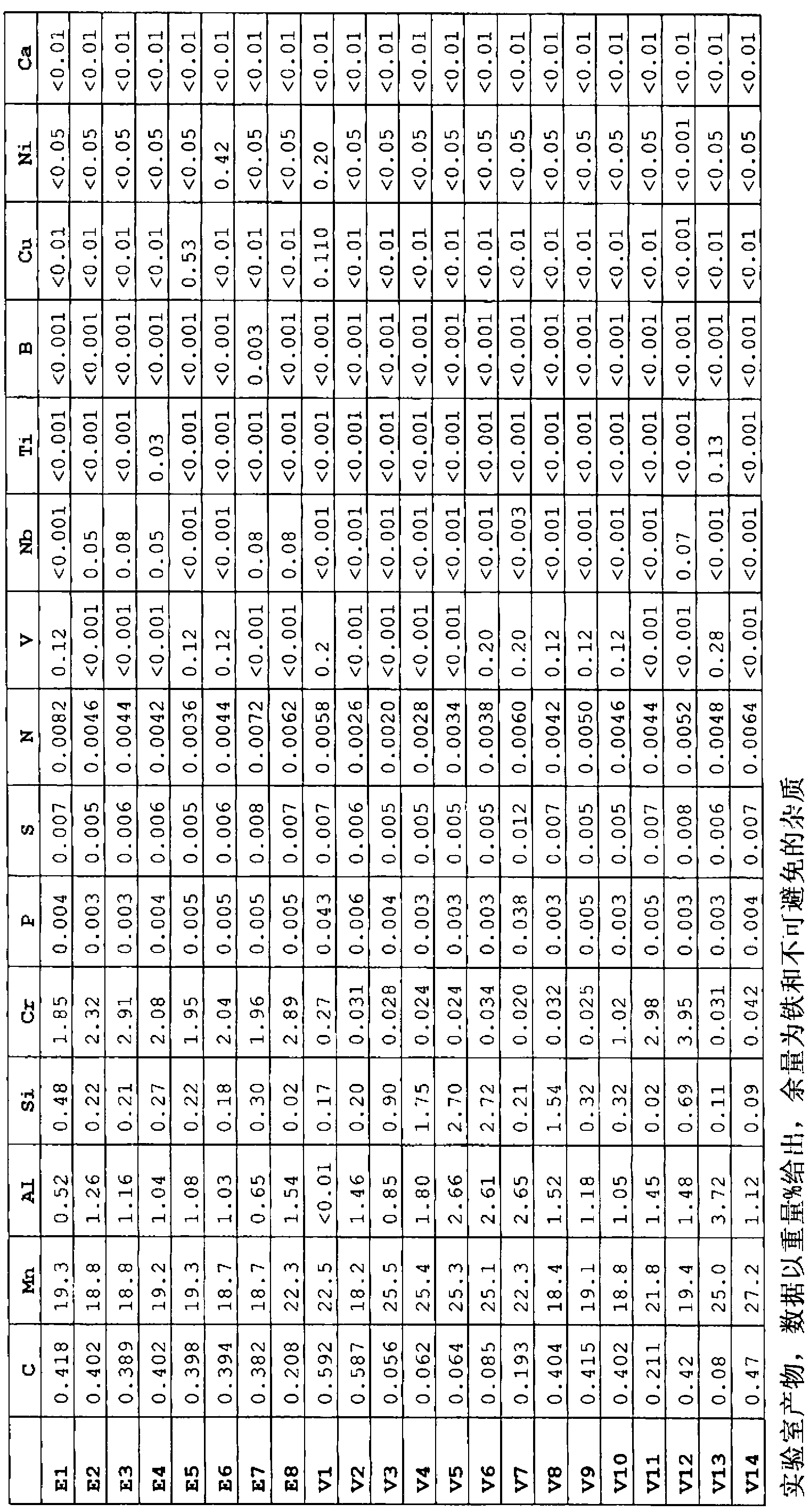
[0073] In Table 1, 8 alloys E1-E8 of the steel according to the invention and 14 comparative steel plates V1-V14 are given.

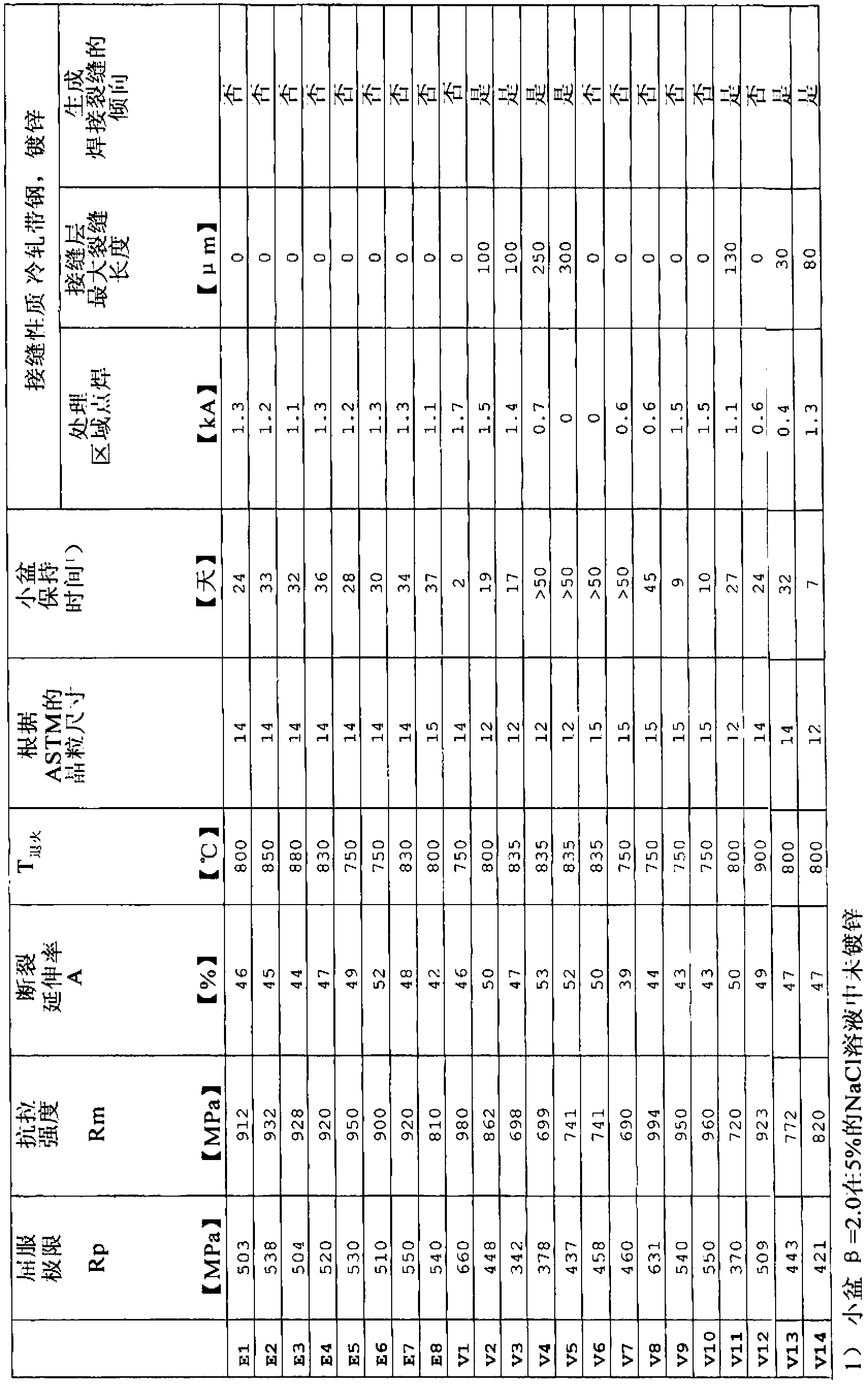
[0074] The cast steel ingots made of the steel E1-E8 according to the present invention and the comparative steel plates V1-V14 were heated at a preheating temperature of about 1250°C and then hot-rolled at a hot rolling temperature of about 950°C to a thickness of about 3 mm. Rolled steel sheet.

[0075] The resulting hot-rolled steel sheet is wound into coils at a winch temperature of about 20°C (room temperature).

[0076] After coiling, the hot-rolled steel sheet is cold-rolled to a cold-rolled strip with a thickness of 1 mm with a cold rolling degree of about 66%.

[0077] The cold-rolled strip obtained in this way is subjected to final annealing at the end of the continuous processing steps. During the annealing process, the steel plate is at a temperature of T annealing Medium heating for about 140 seconds, the temperature is below 890°C. The mechanica...