This helps you quickly interpret patents by identifying the three key elements:
Problems solved by technology
Method used
Benefits of technology
Problems solved by technology
Since the polyolefin-based organic separator has a physical property of melting below 200°C, when the battery reaches a high temperature due to internal and / or external stimuli, volume changes such as shrinkage or melting may occur, and as a result, the positive electrode may be damaged. And the short circuit of the negative pole, the explosion caused by the release of electric energy, etc.
Method used
the structure of the environmentally friendly knitted fabric provided by the present invention; figure 2 Flow chart of the yarn wrapping machine for environmentally friendly knitted fabrics and storage devices; image 3 Is the parameter map of the yarn covering machine
View more
Image
Smart Image Click on the blue labels to locate them in the text.
Viewing Examples
Smart Image
Click on the blue label to locate the original text in one second.
Reading with bidirectional positioning of images and text.
Smart Image
Examples
Experimental program
Comparison scheme
Effect test
Embodiment 1
[0341] (Preparation of samples)
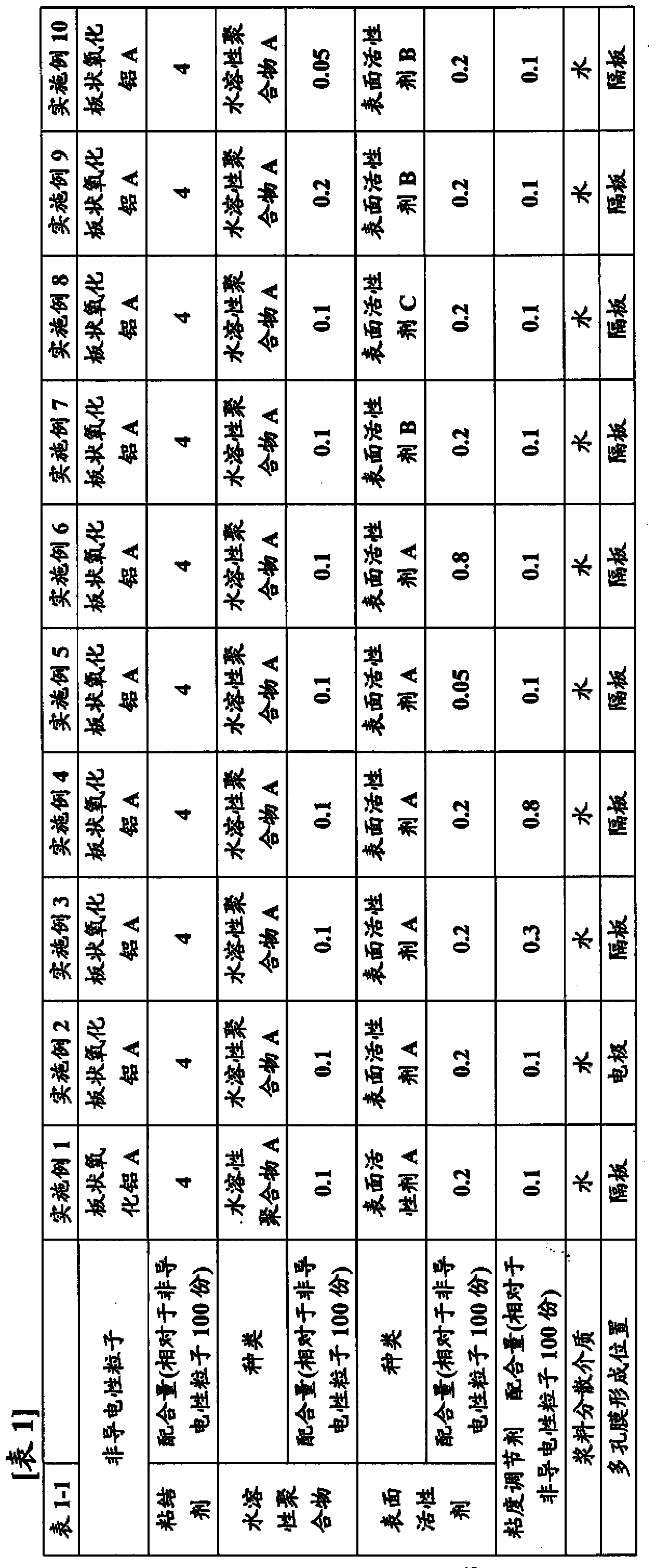
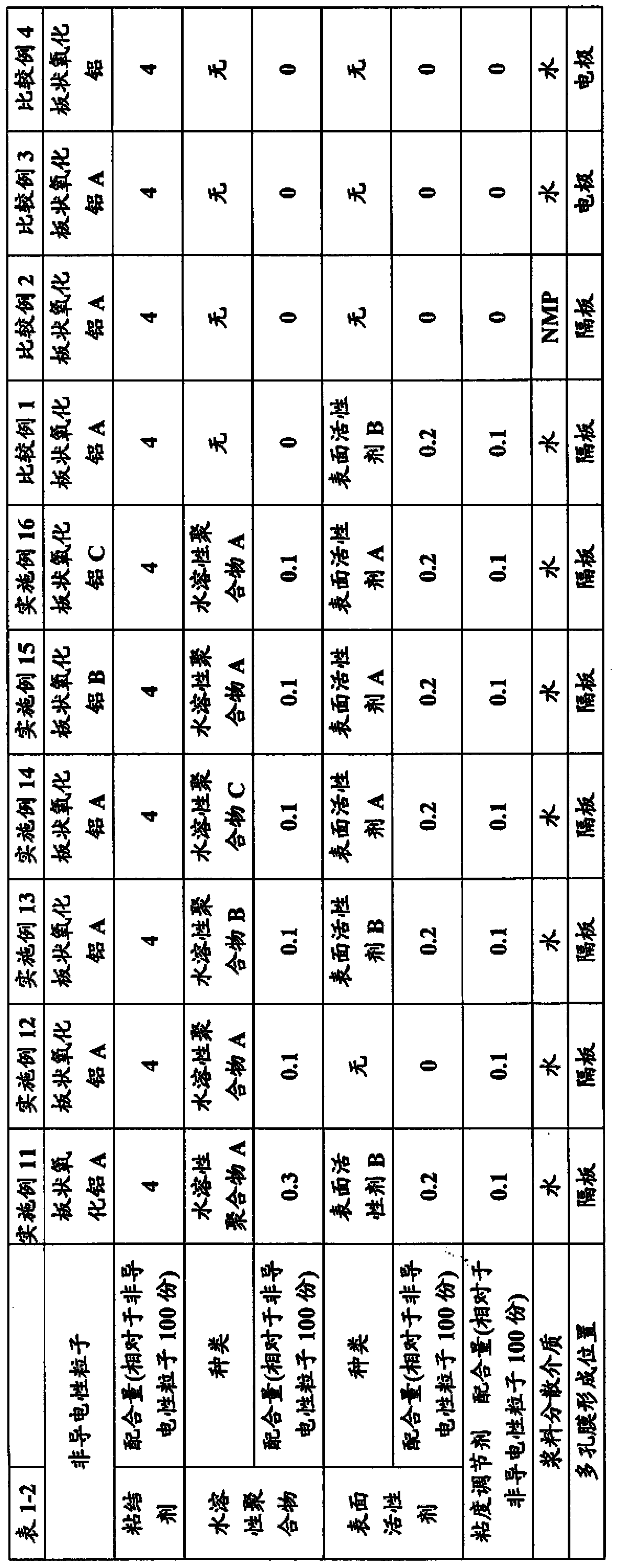
[0342] As non-conductive particles, L / b was 1.5, b / t was 50, L was 5 micrometers, and the plate-shaped alumina particle A whose volume average particle diameter was 0.6 micrometers was prepared.
[0343] As a viscosity modifier, carboxymethylcellulose (manufactured by Daiichi Kogyo Pharmaceutical Co., Ltd., trade name BSH-12) having an average degree of polymerization of 1600 to 1800 and a degree of etherification of 0.65 to 0.75 was used. Moreover, the viscosity of the 1% aqueous solution of a viscosity modifier is 6000-8000 mPa*s.
[0344] (Manufacture of slurry for porous membrane)
[0345] 100 parts of platy alumina particles A, 0.1 part of water-soluble polymer A, and 0.1 part of a viscosity modifier were mixed, and water was mixed so that the solid content concentration became 40% by mass, and dispersed using a bead mill. Then, 4 parts of binder-containing aqueous dispersions and 0.2 parts of surfactant A were added in terms of solid c...
Embodiment 2
[0359] (Fabrication of Electrode with Porous Membrane)
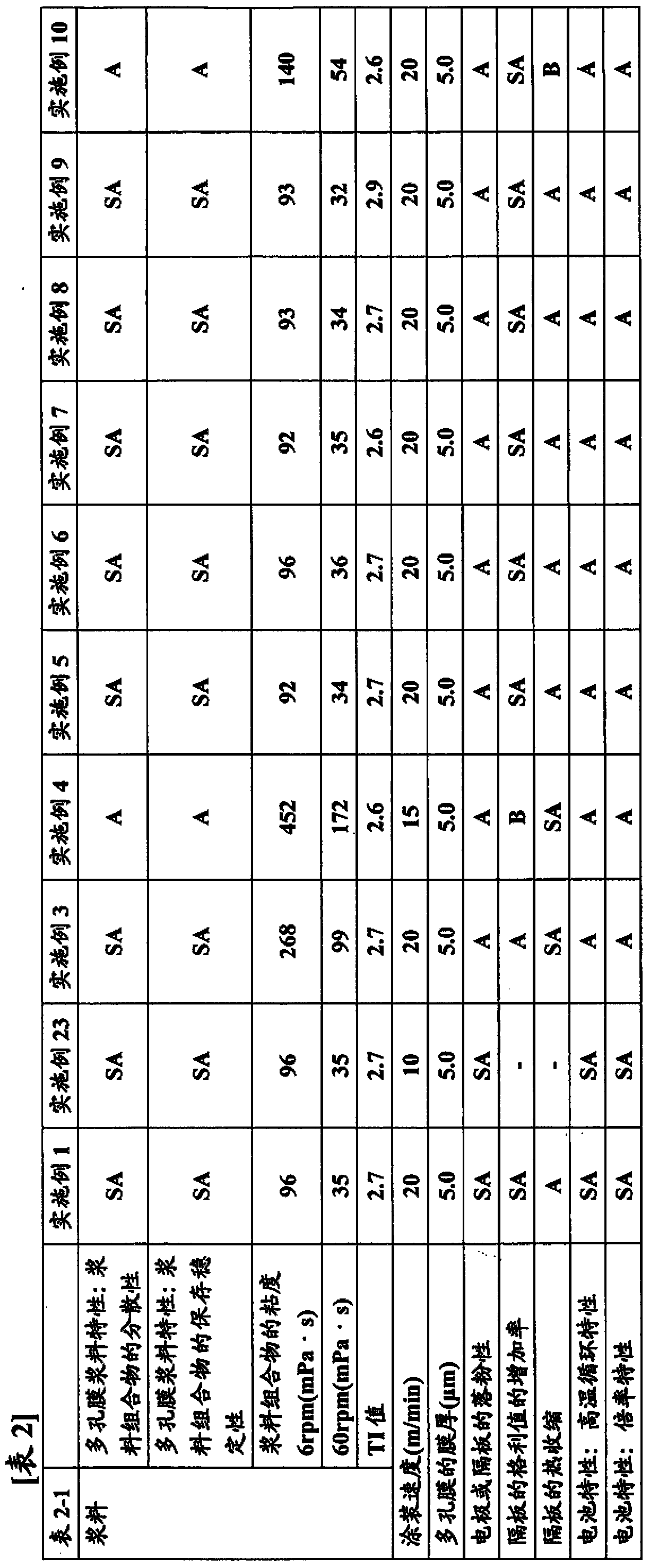
[0360] Use a gravure coater to coat the above-mentioned slurry 1 for a porous membrane on the negative electrode obtained in the same manner as in Example 1 at a speed of 10 m / min, and completely cover the negative electrode mixture layer and make the thickness after drying be 5 μm, then The electrode 1 with a porous membrane was obtained by drying at 10°C and winding. The flexibility and powder falling properties of the obtained electrode 1 with a porous membrane were evaluated. The results are shown in Table 2.
[0361] The positive electrode obtained in Example 1 was cut into a circle with a diameter of 13 mm to obtain a circular positive electrode. The negative electrode with a porous membrane obtained above was cut into a circular shape with a diameter of 14 mm to obtain a circular negative electrode. In addition, the single-layer polyethylene separator used in Example 1 was cut into a circle with a diameter of 1...
Embodiment 3、4
[0365] The compounding amount of the viscosity modifier is as follows Table 1 It was the same as Example 1 except that it was changed as described in . show the result in Table 2 . In addition, in Example 4, the coating speed was set to 15 m / min.
the structure of the environmentally friendly knitted fabric provided by the present invention; figure 2 Flow chart of the yarn wrapping machine for environmentally friendly knitted fabrics and storage devices; image 3 Is the parameter map of the yarn covering machine
Login to View More
PUM
Property
Measurement
Unit
cloud point
aaaaa
aaaaa
elongation
aaaaa
aaaaa
particle diameter
aaaaa
aaaaa
Login to View More
Abstract
The invention provides a porous membrane for a secondary battery, a slurry for the secondary battery porous membrane and a secondary battery. The porous membrane comprises non-conductive particles, a binder, and a water-soluble polymer, and is characterized in that: the three dimensions of the non-conductive particles, namely the length (L), thickness (t), and width (b), are such that the length (L) is 0.1 to 20 [mu]m, the ratio (b / t) of the width (b) and the thickness (t) is 1.5 to 100; the binder is a copolymer containing (meth)acrylonitrile monomer units and (meth)acrylic acid ester monomer units; and the water-soluble polymer contains sulfonic acid groups, and has a weight average molecular weight of 1000 to 15000. The slurry for a porous membrane is characterized by being formed by dispersing the non-conductive particles, the binder, and the soluble polymer, in water. Thus, the present invention provides: a porous membrane that can be formed into a thin film, has an excellent sliding property, and generates few particles; and a slurry for porous membranes which is capable of producing porous membrane easily and quickly, and has excellent storage stability.
Description
technical field [0001] The present invention relates to a porous membrane. More specifically, it relates to a porous membrane formed on the surface of an electrode or a separator of a secondary battery such as a lithium ion secondary battery, which can be thinned, and contributes to improving the performance of the electrode. Or the slidability of the separator and the maintenance of a porous film that improves the safety of the battery. Moreover, this invention relates to the slurry for porous membranes used for forming such a porous membrane. Moreover, this invention relates to the secondary battery provided with the electrode or separator provided with such a porous film. Background technique [0002] Among practical batteries, lithium-ion secondary batteries have the highest energy density, and are especially used for small electronic devices. In addition, in addition to small applications, utilization in automobiles is also expected. In particular, higher capacity, l...
Claims
the structure of the environmentally friendly knitted fabric provided by the present invention; figure 2 Flow chart of the yarn wrapping machine for environmentally friendly knitted fabrics and storage devices; image 3 Is the parameter map of the yarn covering machine
Login to View More
Application Information
Patent Timeline
Application Date:The date an application was filed.
Publication Date:The date a patent or application was officially published.
First Publication Date:The earliest publication date of a patent with the same application number.
Issue Date:Publication date of the patent grant document.
PCT Entry Date:The Entry date of PCT National Phase.
Estimated Expiry Date:The statutory expiry date of a patent right according to the Patent Law, and it is the longest term of protection that the patent right can achieve without the termination of the patent right due to other reasons(Term extension factor has been taken into account ).
Invalid Date:Actual expiry date is based on effective date or publication date of legal transaction data of invalid patent.


 Login to View More