
A kind of marine heavy-duty anti-corrosion coating and preparation method thereof
A marine and coating technology, applied in anti-corrosion coatings, polyester coatings, epoxy resin coatings, etc., can solve the problems of unsuitable industrial production, incompatibility, high polyaniline addition, improve metal anti-corrosion performance, and facilitate The effect of conductivity
- Summary
- Abstract
- Description
- Claims
- Application Information
AI Technical Summary
Problems solved by technology
Method used
Image

Examples
Embodiment 1
[0051] (1) Preparation of B-N coordination polyaniline / montmorillonite composite conductive material
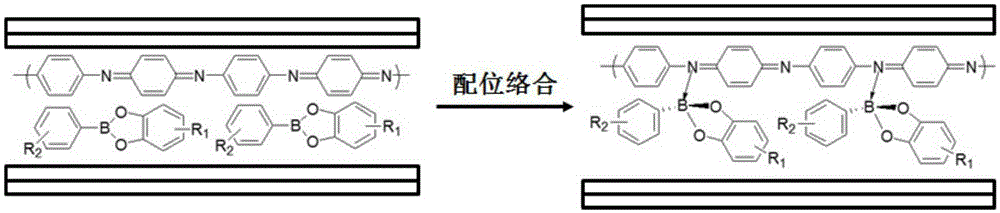
[0052] a. Add 50 parts of CTAB organically modified montmorillonite to 500 parts of 1mol / L organic boric acid solution to disperse, and stir evenly with a mixer at a speed of 800r / min at room temperature to form a suspension system, and continue stirring for 5h. Add 10 parts of aniline monomer to the suspension to carry out aniline intercalation reaction in situ, and continue to stir for 6 hours to fully intercalate. The coordination process of this step is as follows: figure 1 shown;
[0053] b. At room temperature, add an oxidant with the same molar amount as the aniline monomer and 10 parts of bishydroxyphenol derivatives into the aniline emulsion, and react for 8 hours under nitrogen protection;
[0054] c. After the reaction is completed, ultrasonically disperse in water first, and then perform centrifugation. The obtained precipitate is repeatedly washed with deionized...
Embodiment 2
[0058] (1) Preparation of B-N coordination polyaniline / montmorillonite composite conductive material
[0059] a. Add 50 parts of CTAB organically modified montmorillonite to 500 parts of 1mol / L organic boric acid solution to disperse, and stir evenly with a mixer at a speed of 700r / min at room temperature to form a suspension system, and continue stirring for 5h. Add 12 parts of aniline monomer to the suspension for aniline in-situ intercalation reaction, and continue stirring for 6 hours to fully intercalate;
[0060] b. At room temperature, add an oxidant with the same molar amount as the aniline monomer and 15 parts of bishydroxyphenol derivatives into the aniline emulsion, and react for 8 hours under nitrogen protection;
[0061] c. After the reaction is completed, ultrasonically disperse in water first, and then perform centrifugation. The obtained precipitate is repeatedly washed with deionized water and acetone until the filtrate is neutral, and the obtained precipitate...
Embodiment 3
[0065] (1) Preparation of B-N coordination polyaniline / montmorillonite composite conductive material
[0066] a. Add 50 parts of CTAB organically modified montmorillonite to 500 parts of 1mol / L organic boric acid solution to disperse, and stir evenly with a mixer at a speed of 1000r / min at room temperature to form a suspension system, and continue stirring for 5h. Add 15 parts of aniline monomer to the suspension for aniline in-situ intercalation reaction, and continue to stir for 6 hours to fully intercalate;
[0067] b. At room temperature, add an oxidant with the same molar amount as the aniline monomer and 5 parts of bishydroxyphenol derivatives into the aniline emulsion, and react for 8 hours under nitrogen protection;
[0068] c. After the reaction is completed, ultrasonically disperse in water first, and then perform centrifugation. The obtained precipitate is repeatedly washed with deionized water and acetone until the filtrate is neutral, and the obtained precipitate ...
PUM
 Login to View More
 Abstract
Description
Claims
Application Information
 Login to View More