
Fermented pepper product and preparation method thereof
A technology for fermenting peppers and chili peppers, applied in the fields of bacteria, yeast-containing food ingredients, food science, etc. used in food preparation
- Summary
- Abstract
- Description
- Claims
- Application Information
AI Technical Summary
Problems solved by technology
Method used
Image


Examples
Embodiment 1
[0077] The details are as follows: remove the capsicum, clean it, cut into pieces, add 2% salt by weight of the capsicum, 2% sucrose, 2% glucose, then add 0.07% Leuconostoc enterococci and 0.3% Lactobacillus rhamnosus by weight of the capsicum raw material, Put 0.05% Acetobacter acetobacter into the fermented pepper production container, add water to submerge the pepper, and seal the container; control the temperature at 28°C for 10 hours of fermentation, then add 0.2% of CGMCC NO.9405 and 0.02% yeast by weight of raw pepper materials; The temperature is 20°C for 36 hours of post-fermentation; the container is sealed during the entire fermentation period; after the fermentation is complete, the peppers are drained, and seasonings such as garlic, sucrose, and monosodium glutamate are added to prepare, and then sold in vacuum packaging refrigerated or packaged and sterilized. .
[0078] Leuconostoc enterococci, Lactobacillus rhamnosus, Acetobacter, and yeast are all bacteria pow...
Embodiment 2
[0080] The production process of fermented capsicum in the present invention comprises the following steps, specifically as follows: remove capsicum, clean, cut into pieces, add 3% salt by weight of capsicum, 2% sucrose, 2% glucose, then add 0.05% saline by weight of capsicum raw material Put Contomonoccus, 0.5% Lactobacillus rhamnosus, and 0.06% Acetobacter into the fermented pepper production container, add water to submerge the pepper, and seal the container; control the temperature at 25°C for 15 hours of fermentation, and then add 0.5% by weight of the raw pepper material CGMCC NO.9405, 0.01% yeast; control the temperature at 16°C for 50 hours of post-fermentation; seal the container during the entire fermentation period; drain the pepper after fermentation, add garlic, sucrose, monosodium glutamate and other seasonings for deployment, and then It can be sold in vacuum packaging or refrigerated or packaged and sterilized.
[0081] The added amount of seasoning is 5% of ga...
Embodiment 3
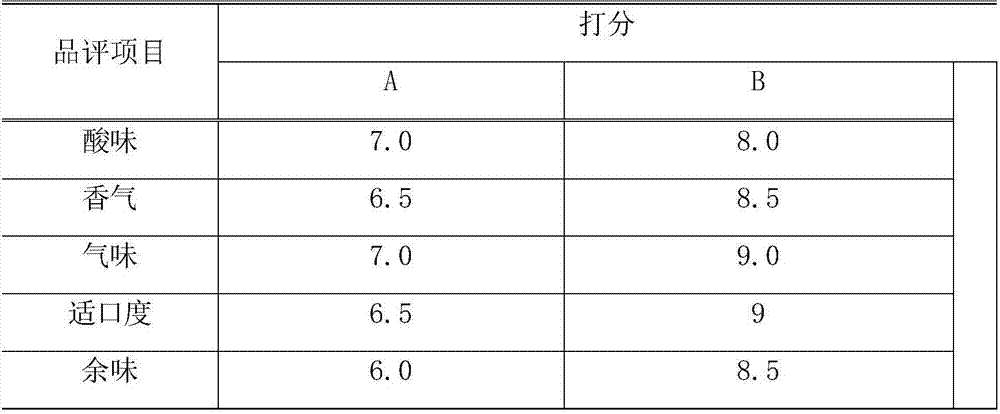
[0085] Sensory evaluation test results:
[0086] Manual tasting test of the product of Example 1 of the present invention: scoring from 7 aspects of sourness, fragrance, smell, palatability, texture and comprehensiveness, each with 10 points, and 10 judges. From the score results, the score of the fermented product of the present invention is obviously higher than that of group A by about 30%.
[0087] The products in Group A are the products in the control group.
[0088] Product Quality Rating Form
[0089]
[0090]
PUM
 Login to View More
 Abstract
Description
Claims
Application Information
 Login to View More