Method for detecting motor kinematics parameters based on pulse feedback

A kinematic parameter and feedback detection technology, which is applied in the direction of motor generator testing, etc., can solve the problems of inability to obtain instantaneous value at the time of signal reading, speed error, inaccurate position detection, etc.

CN104678301AInactive Publication Date: 2015-06-03HUAZHONG UNIV OF SCI & TECH
6 Cites 4 Cited by

Patent Information

Authority / Receiving Office
CN · China
Current Assignee / Owner
Publication Date
2015-06-03
Estimated Expiration
Not applicable · inactive patent

Smart Images

  • Figure 1
    Figure 1
  • Figure 2
    Figure 2
  • Figure 3
    Figure 3
Patent Text Reader

Abstract

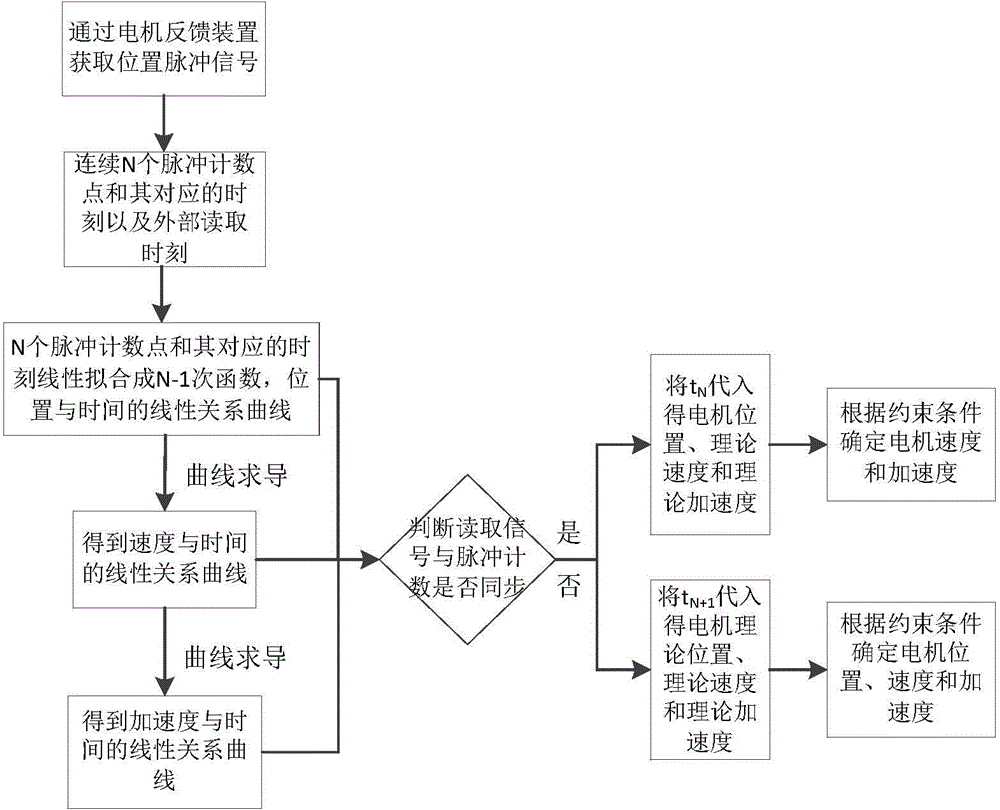
The invention discloses a method for detecting motor kinematics parameters based on pulse feedback. The method comprises the following steps: by continuously collecting the pulse count of N times before the signal reading time, linearly fitting the collected N pulse count and the corresponding time thereof to an N-1 order function, so as to obtain a relational function of a motor position and the time; solving a first-order derivative of the relational function of the motor position and the time to obtain a relational function of motor speed and the time; solving the first-order derivative of the relational function of the motor speed and the time to obtain a relational function of accelerated speed of a motor and the time; judging whether the signal reading time and the pulse count time are synchronous, and putting corresponding constraint conditions to obtain the detection results of the position, the speed and the accelerated speed of the motor. According to the method, the position, the speed and the accelerated speed of the motor as well as the speed range of expanded speed measurement at the signal reading time are calculated at the same time, so that the calculation accuracy and instantaneity of the position, the speed and the accelerated speed of the motor are improved.
Need to check novelty before this filing date? Find Prior Art

Description

technical field

[0001] The invention belongs to the technical field of motor kinematics parameter detection, and more specifically relates to a method for detecting motor kinematics parameters based on pulse feedback. Background technique

[0002] Continuous pulse signals are used as feedback signals to measure motor kinematic parameters, such as displacement, speed and acceleration during linear motor motion or rotary motion, and are increasingly used in various control occasions. With the development of advanced manufacturing technologies such as precision manufacturing technology and microelectronics technology, motion control systems have higher and higher requirements for speed measurement accuracy and real-time performance of moving objects, which puts forward higher requirements for speed calculation algorithms. However, due to some shortcomings in the general motion algorithm, it is difficult to meet such requirements.

[0003] Commonly used speed measurement calcul...

Examples

Embodiment Construction

[0037] In order to make the object, technical solution and advantages of the present invention clearer, the present invention will be further described in detail below in conjunction with the accompanying drawings and embodiments. It should be understood that the specific embodiments described here are only used to explain the present invention, not to limit the present invention. In addition, the technical features involved in the various embodiments of the present invention described below can be combined with each other as long as they do not constitute a conflict with each other.

[0038] In the method for detecting motor kinematics parameters based on pulse feedback in the embodiment of the present invention, the motor kinematics parameters include motor position, motor speed and motor acceleration. Such as figure 1 As shown, the method includes the following steps:

[0039] (1) Continuous acquisition signal reading time t N+1 the previous N moments t 1 ~t N The numb...