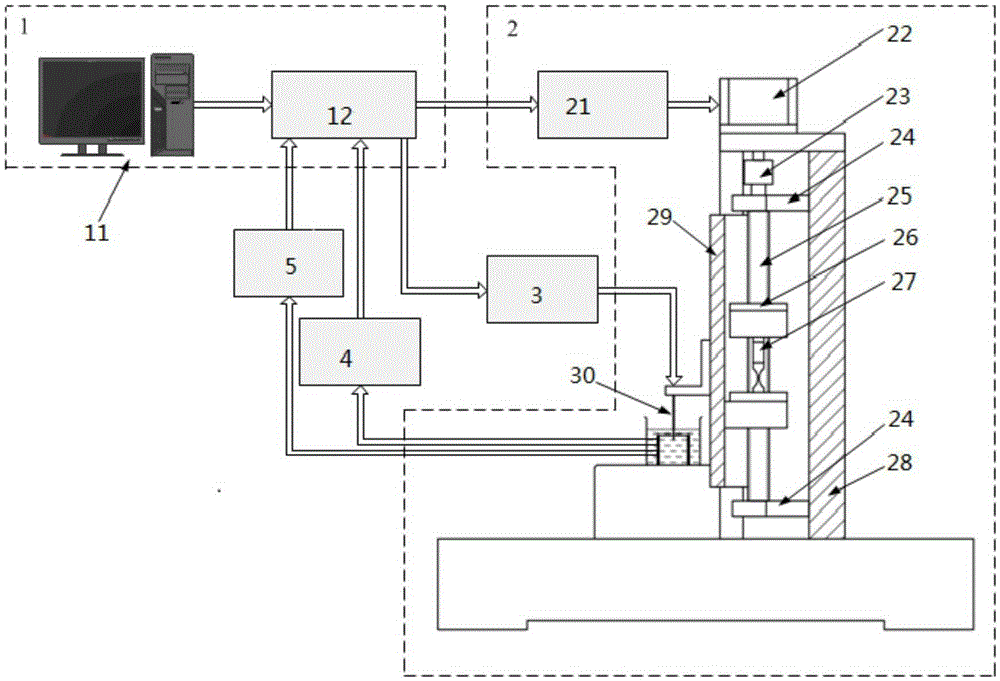
Probe machining equipment

A processing equipment and technology to be processed, applied in the electrolysis process, electrolysis components, etc., can solve the problems of difficult probe high-precision processing, uneven probe surface morphology, affecting probe surface quality, etc. The effect of controllability and morphological standards

CN105239148AInactive Publication Date: 2016-01-13XIANGYANG HONGWEI AIRCRAFT
6 Cites 0 Cited by

Patent Information

Authority / Receiving Office
CN · China
Patent Type
Applications(China)
Current Assignee / Owner
Publication Date
2016-01-13
Estimated Expiration
Not applicable · inactive patent

Smart Images

  • Figure 1
    Figure 1
Patent Text Reader

Abstract

The invention discloses probe machining equipment. The probe machining equipment comprises a controller, a control circuit, a mechanical device and a corrosive liquid device, wherein the controller is connected with the mechanical device; the corrosive liquid device comprises an electrode and corrosive liquid; the mechanical device is used for fixing a probe to be machined and drives the probe to be machined to move; the control circuit comprises a preparation corrosive circuit, a preparation stopping circuit and a judgment circuit; the preparation corrosive circuit is used for outputting corrosive voltage to the electrode; the preparation stopping circuit collects a current change signal of the preparation corrosive circuit; the judgment circuit is used for detecting whether the probe is immersed in the corrosive liquid or not. According to the probe machining equipment, the structure and connection mode of the control circuit are improved, and other components of the mechanical device and the like are matched, so that important parameters like corrosive voltage, probe immersing depth and probe lifting speed in the probe corrosion process are accurately controlled, and the nano probe high in precision, resistant to abrasion, recyclable and low in cost can be obtained through machining.
Need to check novelty before this filing date? Find Prior Art

Description

technical field

[0001] The invention belongs to the technical field of testing, and more specifically relates to a probe processing equipment. Background technique

[0002] At present, precision technology is developing rapidly and has a huge impact on current scientific and technological research, social production, and daily life. Probes are widely used in precision technology fields, such as scanning tunneling microscopes, semiconductor measuring instruments, nanomanipulator arms, etc. The preparation methods of precision probes commonly used in the prior art include ultra-vacuum ion field microscopy, grinding, shearing, field-induced (electrostatic) emission, electrochemical corrosion, and the like. Among them, the electrochemical corrosion method has gained more and more favor due to its good preparation reproducibility, low cost, and simple structure.

[0003] Although the electrochemical corrosion method has the above-mentioned advantages, the electrochemical corros...

Examples

Embodiment 1

[0034] Such as figure 1 As shown, the probe processing equipment in the present invention includes an industrial computer 1, a mechanical device 2 and a control circuit; wherein, the industrial computer 1 includes a host computer 11 and a controller 12, and the controller 12 is connected to the mechanical device 2 and is used to control the mechanical device move; the mechanical device 2 is used to fix the probe and drive the probe to move up and down; the control circuit includes a preparation corrosion circuit 3 connected to the controller 12, a preparation stop circuit 4 and a judgment circuit 5, wherein: the preparation corrosion circuit 3 is used to receive the controller The corrosion voltage signal instruction issued by 12, and output the preset corrosion voltage according to the instruction and keep the corrosion voltage constant; the preparation stop circuit 4 collects the current change signal of the preparation corrosion circuit 3, and transmits the change signal to ...