This helps you quickly interpret patents by identifying the three key elements:
Problems solved by technology
Method used
Benefits of technology
Problems solved by technology
Although this method is useful in the test of specific microorganisms, in the test of the number of living bacteria using the agar plate mixed dilution method (plate-count method) using an agar medium, the cultured activated carbon is colored, and the transparency of the medium is affected by acid clay or decreased attapulgite, making it difficult to identify colonies
Furthermore, since it is difficult to separate and remove these substances, there is a problem that it is difficult to accurately identify and measure colonies
Method used
the structure of the environmentally friendly knitted fabric provided by the present invention; figure 2 Flow chart of the yarn wrapping machine for environmentally friendly knitted fabrics and storage devices; image 3 Is the parameter map of the yarn covering machine
View more
Image
Smart Image Click on the blue labels to locate them in the text.
Viewing Examples
Smart Image
Click on the blue label to locate the original text in one second.
Reading with bidirectional positioning of images and text.
Smart Image
Examples
Experimental program
Comparison scheme
Effect test
Embodiment
[0029] Hereinafter, the present invention will be described in more detail based on examples and the like. In addition, this invention is not limited to these Examples etc. at all.
reference example 1
[0031] Preparation of bacterial suspension:
[0032] According to the general test method 4.05 microbial limit test method in the 16th revised Japanese Pharmacopoeia, the inoculum solution used in the microbiological test was prepared.
[0033] (test strain)
[0034] Escherichia coli ( Escherichiacoli , hereinafter referred to as ECO): IFONo.3972
[0035] Staphylococcus aureus ( Staphylococcus aureus , hereinafter referred to as SAU): IFONo.13276
[0036] Pseudomonas aeruginosa ( Pseudomonasaeruginosa , hereinafter referred to as PAE): IFONo.13275
[0037] Bacillus subtilis ( Bacillus subtilis , hereinafter referred to as BSU): IFONo.3134
[0038] Candida albicans (Candida albicans, hereinafter referred to as CAL): IFONo.1594
[0039] Aspergillus brasiliensis ( Aspergillus brasiliensis , hereinafter referred to as ABR): NBRCNo.9455
[0040] Clostridium sporogenes ( Clostridium sporogenes , hereinafter referred to as CSP): NCTCNo.12935
[0041] (preparation of...
Embodiment 1
[0048] Adsorbent research (1):
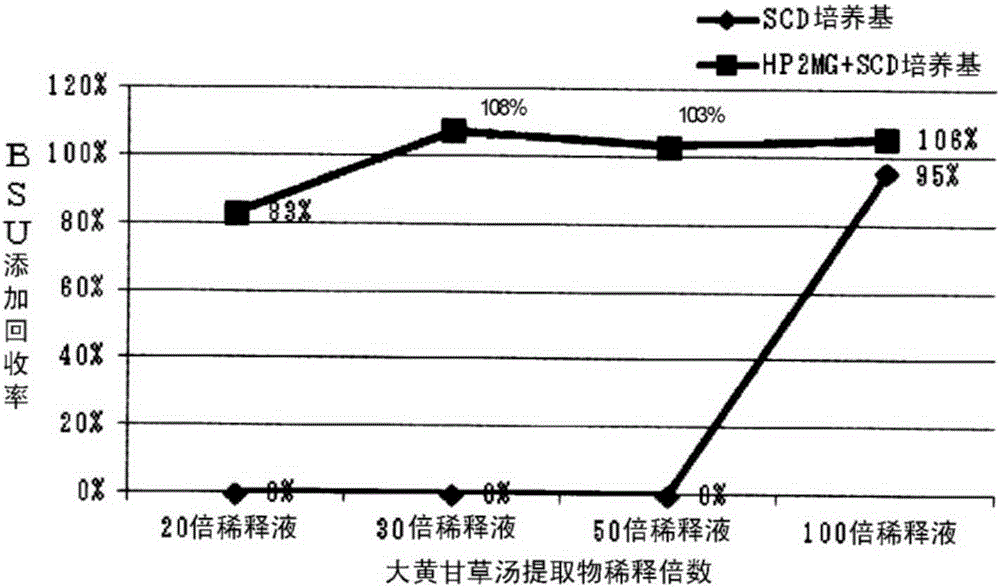
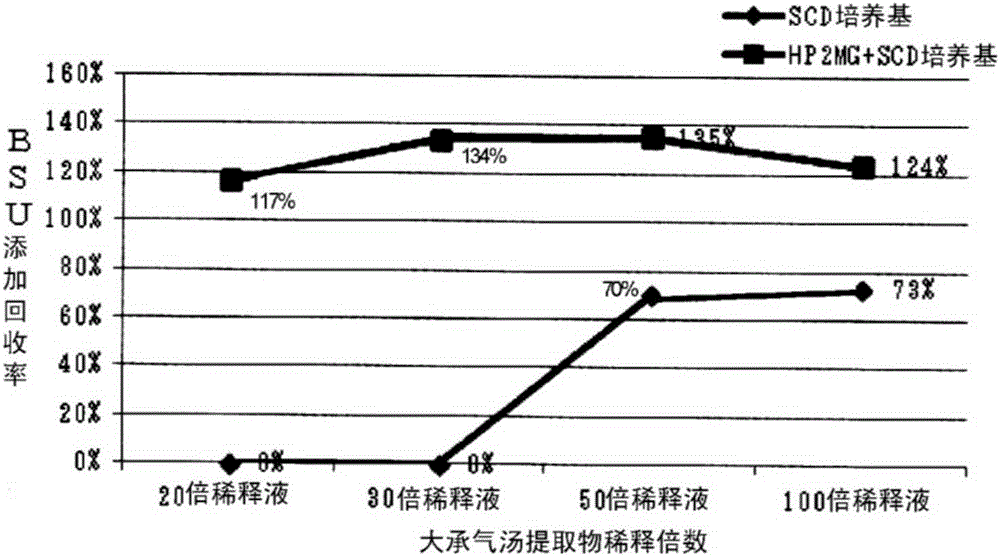
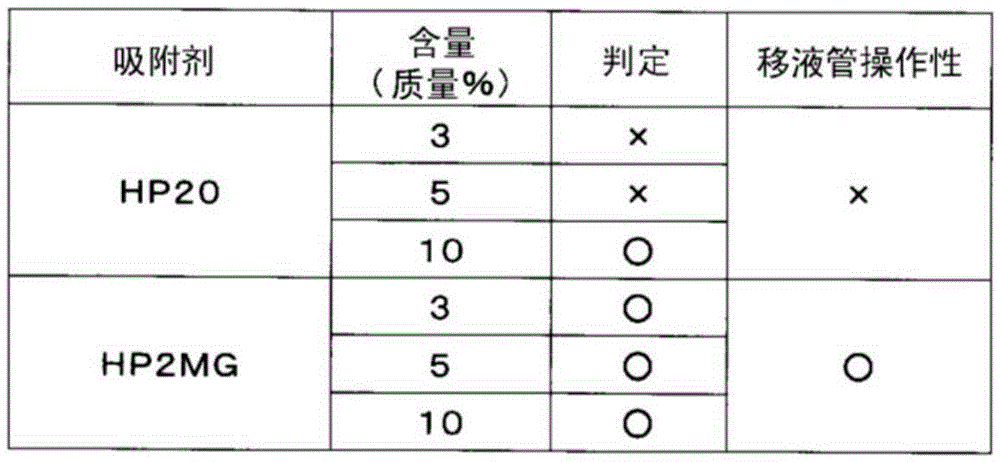
[0049]Weigh 10 g of a sample (daijoki soup extract granule; manufactured by Tsumura Co., Ltd.), add it to 90 mL of peptone salt buffer solution (prepared in a 200 mL Erlenmeyer flask) added with 10% by mass of adsorbent, and stir to prepare a sample liquid. As the adsorbent, DIAION (registered trademark) HP20 (styrene system), DIAION (registered trademark) HP2MG (methacrylic acid system), SEPABEADS (registered trademark) SP700 (styrene system), SEPABEADS (registered trademark) SP207 (benzene vinyl) (all are manufactured by Mitsubishi Chemical Corporation). In addition, a sample solution prepared in the same manner using 10% by mass of skim milk instead of 10% by mass of the adsorbent, and an SCD medium to which 3% by mass of activated carbon and 5% by mass of activated clay were added were prepared. Each sample solution was divided and passed through a sieve (made of stainless steel) to prepare a 10-fold diluted sample solution. Separate 10 ...
the structure of the environmentally friendly knitted fabric provided by the present invention; figure 2 Flow chart of the yarn wrapping machine for environmentally friendly knitted fabrics and storage devices; image 3 Is the parameter map of the yarn covering machine
Login to View More
PUM
Login to View More
Abstract
A microorganism detection method that: is highly versatile, being applicable to both a test for specified microorganisms and a microbial enumeration test using the same test conditions for Kampo extract preparations and crude drugs containing a wide variety of antimicrobial substances; makes it possible to reduce the impact of antimicrobial substances in a test sample effectively; and allows the detection of target microorganisms with a high degree of precision. Said method, which is used to detect microorganisms in a test sample that exhibits antimicrobial activity, is characterized by having a step in which a liquid sample containing a test sample that exhibits antimicrobial activity is prepared and a step in which target microorganisms are cultured in a culture medium. Said method is also characterized in that a (meth)acrylic-acid-ester synthetic adsorbent is made to act on the liquid sample and / or the culture medium.
Description
technical field [0001] The present invention relates to a method for detecting microorganisms, and more specifically, to a method for detecting microorganisms capable of detecting target microorganisms with high accuracy while reducing the influence of antibacterial substances contained in a test sample. Background technique [0002] In the fields of food and pharmaceuticals, microbiological inspections of products and raw materials are performed to ensure quality and safety. For the test methods, official methods are prescribed in each field, and for pharmaceuticals, various microbial test methods are recorded in the Japanese Pharmacopoeia. Among them, for non-sterile preparations and their raw materials, the microbial limit test method is specified, including the viable count test for measuring the viable count and specific microbial tests related to specific pathogenic microorganisms. Furthermore, for crude drugs, the microbial limit test method for crude drugs is specif...
Claims
the structure of the environmentally friendly knitted fabric provided by the present invention; figure 2 Flow chart of the yarn wrapping machine for environmentally friendly knitted fabrics and storage devices; image 3 Is the parameter map of the yarn covering machine
Login to View More
Application Information
Patent Timeline
Application Date:The date an application was filed.
Publication Date:The date a patent or application was officially published.
First Publication Date:The earliest publication date of a patent with the same application number.
Issue Date:Publication date of the patent grant document.
PCT Entry Date:The Entry date of PCT National Phase.
Estimated Expiry Date:The statutory expiry date of a patent right according to the Patent Law, and it is the longest term of protection that the patent right can achieve without the termination of the patent right due to other reasons(Term extension factor has been taken into account ).
Invalid Date:Actual expiry date is based on effective date or publication date of legal transaction data of invalid patent.



 Login to View More
  Login to View More