A self-driven all-solid-state glucose biosensor and its preparation method
What is AI technical title?
AI technical title is built by Patsnap AI team. It summarizes the technical point description of the patent document.
A biosensor, all-solid-state technology, applied in the direction of electrochemical variables of materials, etc.
Inactive Publication Date: 2018-06-19
ZHEJIANG UNIV
View PDF3 Cites 0 Cited by
Summary
Abstract
Description
Claims
Application Information
AI Technical Summary
This helps you quickly interpret patents by identifying the three key elements:
Problems solved by technology
Method used
Benefits of technology
Problems solved by technology
[0004] No SnO-based 2 / NiCo 2 o 4 Related reports of self-driven all-solid-state glucose biosensor
Method used
the structure of the environmentally friendly knitted fabric provided by the present invention; figure 2 Flow chart of the yarn wrapping machine for environmentally friendly knitted fabrics and storage devices; image 3 Is the parameter map of the yarn covering machine
View more
Image
Smart Image Click on the blue labels to locate them in the text.
Viewing Examples
Smart Image
Click on the blue label to locate the original text in one second.
Reading with bidirectional positioning of images and text.
Smart Image
Examples
Experimental program
Comparison scheme
Effect test
Embodiment 1
[0030] 1) Cut the FTO substrate into a size of 1cm×2cm, ultrasonically clean it with acetone, ethanol, and deionized water for 10 minutes, and then dry it for later use;
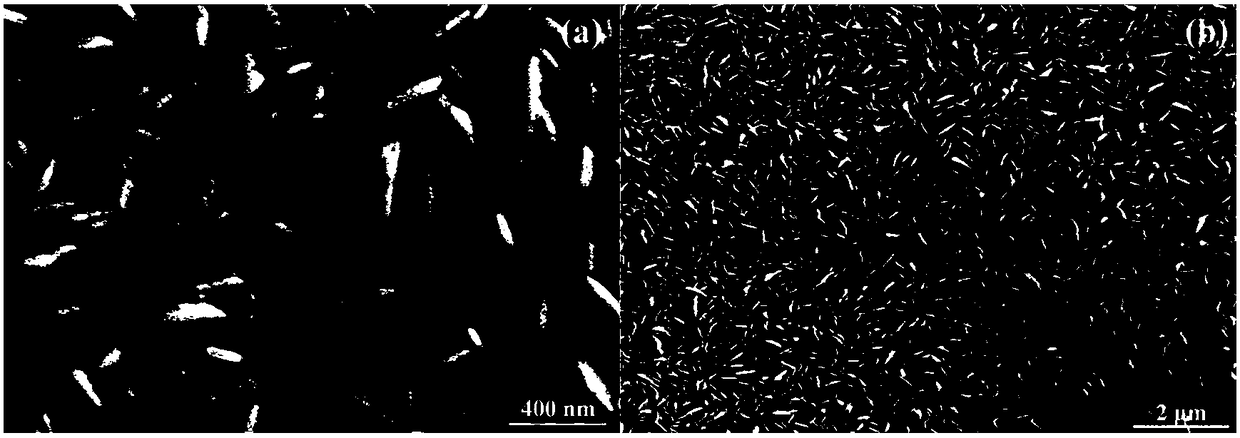
[0031] 2) Combine 8.55mmNaF and 2.85mmSnCl 2Dissolve in 30ml of deionized water to obtain the precursor body fluid, transfer it to the liner of a 50ml hydrothermal kettle, and put the FTO substrate obtained in step (1), put the hydrothermal kettle into a 180°C thermostat for 20 hours, take it out, wash and dry , to get grown with Sn 2+ Doped SnO 2 FTO substrates for nanosheet arrays, see figure 1 ;
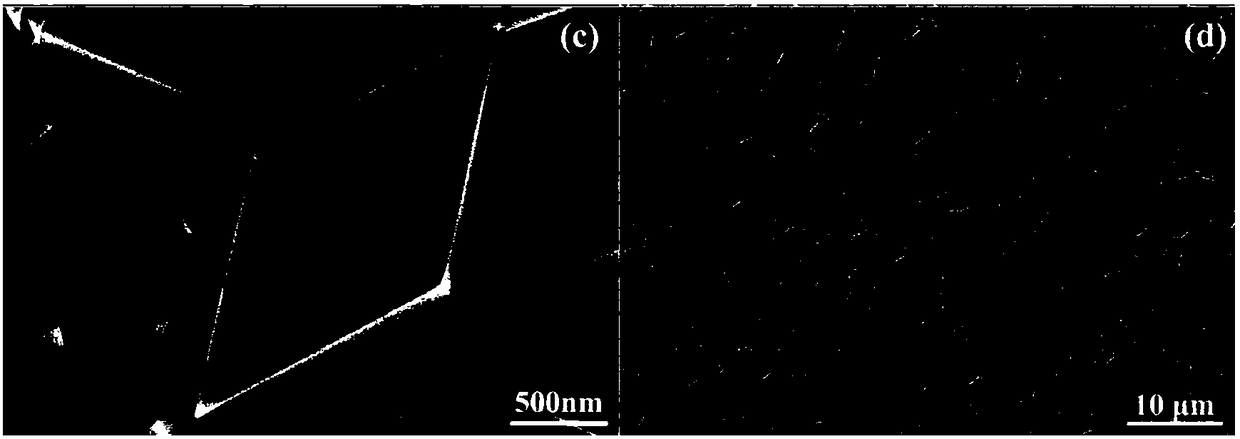
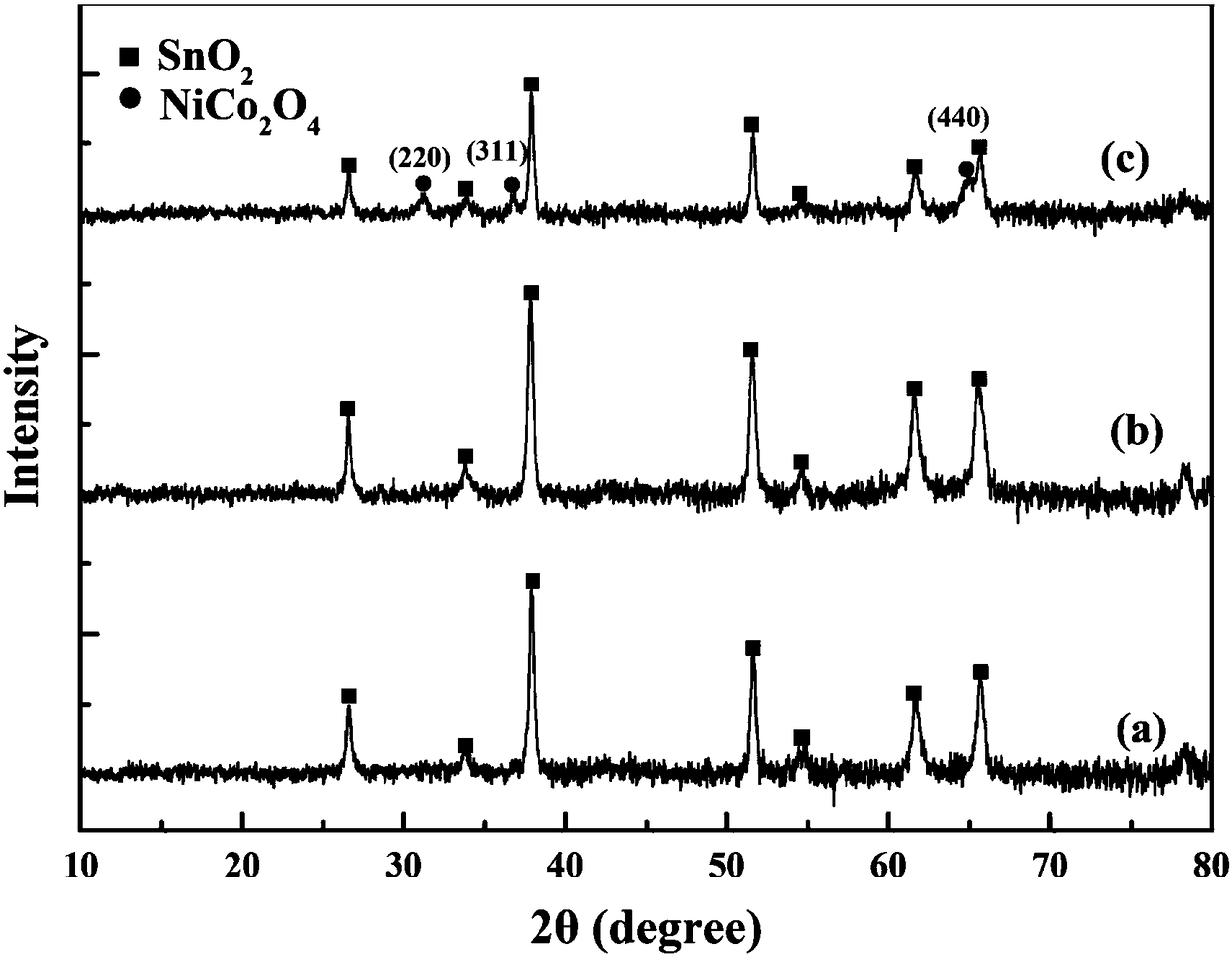
[0032] 3) Add 2mm Ni(NO 3 ) 2 ·6H 2 O, 4mm Co(NO 3 ) 2 ·6H 2 O, 16mm NH 4 F, 8mmC 6 h 12 N 4 Dissolve it in 40ml of deionized water, transfer the precursor liquid to the liner of a 50ml hydrothermal kettle, and put the FTO substrate obtained in step (1), put the hydrothermal kettle into a 100°C thermostat for 24 hours, and then take out the FTO substrate The bottom was cleaned and dried, and anneal...
Embodiment 2
[0042] 1) Cut the FTO substrate into a size of 1cm×2cm, ultrasonically clean it with acetone, ethanol, and deionized water for 10 minutes, and then dry it for later use;
[0043] 2) Combine 8.55mmNaF and 2.85mmSnCl 2 Dissolve in 30ml of deionized water to obtain the precursor body fluid, transfer it to the liner of a 50ml hydrothermal kettle, and put the FTO substrate obtained in step (1), put the hydrothermal kettle into a 180°C thermostat for 20 hours, take it out, wash and dry , to get grown with Sn 2+ Doped SnO 2 FTO substrates of nanosheet arrays;
[0044] 3) Add 2mm Ni(NO 3 ) 2 ·6H 2 O, 4mmCo(NO 3 ) 2 ·6H 2 O, 8mm NH 4 F, 8mmC 6 h 12 N 4 Dissolve it in 40ml of deionized water, transfer the precursor liquid to the liner of a 50ml hydrothermal kettle, and put the FTO substrate obtained in step (1), put the hydrothermal kettle into a 100°C thermostat for 24 hours, and then take out the FTO substrate The bottom was washed and dried, and annealed at 250 °C for 3 ...
the structure of the environmentally friendly knitted fabric provided by the present invention; figure 2 Flow chart of the yarn wrapping machine for environmentally friendly knitted fabrics and storage devices; image 3 Is the parameter map of the yarn covering machine
Login to View More
PUM
Login to View More
Abstract
The invention relates to a self-driven all-solid-state glucose biosensor and a preparation method thereof. According to the self-driven all-solid-state glucose biosensor and the preparation method thereof, self-driven glucose concentration detection is realized, glucose concentration can be detected under the illumination and non-illumination conditions, the linear detection range reaches 2-40 mM, and glucose concentration detection requirements of a normal human body (with the linear detection range of 3.61-6.11 mM) and a diabetic patient; light conversion, light storage and biosensing are integrated to one device, a new field is developed for miniaturization and portability of the biosensor, and the biosensor is assembled by adopting a Sn<2+> doped SnO2 nanosheet array as a photoresponse electrode and adopting a rhombic NiCo2O4 nanorod array as an electrochemical energy storageelectrode through a Celgard 2400 diaphragm and a PVA / KOH solidelectrolyte.
Description
(1) Technical field [0001] The invention relates to a SnO-based 2 / NiCo 2 o 4 Self-driven all-solid-state glucose biosensor and its preparation method. (2) Background technology [0002] Since human society entered modern civilization, with the improvement of people's material living standards, "diseases of wealth" such as diabetes have spread widely all over the world, and about 400 million people suffer from diabetes every year. Therefore, the daily monitoring of diabetes has become an urgent problem to be solved. In order to facilitate daily use, it is necessary to make its core component, the glucose sensor, small and portable. However, many current glucose sensors usually require an external power supply to provide energy, which virtually increases the size of the sensor. Self-driven biosensors open up a new direction for the miniaturization of sensors. [0003] As an inexhaustible energy source on the earth, solar energy can provide a good energy source for biose...
Claims
the structure of the environmentally friendly knitted fabric provided by the present invention; figure 2 Flow chart of the yarn wrapping machine for environmentally friendly knitted fabrics and storage devices; image 3 Is the parameter map of the yarn covering machine
Login to View More
Application Information
Patent Timeline
Application Date:The date an application was filed.
Publication Date:The date a patent or application was officially published.
First Publication Date:The earliest publication date of a patent with the same application number.
Issue Date:Publication date of the patent grant document.
PCT Entry Date:The Entry date of PCT National Phase.
Estimated Expiry Date:The statutory expiry date of a patent right according to the Patent Law, and it is the longest term of protection that the patent right can achieve without the termination of the patent right due to other reasons(Term extension factor has been taken into account ).
Invalid Date:Actual expiry date is based on effective date or publication date of legal transaction data of invalid patent.


 Login to View More
  Login to View More