
Reverse conducting MOS gate-controlled thyristor and fabrication method thereof
A reverse-conducting, thyristor technology, applied in the field of power semiconductor devices, can solve problems such as adverse effects of forward conduction, voltage stagnation, and device damage, and achieve the effects of suppressing the snapback effect, large current conduction capability, and reducing the effective area.
- Summary
- Abstract
- Description
- Claims
- Application Information
AI Technical Summary
Problems solved by technology
Method used
Image

Examples
Embodiment Construction
[0033] Below in conjunction with accompanying drawing, describe technical scheme of the present invention in detail:
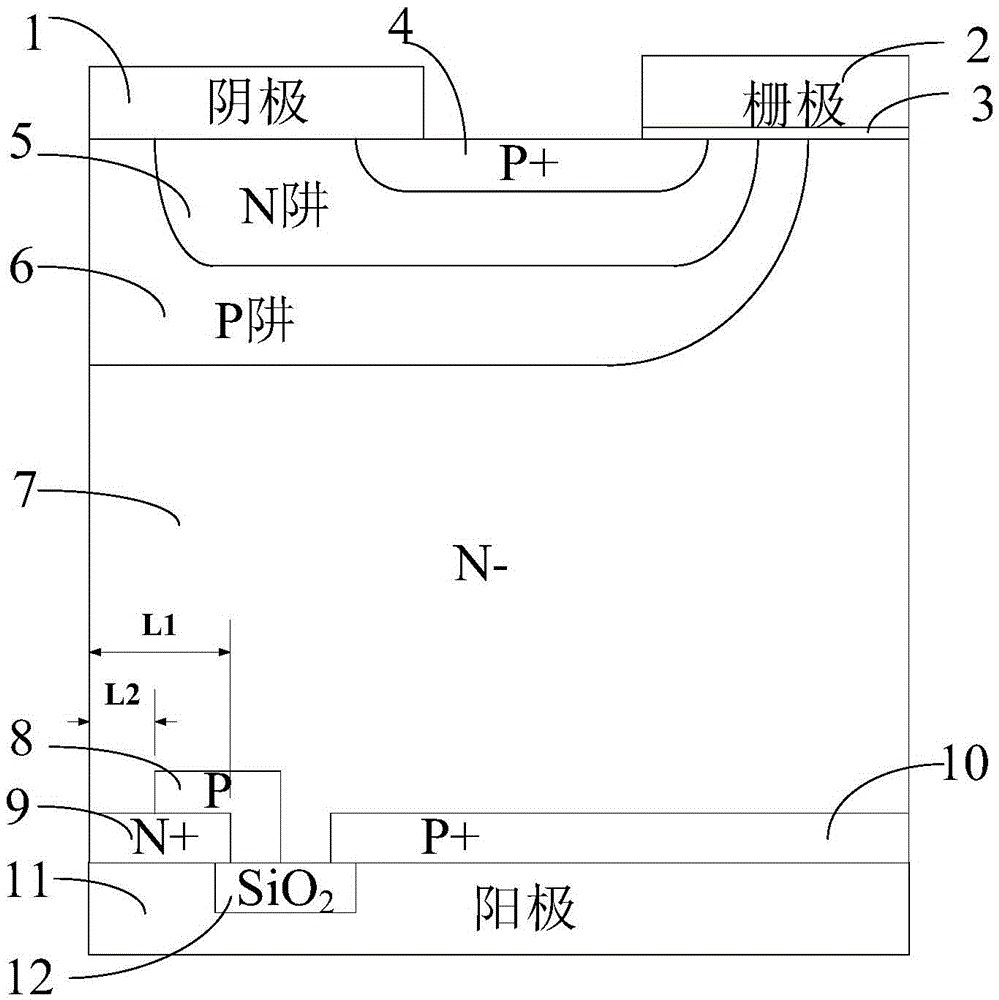
[0034] figure 2 It is a structural schematic diagram of a reverse conduction type MOS gate-controlled thyristor of the present invention. As shown in the figure, it includes metallized cathode 1, gate electrode 2, gate oxide layer 3, P well 4, N well 5, P well 6, N drift region 7, P floating layer 8, N anode region 9, and P anode Region 10, metallized anode 11 and anode isolation oxide layer 12; P well 6 is located on top of N drift region 7, N well 5 is located in P well 6, P well 4 is located in N well 5, gate oxide layer 3 is located in N well 5 , the surfaces of the P well 6 and the N drift region 7, the gate electrode 2 is located on the surface of the gate oxide layer 3, and the metallized cathode 1 covers the N well 5, the P well 6 and a part of the P well 4. The lower surface of the N drift region 7 has a P floating region 8, between the P floating ...
PUM
 Login to View More
 Abstract
Description
Claims
Application Information
 Login to View More