
Alcohol-solvent-resistant, wear-resistant and yellowing-resistant surface polyurethane resin and preparation method thereof
A polyurethane resin, anti-yellowing technology, applied in polyurea/polyurethane coatings, coatings, etc., can solve the problems of alcohol wipe resistance and poor wear resistance
- Summary
- Abstract
- Description
- Claims
- Application Information
AI Technical Summary
Problems solved by technology
Method used
Image

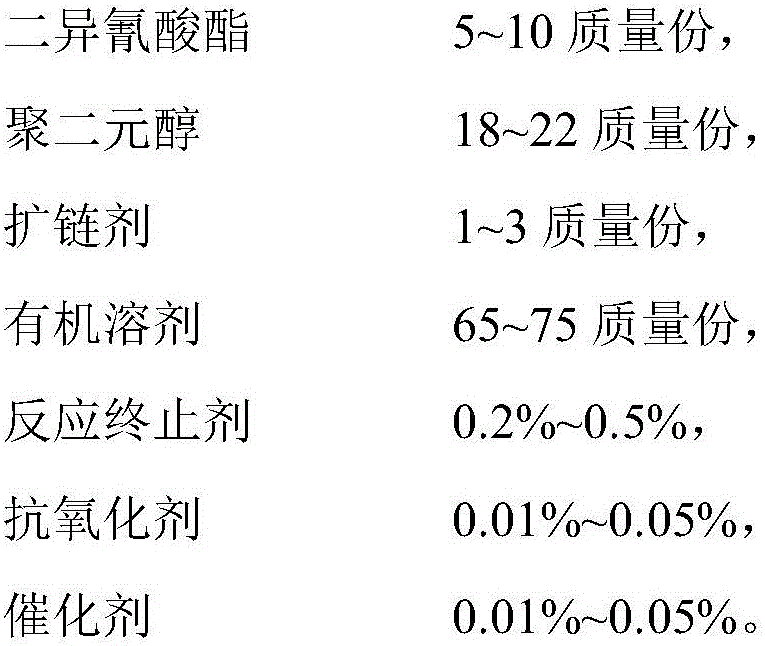
Examples
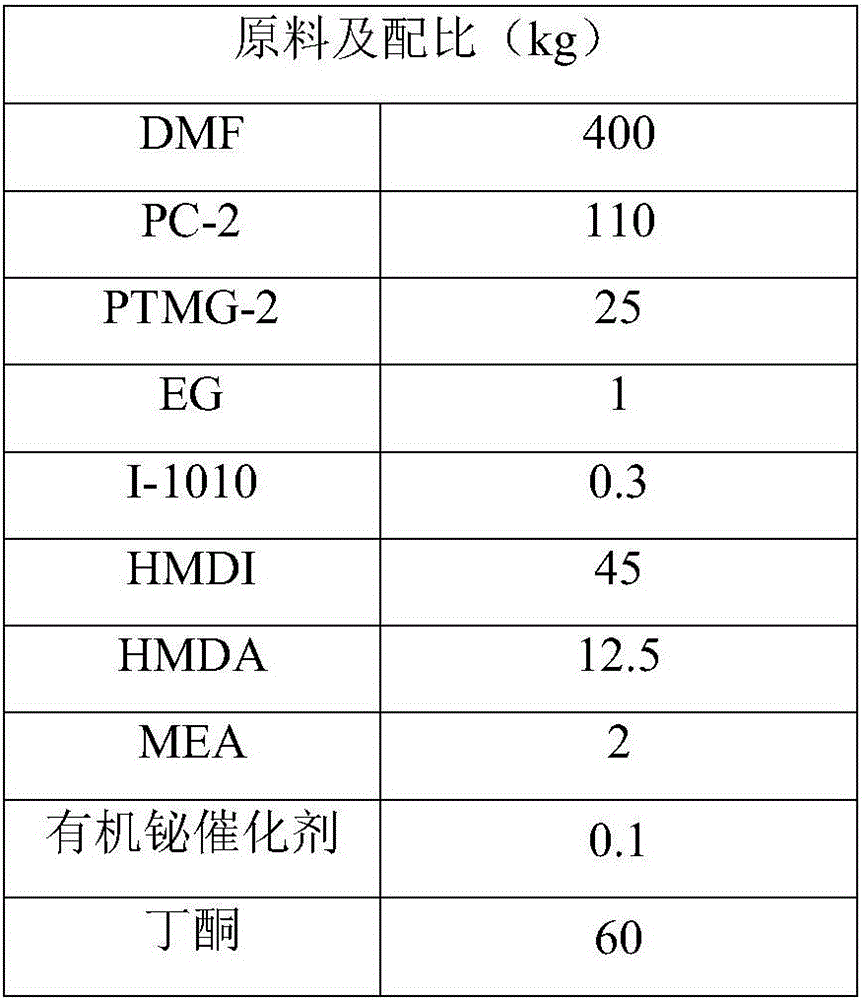
Embodiment 1
[0042] 1. Raw material and ratio:
[0043]
[0044] 2. Preparation
[0045] (1) earlier the PC-2 of 110kg, the PTMG-2 of 25kg, the EG of 1kg, 0.3kg antioxidant I-1010 and 0.1kg organic bismuth catalyst are joined in 60kg DMF, after stirring, add 45kg HMDI, be warming up to React at 95°C for 2 hours;
[0046] (2) Add an organic solvent with 75% of the total mass of the organic solvent to the reaction solution of step (1), drop the temperature of the reactor to 40-45° C., add the diamine HMDA dropwise, and continuously add the remaining amount of solvent in the process, Add 2kg of reaction terminator MEA until the viscosity reaches 60-80Pa·s / 25℃;
[0047] (3) The temperature of the reaction solution in step (2) was raised to 80° C. and stirred for 1.5 hours to obtain a polyurethane resin.
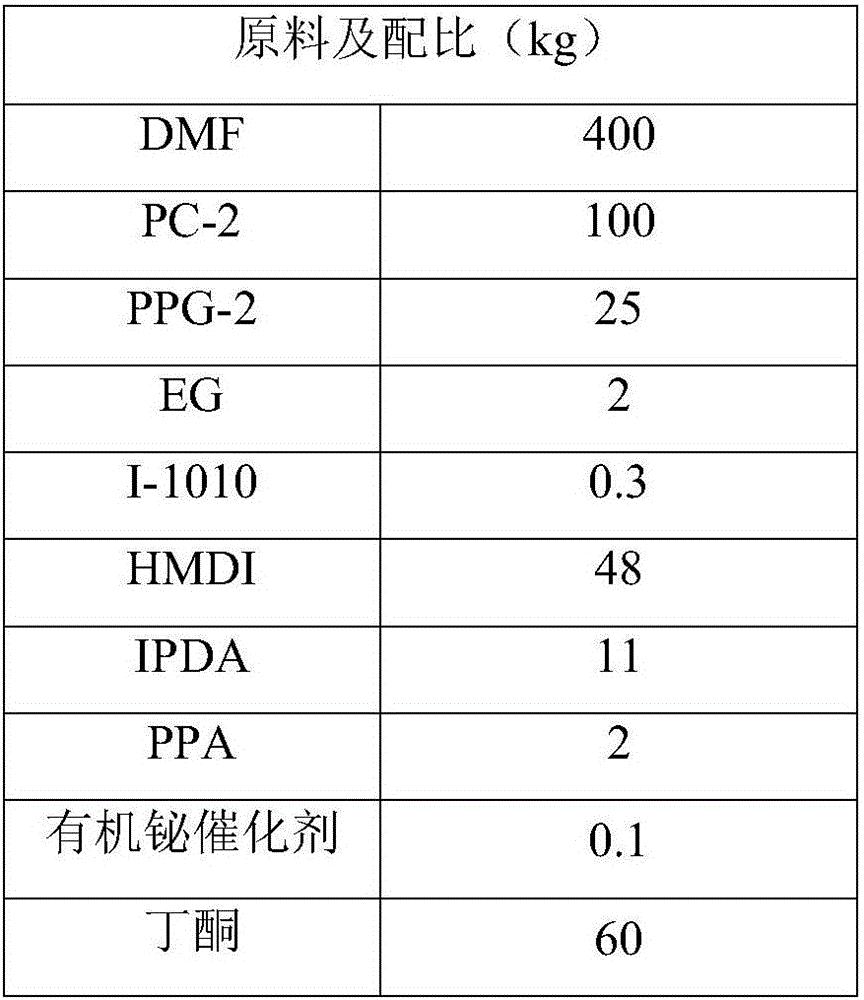
Embodiment 2
[0049] 1. Raw material and ratio:
[0050]
[0051] 2. Preparation
[0052] (1) earlier the PC-2 of 100kg, the PPG-2 of 25kg, the EG of 2kg, 0.3kg antioxidant I-1010 and 0.1kg organic bismuth catalyst are joined in 48kg DMF, after stirring, add 48kg HMDI, be warming up to React at 95°C for 2 hours;
[0053] (2) Add an organic solvent with 70% of the total mass of the organic solvent to the reaction solution in step (1), drop the temperature of the reactor to 35-40° C., add diamine IPDA dropwise, and continuously add a surplus of solvent in the process, Add 2kg of reaction terminator PPA until the viscosity reaches 80-120Pa·s / 25℃;
[0054] (3) The temperature of the reaction solution in step (2) was raised to 75° C. and stirred for 1 hour to obtain a polyurethane resin.
Embodiment 3
[0056] 1. Raw material and ratio:
[0057]
[0058]
[0059] 2. Preparation
[0060] (1) earlier the PC-1 of 80kg, the BG of the PTMG-2 of 55kg, 3kg, 0.3kg antioxidant I-1010 and 0.2kg organic bismuth catalyst are joined in 108kg DMF, after stirring, add 100kg HMDI, be warming up to React at 45-50°C for 1 hour;
[0061] (2) Add an organic solvent with a total mass of 75% of the organic solvent to the reaction solution in step (1), lower the temperature of the reactor to 40-45° C., add diamine HMDA dropwise, and continuously add the remaining solvent in the process until the viscosity is reached. After reaching 60~80Pa·s / 25℃, add 3kg of reaction terminator MEA;
[0062] (3) The temperature of the reaction solution in step (2) was raised to 85° C., and stirred for 1 hour to obtain a polyurethane resin.
PUM
 Login to View More
 Abstract
Description
Claims
Application Information
 Login to View More