Evaluation method for evaluating branch importance of power system

A power system and importance technology, applied in the evaluation field of branch importance in the power system, can solve problems such as large amount of calculation, no consideration of real-time operation mode, and the gap between the real situation of the power grid, etc., and achieve simple and simple calculation Rapid, thoughtful and comprehensive effects

CN106529791AActive Publication Date: 2017-03-22YUNNAN POWER GRID +1
5 Cites 19 Cited by

Patent Information

Authority / Receiving Office
CN · China
Patent Type
Applications(China)
Current Assignee / Owner
Publication Date
2017-03-22

Smart Images

  • Figure 1
    Figure 1
  • Figure 2
    Figure 2
  • Figure 3
    Figure 3
Patent Text Reader

Abstract

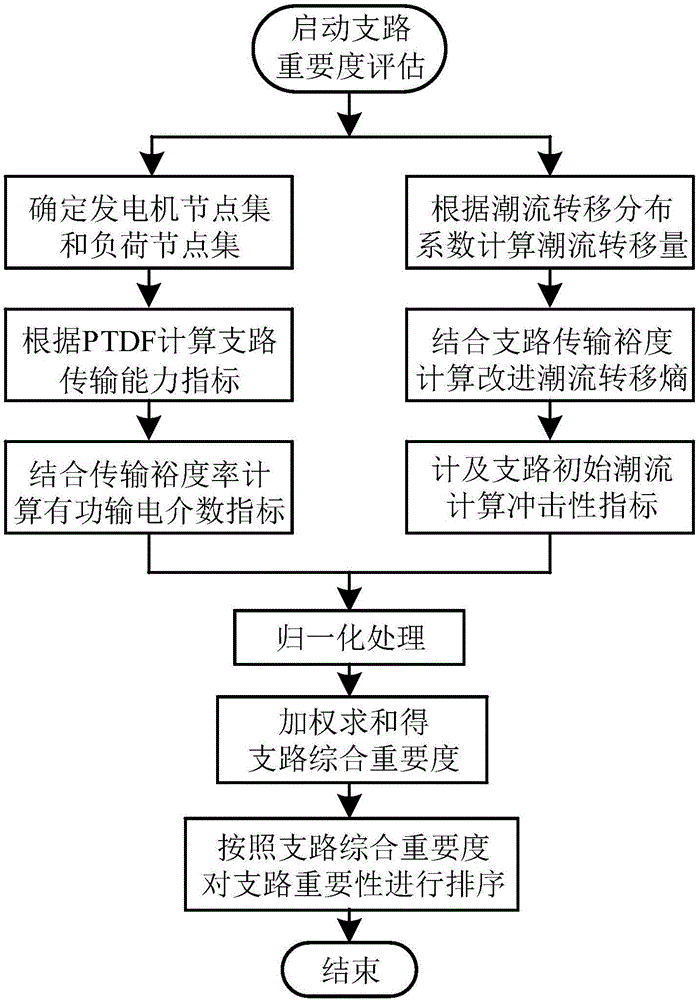
The invention discloses an evaluation method for evaluating the branch importance of a power system. The comprehensive importance index of a to-be-evaluated branch is obtained, and then the branch importance of the power system is evaluated. Tl* represents an active power transmission betweenness of the to-be-evaluated branch after being normalized. img file = 'DDA 0001143047330000012. TIF 'wi = '51 'he = '57' represents the impact resistance index of the to-be-evaluated branch after being normalized. Sigma represents the weight coefficient of the active power transmission betweenness. Mu represents the weight coefficient of the impact resistance index. According to the technical scheme of the invention, the complicated network theory and the entropy theory are organically combined, and the branch importance is comprehensively evaluated in the two aspects of the active transmission betweenness and the impact resistance index. A configured branch comprehensive importance index gives consideration to both the branch structure and the state importance. In this way, not only the contribution degree and the carrying capacity of an important branch during the power transfer process can be reflected, but also the influence of the on-off impact of the branch on the system is also considered. Therefore, the method is more accurate and more reasonable. The consideration range is more comprehensive and the evaluation result is more close to the real situation of the power grid.
Need to check novelty before this filing date? Find Prior Art

Description

technical field

[0001] The invention belongs to the field of identification of key branches in electric power systems, and more specifically relates to an evaluation method for the importance of branches in electric power systems. Background technique

[0002] The take-off of the power industry, while promoting social progress and economic development, has also brought great challenges to the safe and reliable operation of the power grid. With the increasing complexity, large-scale and interconnection of modern power systems, the security problems of power grids are becoming more and more prominent and need to be solved urgently. Looking at the frequent large-scale power outages in recent years, almost all of them originated from partial failures of some components, and eventually developed into an avalanche of cascading failures that caused system crashes. Research shows that a very small number of critical branches play a pivotal role in the fault evolution process. Ther...

Examples

Embodiment 1

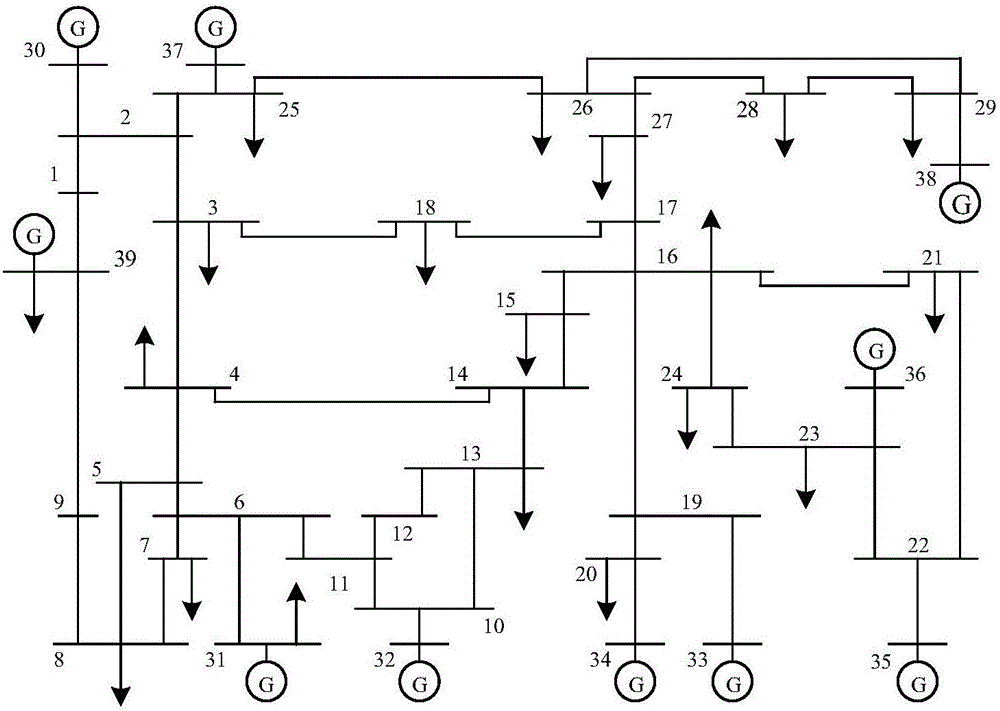
[0044] In order to further illustrate the branch importance evaluation method provided by the present invention in consideration of the topology and operating state, the IEEE39 node system is used as an example for simulation. The system includes 10 generators, 39 nodes, 12 transformers, 19 load points and 46 branches, its topology is as follows figure 2 As shown, the number represents the serial number of the node, G represents the generator, the arrow represents the load method, and the cross represents the busbar. In this embodiment, the weight coefficient σ=1 of the active power transmission factor, and the weight coefficient μ=0 of the impact index.

Embodiment 2

[0054] Embodiment 1 is repeated with the same steps described above, with the difference that the weight coefficient σ=0 for the active power transmission factor, and the weight coefficient μ=1 for the impact index.

Embodiment 3

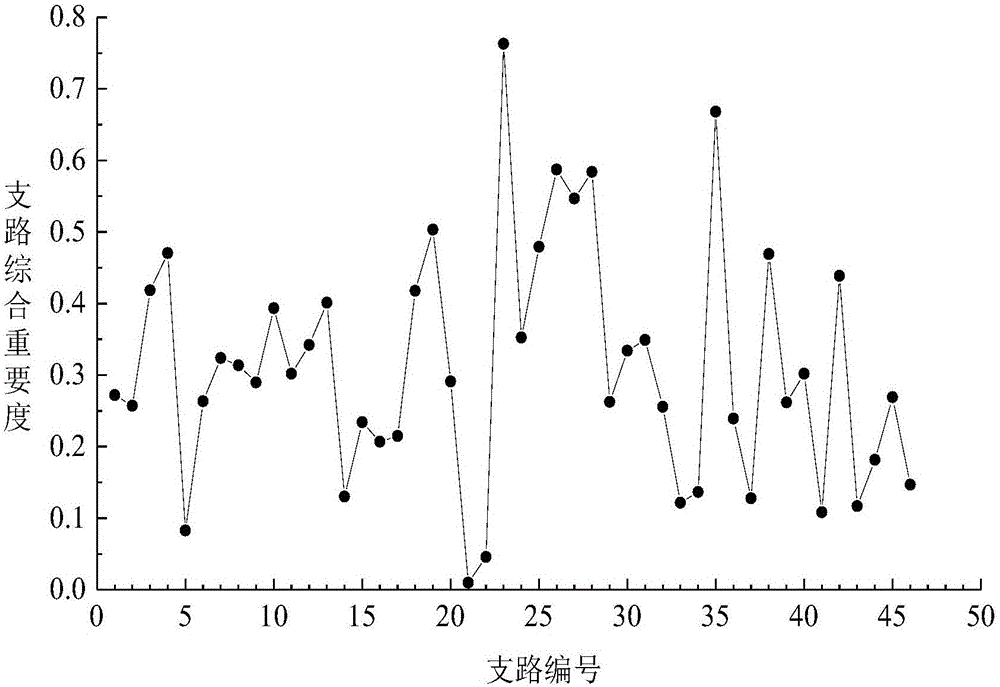
[0063] Repeat embodiment 1 with the same steps described above, the difference is that the weight coefficient σ=0.5 of the active power transmission intermediary factor, and the weight coefficient μ=0.5 of the impact index, and the comprehensive importance of each branch is obtained as image 3 shown.