
Electronic organ remote intelligent teaching system
A teaching system, electronic piano technology, applied to electric-operated teaching aids, teaching aids, music teaching aids, etc., can solve the problems that learners cannot choose the learning mode independently, and cannot provide large data reference for learners, so as to avoid delay and distortion Effect
- Summary
- Abstract
- Description
- Claims
- Application Information
AI Technical Summary
Problems solved by technology
Method used
Image

Examples
specific Embodiment approach 1
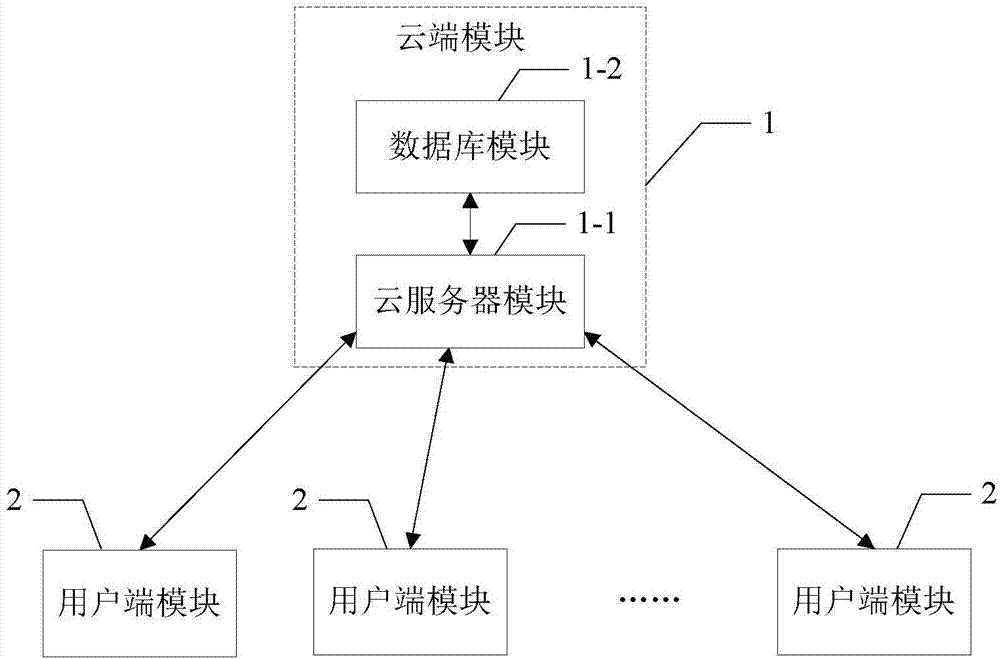
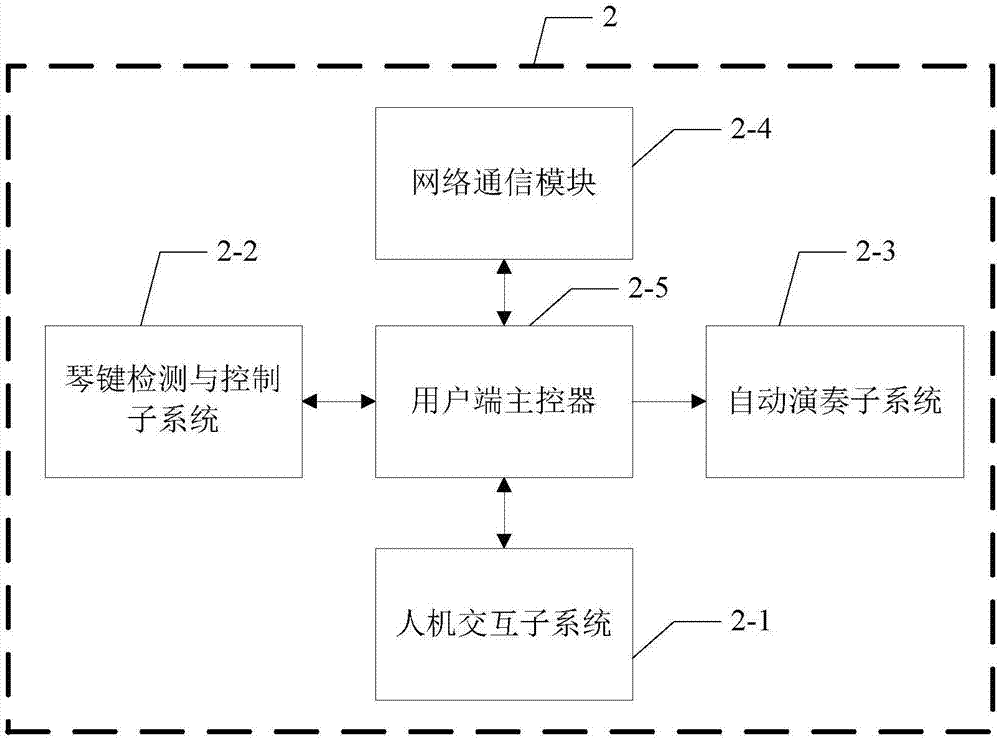
[0024] Specific implementation mode one: combine figure 1 and figure 2 Describe this embodiment, a remote intelligent teaching system for an electronic organ described in this embodiment, is characterized in that the system includes a cloud module 1 and a plurality of client modules 2;
[0025] The plurality of client modules 2 are respectively held by the teacher and the learner;
[0026] Each client module 2 includes a human-computer interaction subsystem 2-1, a keyboard detection and control subsystem 2-2, an automatic performance subsystem 2-3, a network communication module 2-4 and a client master controller 2-5 ;
[0027] The human-computer interaction subsystem 2-1 is used to input user instructions, and is also used to collect user video and audio signals in real time, and is also used to play and display the received video and audio signals, and is also used to indicate whether the corresponding key of the electronic organ is pressed It is also used to play voice ...
specific Embodiment approach 2
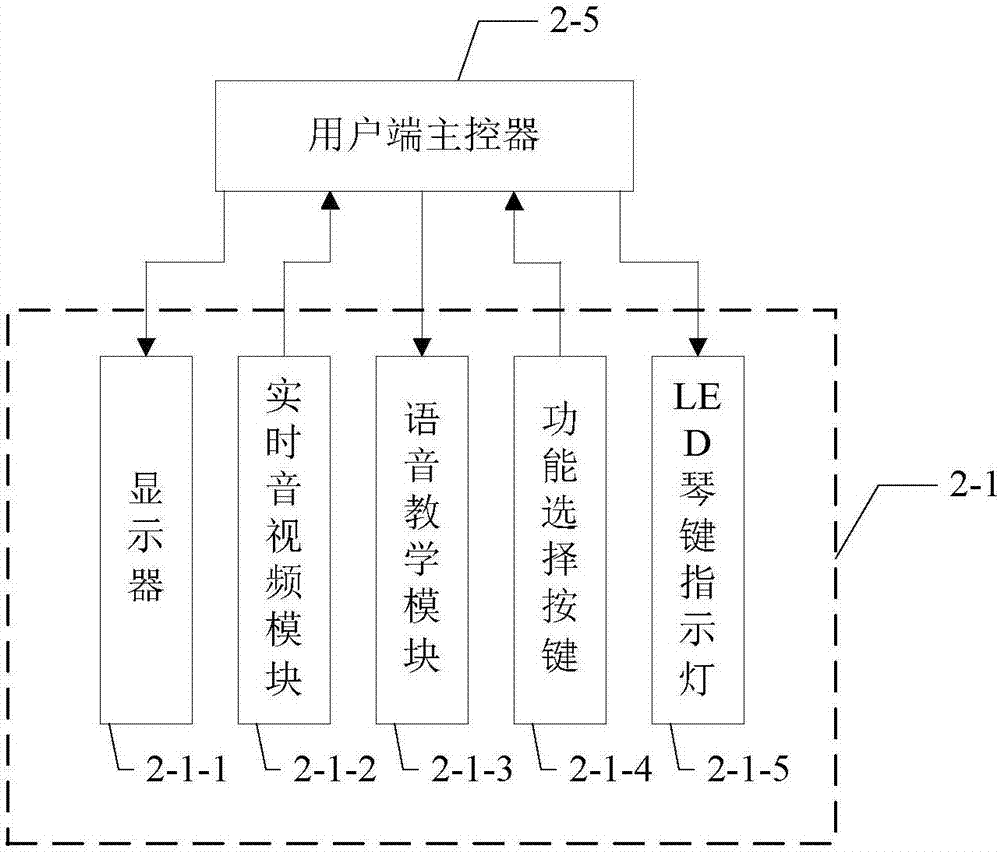
[0046] Specific implementation mode two: combination image 3Describe this embodiment. This embodiment is to further limit the remote intelligent teaching system for electronic piano described in the first specific embodiment. In this embodiment, the human-computer interaction subsystem 2-1 includes a display 2-1-1 , real-time audio and video module 2-1-2, voice teaching module 2-1-3, function selection button 2-1-4 and LED key indicator light 2-1-5;
[0047] Display 2-1-1, used to display the received video signal;
[0048] The real-time audio and video module 2-1-2 is used to collect the user's video and audio signals in real time, and send the video and audio signals collected in real time to the client main controller 2-5;
[0049] Voice teaching module 2-1-3, used to play voice teaching prompts;
[0050] Function selection buttons 2-1-4, used to input user instructions;
[0051] LED key indicator lights 2-1-5 are used to indicate whether the corresponding key of the el...
specific Embodiment approach 3
[0053] Specific implementation mode three: combination Figure 4 Describe this embodiment, this embodiment is to further limit a kind of remote intelligent teaching system for electronic piano described in the second specific embodiment, in this embodiment, the automatic performance subsystem 2-3 includes the main controller of the automatic performance subsystem 2-3-1, motor controller 2-3-2, stepper motor 2-3-3 and mechanical mechanism 2-3-4;
[0054] The main controller 2-3-1 is used to send a control signal according to the button information sent by the user-side main controller 2-5;
[0055] The motor controller 2-3-2 is used to control the rotation of the stepper motor 2-3-3 according to the control signal;
[0056] Stepper motor 2-3-3, used to pull the keys of the electronic organ;
[0057] The mechanical mechanism 2-3-4 is used to assist the stepping motor 2-3-3 to pull the keys of the electronic organ.
[0058] In this embodiment, the mechanical mechanism 2-3-4 in...
PUM
 Login to View More
 Abstract
Description
Claims
Application Information
 Login to View More