
Application of Rapeseed bnaspt3 Gene in Promoting Dicotyledonous Silique Growth
A technology for dicotyledonous plants and rapeseed, which is applied in the field of bioengineering to achieve the effects of improving the size of siliques, restoring the number of seeds, and contributing to high-yield research
- Summary
- Abstract
- Description
- Claims
- Application Information
AI Technical Summary
Problems solved by technology
Method used
Image

Examples
Embodiment 1
[0032] Example 1 Construction of Rapeseed bHLH Transcription Factor BnaSPT3 Gene Overexpression Vector and Arabidopsis Genetic Transformation
[0033] (1) Rapeseed (Brassica napus) leaves were taken, ground with liquid nitrogen, and RNAiso reagent (Takara Company) was added to extract RNA. 1 μg of RNA was taken for reverse transcription reaction to obtain cDNA.
[0034] (2) Design specific primers according to the gene sequence of BnaSPT3 (BnaA08g15580D) on Genbank, and add Sal I and Not I restriction enzyme sites to the 5' ends of the primers respectively. The sequences are as follows:
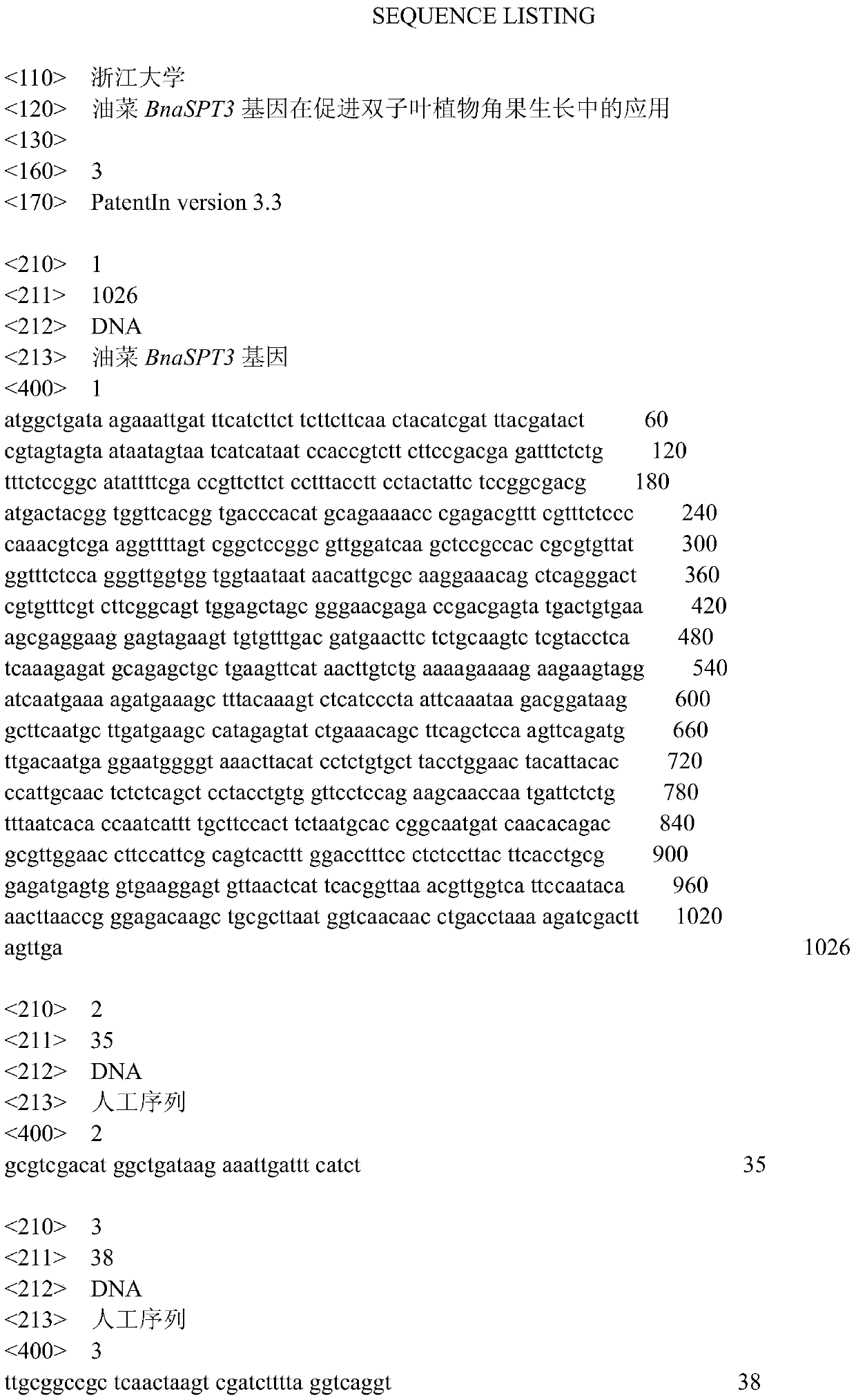
[0035] Primer 1: 5'-GCGTCGACATGGCTGATAAGAAATTGATTTCATCT-3';
[0036] Primer 2: 5'-TTGCGGCCGCTCAACTAAGTCGATCTTTTAGGTCAGGT-3'.
[0037] (3) Perform PCR amplification using the full-length cDNA as a template.
[0038] high fidelity enzyme HS DNA Polymerase (TaKaRa Code: DR010A) system:
[0039] 5×PrimeSTAR Buffer (Mg 2+ plus) 10 μL,
[0040] dNTP Mixture (2.5mM each) 4μL,
[0041] Prime...
Embodiment 2
[0059] The character observation of embodiment 2 Arabidopsis siliques
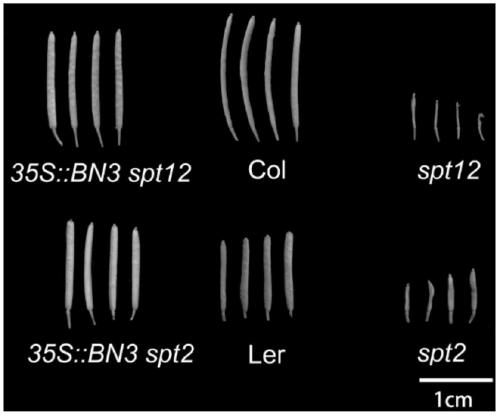
[0060] The siliques of Arabidopsis spt2 and spt12 mutants are shorter than those of the wild type, and are relatively flat in the middle near the top. We selected spt2 and spt12 mutants as transgene recipients.
[0061] Carry out silique length measurement record to the obtained transgenic Arabidopsis plant, such as figure 1 As shown, overexpression of the rape BnaSPT3 gene (sequence shown in SEQ ID NO.1) in Arabidopsis silique dysplasia mutants significantly increases the length of the mutant siliques and restores them to wild-type levels.
[0062] With the help of genetic engineering technology, the functional gene can be overexpressed in the recipient, and the size of the silique can be improved, which is helpful for high-yield research.
Embodiment 3
[0064] In order to detect whether the overexpression of the rapeseed gene BnaSPT3 can promote the growth of Arabidopsis wild-type siliques, we also conducted functional verification using the Arabidopsis wild-type plant Columbia as the transgenic receptor in Example 1.
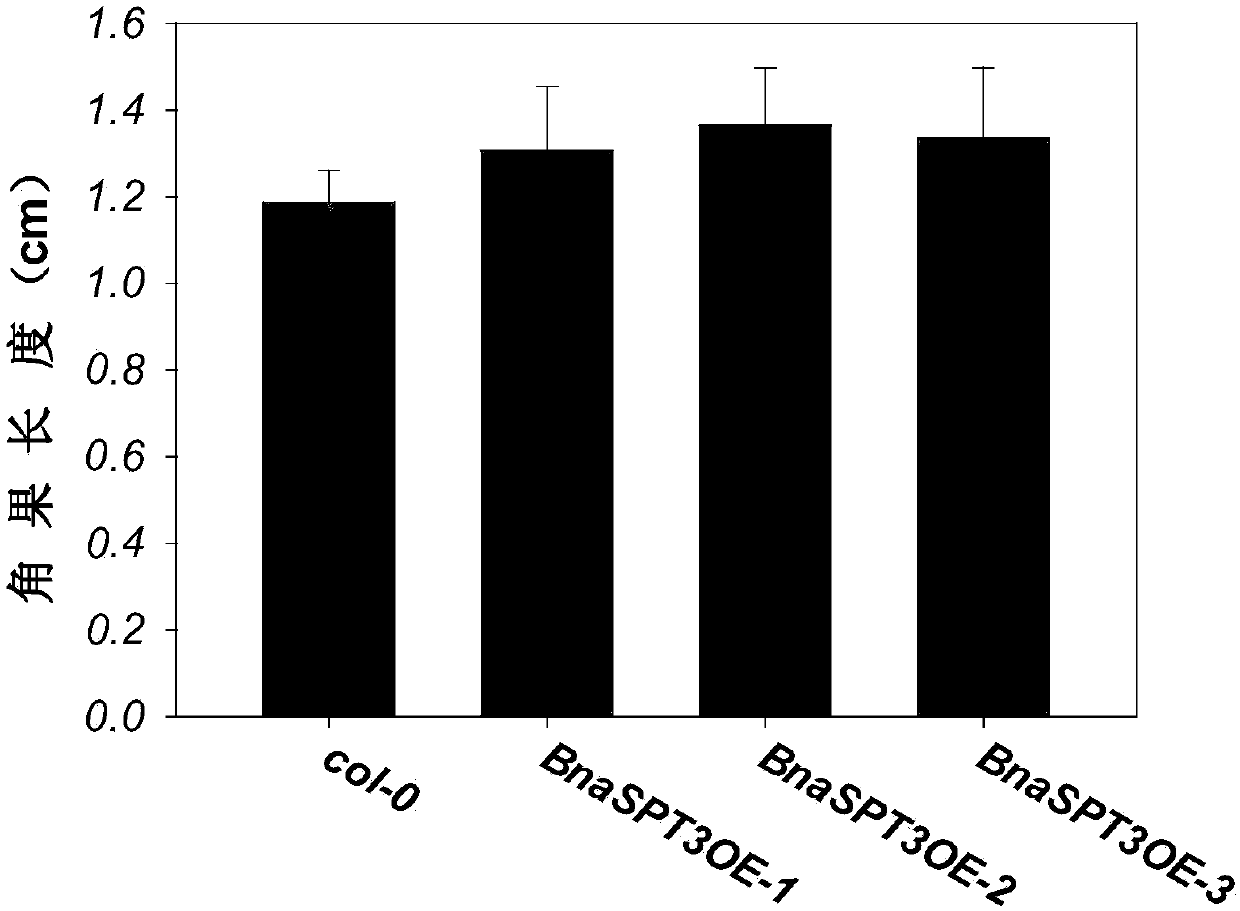
[0065] The harvested transgenic Arabidopsis plants were measured and recorded for the length of siliques, and the statistical results were as follows: figure 2 shown. Overexpression of rapeseed BnaSPT3 gene in Arabidopsis wild-type can promote the growth of siliques, which are significantly larger than untransformed Arabidopsis wild-type plants.
[0066] Our experimental results took the model plant Arabidopsis as the background, and proved that the BnaSPT3 gene of rapeseed can promote the growth of dicotyledonous siliques.
[0067]
PUM
 Login to View More
 Abstract
Description
Claims
Application Information
 Login to View More