Double-sparse dictionary learning-based seismic data denoising method

A technique for sparse dictionaries and seismic data, applied in electrical digital data processing, special data processing applications, informatics, etc., can solve problems such as large calculation amount, increased calculation amount, and restricted application, so as to improve accuracy and signal-to-noise ratio , the effect of reducing computational complexity

Inactive Publication Date: 2017-11-21
CHINA UNIV OF PETROLEUM (EAST CHINA)
View PDF2 Cites 12 Cited by
  • Summary
  • Abstract
  • Description
  • Claims
  • Application Information

AI Technical Summary

Problems solved by technology

[0003] The K-SVD dictionary learning algorithm uses the seismic data itself as a sample, and can adaptively train a super-complete dictionary according to sparse constraints. Compared with traditional complete dictionaries (such as DCT dictionary and wavelet dictionary), this dictionary can adaptively Extract features from training samples, so it has stronger sparse representation ability; but it often requires a large amount of calculation, and with the increase of data size, the amount of calculation also increases significantly, which seriously restricts its actual production. application in

Method used

the structure of the environmentally friendly knitted fabric provided by the present invention; figure 2 Flow chart of the yarn wrapping machine for environmentally friendly knitted fabrics and storage devices; image 3 Is the parameter map of the yarn covering machine
View more

Image

Smart Image Click on the blue labels to locate them in the text.
Viewing Examples
Smart Image
  • Double-sparse dictionary learning-based seismic data denoising method
  • Double-sparse dictionary learning-based seismic data denoising method
  • Double-sparse dictionary learning-based seismic data denoising method

Examples

Experimental program
Comparison scheme
Effect test

Embodiment

[0131] Above-mentioned method of the present invention can be summarized as:

[0132] (1) Extract partial gathers from the complete noisy seismic records as training samples.

[0133] (2) Select the DCT dictionary as the base dictionary.

[0134] (3) Batch-OMP algorithm is used to solve the formula for sparse coding.

[0135] (4) Dictionary updating via double sparse dictionary learning.

[0136](5) Judging whether the iteration termination condition is met, if the condition is not met, return to step 3. If so, the iteration terminates and the dictionary is output.

[0137] (6) The complete noisy seismic records are divided into blocks, and each sub-block is sparsely represented according to the learned dictionary.

[0138] (7) Output the denoising result.

[0139] The main technical key points are: ①Batch-OMP algorithm; ②Double dictionary learning algorithm.

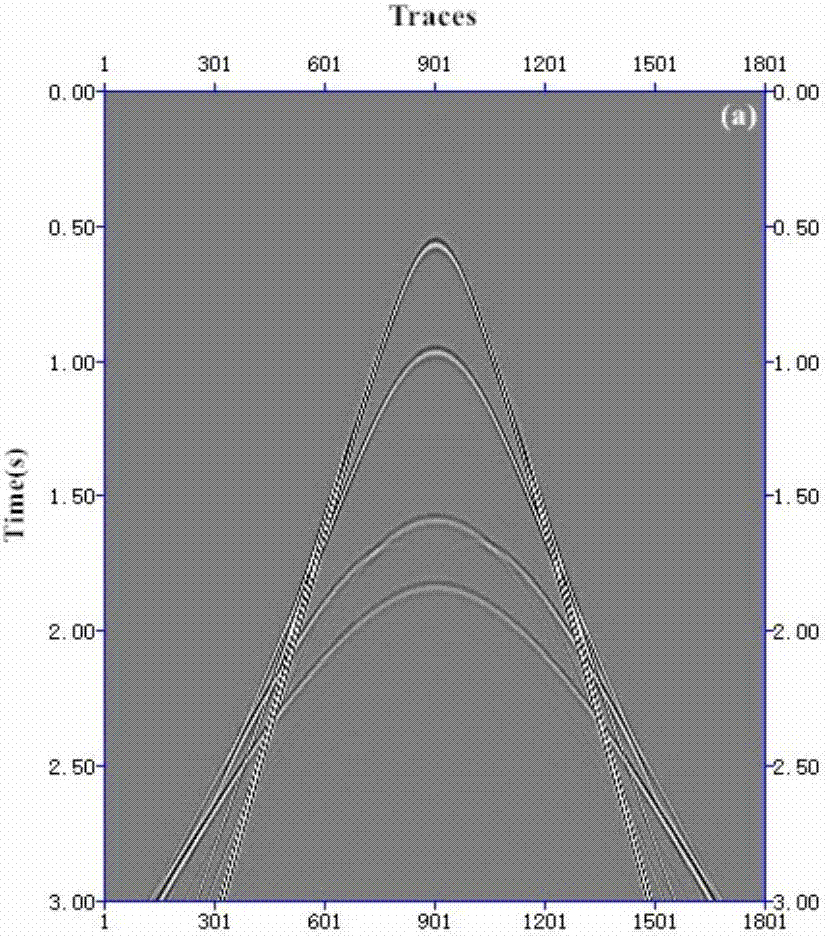
[0140] The research of this embodiment is tested with a synthetic single-shot record. The model parameters are...

the structure of the environmentally friendly knitted fabric provided by the present invention; figure 2 Flow chart of the yarn wrapping machine for environmentally friendly knitted fabrics and storage devices; image 3 Is the parameter map of the yarn covering machine
Login to View More

PUM

No PUM Login to View More

Abstract

The invention discloses a double-sparse dictionary learning-based seismic data denoising method. The method comprises the following steps of: expressing seismic data with random noise as a formula 2 on the basis of compressed sensing and a sparse expression theory; expressing a sparse dictionary as a formula 4; expressing a target function of double-sparse dictionary learning as a formula 5; and solving a sparse dictionary according to the formula 4 and applying the sparse dictionary in the formula 2. In the method of solving the sparse dictionary according to the formula 4, a sparse K-SVD algorithm and a Batch-OMP algorithm after optimizing large-calculation amount steps and large-scale data are adopted. According to the method, the denoising of seismic data is realized through a double-sparse dictionary learning manner, so that the signal to noise ratio is improved, the problem that the calculation amount is greatly increased along with the increase of the data scale in the prior art is overcome, the calculation complexity of dictionary learning is reduced, the precision of the denoising result is improved, and more effective and reliable application is provided in practical production.

Description

technical field [0001] The invention belongs to the field of oil and gas exploration seismic data processing, in particular to a seismic data denoising method based on double sparse dictionary learning, which can effectively remove random noise of seismic data. Background technique [0002] Improving the signal-to-noise ratio is one of the key tasks in seismic data processing. The traditional transform domain method uses a transformation to sparsely represent the seismic data to remove random noise and improve the signal-to-noise ratio; however, due to the complexity of the seismic signal, the sparse dictionary composed of a single basis transformation often cannot perform effective sparse representation. It will affect the denoising results, so scholars have proposed a dictionary learning method. The basic principle of dictionary learning is to use the signal itself to train the dictionary. In the process of updating the dictionary, adaptively obtain the atoms that reflect...

Claims

the structure of the environmentally friendly knitted fabric provided by the present invention; figure 2 Flow chart of the yarn wrapping machine for environmentally friendly knitted fabrics and storage devices; image 3 Is the parameter map of the yarn covering machine
Login to View More

Application Information

Patent Timeline
no application Login to View More
IPC IPC(8): G06F19/00
CPCG16Z99/00
Inventor张凯李振春田鑫
OwnerCHINA UNIV OF PETROLEUM (EAST CHINA)