Fluoro-alkyl sulfonamide additive for promoting film formation of graphite carbon anode and electrolyte containing fluoro-alkyl sulfonamide additive

A fluoroalkylsulfonimide, negative electrode film forming technology, applied in circuits, electrical components, secondary batteries, etc., can solve problems such as deterioration, unstable VC, high price, etc., to reduce consumption and prevent co-embedding , the effect of improving safety performance

CN107706454AActive Publication Date: 2018-02-16SOUTH CHINA NORMAL UNIVERSITY +1
6 Cites 7 Cited by

Patent Information

Authority / Receiving Office
CN · China
Current Assignee / Owner
Publication Date
2018-02-16

Smart Images

  • Figure 1
    Figure 1
  • Figure 2
    Figure 2
  • Figure 3
    Figure 3
Patent Text Reader

Abstract

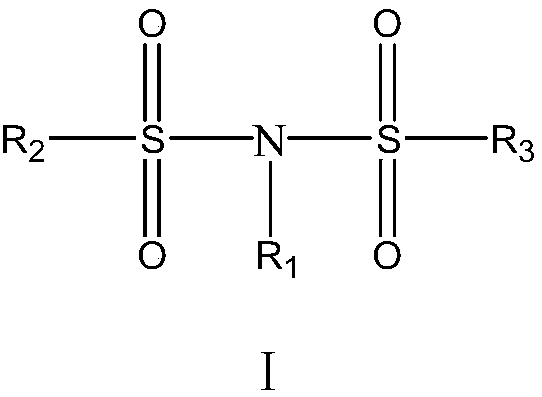
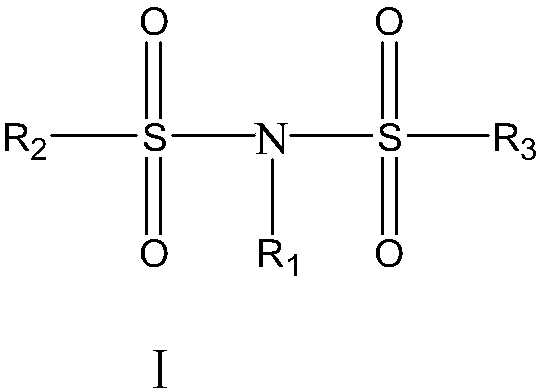
The invention discloses a fluoro-alkyl sulfonamide additive, with a structural formula as shown in a formula I, for a lithium-ion battery electrolyte for promoting film formation of a graphite carbonanode; the formula I is as shown in the specification, wherein R1 is hydrogen, a benzene ring and a pentabasic or hexahydric heterocyclic group; the pentabasic or hexahydric heterocyclic group is selected from furan, thiophene, pyrrole, thiazole, imidazole, pyridine, pyrazine, pyrimidine and pyridazine; and R2 and R3 are F atoms or fluorinated alkyl of which 1-3 hydrogen atoms in methyl, ethyl andpropyl are substituted by F. The performance of an SEI film formed by the fluoro-alkyl sulfonamide additive is superior to that of an SEI film formed by VC, the cycling stability of the graphite carbon anode is better improved, the safety performance of a lithium-ion battery is improved and the fluoro-alkyl sulfonamide additive has good practicability and economic value.
Need to check novelty before this filing date? Find Prior Art

Description

Technical field:

[0001] The invention relates to the field of lithium-ion battery electrolytes, in particular to a fluoroalkylsulfonimide additive for promoting the film formation of a graphite carbon negative electrode and an electrolyte containing the additive. Background technique:

[0002] Lithium-ion batteries (LIBs) have become the main power source of consumer electronics due to their high energy density and long cycle life, and also show promising applications in fields such as electric vehicles, power tools, and energy storage. Graphite carbon materials are currently the most commonly used anode materials for commercial lithium-ion batteries, with stable cycle performance and high safety performance. Lithium deposition in graphitic carbon materials usually cannot be completely avoided under low electrochemical potential conditions. In particular, obvious lithium dendrites are generated on the surface of graphitic carbon materials under high current density charging...

Examples

Embodiment 1

[0019] In a glove box filled with argon, ethylene carbonate (EC), dimethyl carbonate (DMC) and ethyl methyl carbonate (EMC) were mixed in a weight ratio of EC:DMC:EMC=1:1:1, solvent The mass percentage is 87%, using lithium hexafluorophosphate as lithium salt, its concentration is 1mol / L (mass fraction is 12.5%), and the film-forming additive N-phenylbis(trifluoromethanesulfonyl) of 0.5wt.% is added thereto ) imine (PhTFSI), mixed uniformly to obtain the electrolyte solution of Example 1.

Embodiment 2

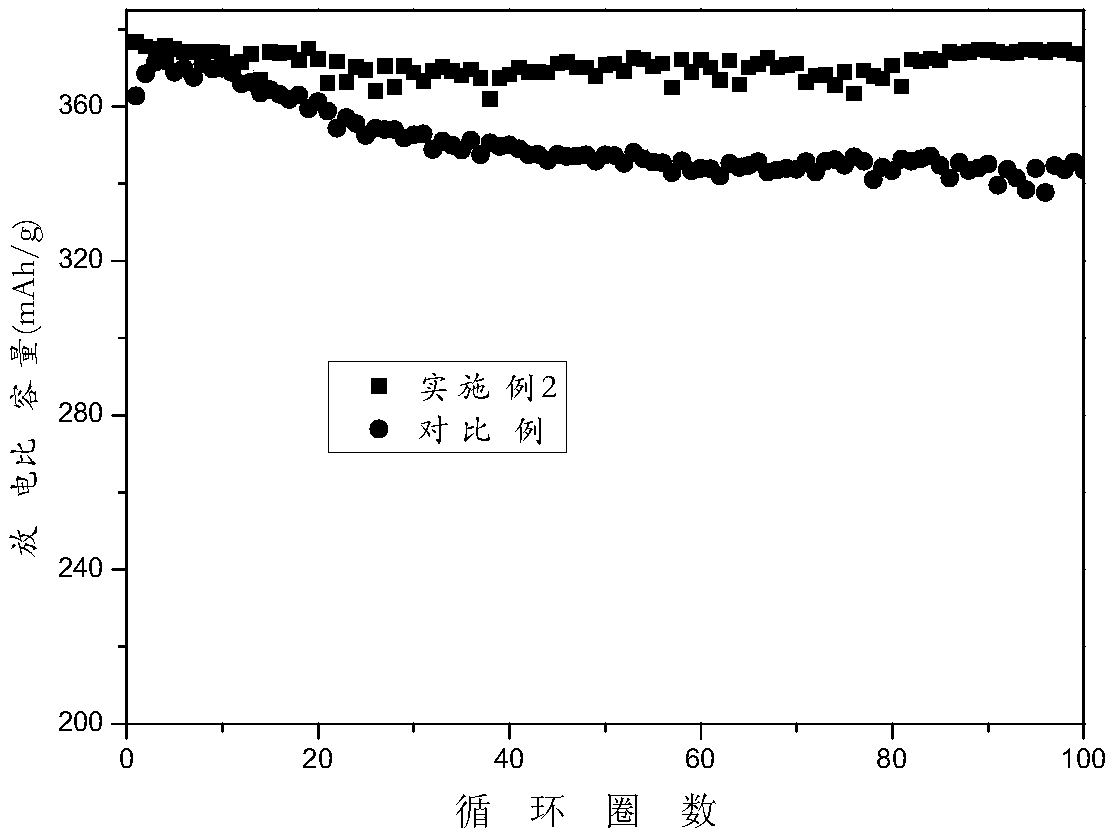
[0023] The electrolyte preparation method refers to Example 1, the difference is that 1.0 wt% of film-forming additive N-phenylbis(trifluoromethanesulfonyl)imide (PhTFSI) is added to the electrolyte.

Embodiment 3

[0025] The electrolyte solution preparation method refers to Example 1, the difference is that 0.5 wt% film-forming additive bis(trifluoromethanesulfonyl)imide (HTFSI) is added to the electrolyte solution.