
Quick calculation method based on Zernike moment of GPU
A fast calculation and algorithm technology, applied in the field of orthogonal moment acceleration, can solve the problems of complex optimization process, and achieve the effect of overcoming the small amount of calculation, shortening the calculation time, and achieving a significant acceleration effect.
- Summary
- Abstract
- Description
- Claims
- Application Information
AI Technical Summary
Problems solved by technology
Method used
Image



Examples
Embodiment Construction
[0040] The present invention is described below in conjunction with accompanying drawing.
[0041] 1. A hybrid algorithm that stores radial polynomial coefficients combined with image re-layout gossip-limited symmetry algorithms
[0042] 1.1 Store the polar diameter and polar angle values of the first hexagram limit
[0043] figure 1 The mapping transformation of mapping an N×N image coordinate [i, j] to an inscribed unit circle [x, y] in Cartesian coordinates is illustrated. The number in each square represents the address index of the pixel. The normalized coordinates are:
[0044]
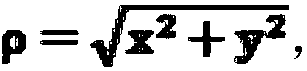
[0045] Wherein, i=tid%8, k=tid / 8, tid is a thread index, and its value ranges from 0 to 63. according to figure 2 The read order shown in (b) loads the index values using figure 2 Calculate the corresponding polar radius ρ and polar angle θ for the address index value in the first hexagram limit in (a). Its calculation result is as figure 2 (d), store them in global memory.
...
PUM
 Login to View More
 Abstract
Description
Claims
Application Information
 Login to View More