Anti-human CD25 chimeric monoclonal antibody and preparation method and application thereof
A monoclonal antibody, chimeric antibody technology, applied in the preparation of antibodies, anti-human CD25 chimeric monoclonal antibody and its preparation field, can solve problems such as inability to regulate T cell proliferation
- Summary
- Abstract
- Description
- Claims
- Application Information
AI Technical Summary
Problems solved by technology
Method used
Image

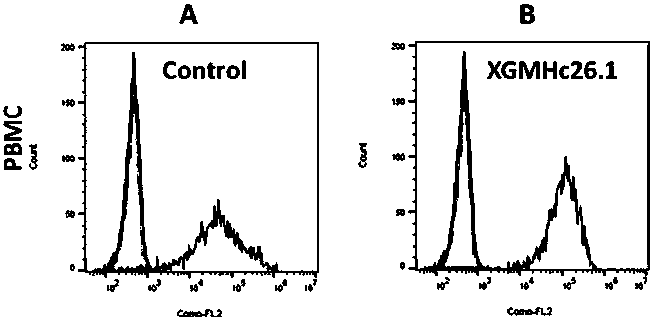
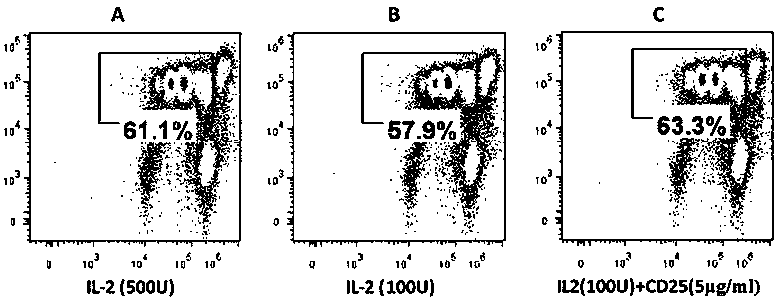
Examples
Embodiment 1
[0052] Example 1 Obtaining of Hybridomas Producing CD25 Monoclonal Antibodies
[0053] (1) Immune mice
[0054] Mice were immunized with fusion protein or transgenic cells, immunized four times with an interval of 21 days each time, and the orbital blood titer of the mice was measured 7-10 days after the fourth immunization.
[0055] (2) Cell culture
[0056] 1. One day before fusion, take one BALB / c mouse aged 6-7 weeks and place it in 75% ethanol solution for 2 minutes.
[0057] 2. The mouse spleen was aseptically taken out, placed in a 200-mesh stainless steel screen, and ground to obtain a single cell suspension. Wash twice with 1640 basal medium (1400rpm, 5min) for later use. Use 15% FBS 1640 medium to adjust the cell concentration to 2×10 5 / ml, drop into 96-well culture plate, 100μL per well, 37℃, 5%CO 2 cultured in an incubator.
[0058] 3. Cultivate overnight, and observe under a low-power microscope the next day. And spread subcloned cells 150ul.
[0059] (3)...
Embodiment 2
[0073] Example 2 CD25 mouse / human chimeric antibody acquisition method
[0074] 1. Extract the cDNA of hybridoma cells: extract RNA from the hybridoma cell line, and use RT-PCR technology to reverse-transcribe the obtained RNA into cDNA; use specially designed upstream and downstream primers to PCR clone the hybridoma cells chain variable region (mVH) and light chain variable region (mVL);
[0075] 2. mVH and mVL were respectively connected to the cloning vector (pJET cloning vector), and the connection product was transformed into competent bacteria DH5a. Since the pJET vector carries the ampicillin (Amp+) resistance gene, the transformed bacteria can be coated on the Amp-resistant LB solid culture medium, 37 ° overnight culture;
[0076] 3. The bacteria to be plated grow scattered colonies, select colonies with clear edges and good growth, and further sequence and identify them;
[0077] 4. According to the sequencing results, the candidate heavy and light chain variable r...
Embodiment 3
[0087] 1. Isolation and extraction of PBMC
[0088] Aseptically draw the blood in the apheresis platelet leukocyte filter, hereinafter referred to as filter blood, and dilute it with PBS 1:20; take normal heparin anticoagulated peripheral blood from the same individual, hereinafter referred to as peripheral blood, and dilute it with PBS 1:2; The above-mentioned diluted filter blood and peripheral blood were separated by conventional Ficoll to obtain PBMC, washed 2 times with PBS, counted, and the cell density was adjusted to 1x10⁶ / ml with RPMI-1640 containing 10% FBS for later use, respectively, whole blood PBMC Cells and filter blood PBMC cells.
[0089] 2. CFSE-labeled cells
[0090] The method of using CFSE labeling to detect the expansion of human peripheral blood T cells in vitro is to take an appropriate amount of separated human peripheral blood mononuclear cells (PBMC) in an appropriate amount of CFSE working solution, mix them gently, and then place them in a water b...
PUM
 Login to View More
 Abstract
Description
Claims
Application Information
 Login to View More
 - R&D
- Intellectual Property
- Life Sciences
- Materials
- Tech Scout
- Unparalleled Data Quality
- Higher Quality Content
- 60% Fewer Hallucinations
Browse by: Latest US Patents, China's latest patents, Technical Efficacy Thesaurus, Application Domain, Technology Topic, Popular Technical Reports.
© 2025 PatSnap. All rights reserved.Legal|Privacy policy|Modern Slavery Act Transparency Statement|Sitemap|About US| Contact US: help@patsnap.com