
Kit for early screening and detecting carcinoma of urinary bladder by demethylation fluorescent quantitation PCR method
A kit and bladder cancer technology, applied in the field of molecular biology, can solve the problems of inability to carry out early diagnosis, low clinical detection rate, and low sensitivity, so as to reduce detection blind spots and missed diagnoses, facilitate amplification conditions, and detect sensitively sex high effect
- Summary
- Abstract
- Description
- Claims
- Application Information
AI Technical Summary
Problems solved by technology
Method used
Image

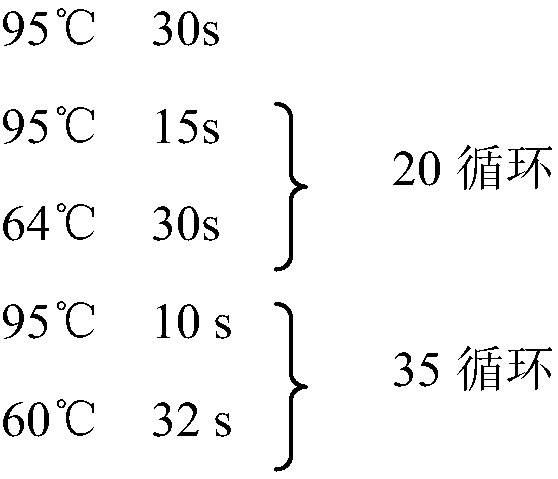

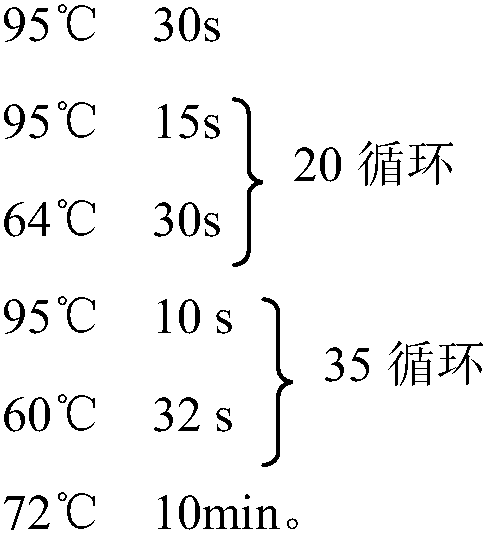
Examples
Embodiment 1
[0037] Example 1 Design of primers and probes for detecting the methylation level of bladder cancer urine precipitate cells
[0038]According to the human whole genome sequence p16 and RASSF1A gene sequence published by National Center for Biotechnology Information (NCBI), the present invention designs primers, the primers are synthesized by TAKARA (Treasure Bioengineering Co., Ltd.), and the probes are synthesized by LifeTechnologies.
[0039] (1) Detect the nucleic acid sequence of p16 gene fragment methylation (FAM fluorescence channel)
[0040] The forward primer sequence is SEQ ID NO.1 (5'-AGCGGGCGGCGGGGAGTAGTA-3'),
[0041] The reverse primer sequence is SEQ ID NO.2 (5'-AGTCGGCGGCGGGGAGTAGTATG-3'),
[0042] The fluorescent probe sequence is SEQ ID NO.3 (5'-FAM-GATTGGTTGGTTACGGTCGCGGTT-MGB-3');
[0043] The 5' end of the fluorescent probe SEQ ID NO: A3 is labeled with FAM (fluorescence reporter group), and the 3' end is labeled with MGB (fluorescence quencher group).
...
Embodiment 2
[0048] Embodiment 2 A kind of test kit
[0049] The kit includes primers and probes for the above two target genes of p16 and RASSF1A; in addition, it also includes forward primers and probes for detecting GAPDH, PCR Master Mix, lysate, proteinase K, rinse solution, bisulfite solution and ddH 2 O.
[0050] The forward primer sequence of p16 is shown in SEQ ID NO.1, the reverse primer sequence is shown in SEQ ID NO.2; the fluorescent probe sequence is SEQ ID NO.3, the 5' end of the probe is labeled with FAM, 3 ' end labeled MGB.
[0051] The forward primer sequence of RASSF1A is shown in SEQ ID NO.4, the reverse primer sequence is shown in SEQ ID NO.5; the fluorescent probe sequence is SEQ ID NO.6, the 5' end of the probe is labeled with FAM, 3 ' end labeled MGB.
[0052] Forward primers and probes for detecting GAPDH can be primers and probes known in the art.
Embodiment 3
[0053] The using method of kit described in embodiment 3
[0054] (1) Extraction of genomic DNA from urine precipitated cells: take the patient's urine precipitated cells, use lysate, proteinase K, rinse solution and ddH 2 O is extracted to obtain a genomic DNA solution;
[0055] The specific steps are:
[0056] Aspirate 200 μL of urine sample, put it into a 1.5mL centrifuge tube, add 1mL Lysis Solution 1, then continue to vortex and shake for 1min, and then place the 1.5mL centrifuge tube in a 70°C water bath for 5min.
[0057] Take the 1.5mL centrifuge tube out of the water bath, centrifuge at 12,000rpm for 5min, and slowly pipette 300μL of the supernatant into a new 1.5mL centrifuge tube.
[0058] Add 200 μL Lysis Solution 2 and 20 μL Proteinase K to a new 1.5 mL centrifuge tube in sequence, and vortex to mix.
[0059] Place a new 1.5mL centrifuge tube in a 70°C water bath for 10min.
[0060] Add 200 µL of isopropanol and vortex to mix.
[0061] Put all the solution ob...
PUM
| Property | Measurement | Unit |
|---|---|---|
| Sensitivity | aaaaa | aaaaa |
| Sensitivity | aaaaa | aaaaa |
| Sensitivity | aaaaa | aaaaa |
Abstract
Description
Claims
Application Information
 Login to View More