
Industrial process fault diagnosis method based on high order correlation
An industrial process and fault diagnosis technology, applied in the direction of instruments, electrical testing/monitoring, control/regulation systems, etc., can solve problems such as unbalanced fault data categories, complex industrial process systems, etc., achieve effective fault detection and identification, and is conducive to The effect of safe operation
- Summary
- Abstract
- Description
- Claims
- Application Information
AI Technical Summary
Problems solved by technology
Method used
Image

Examples
Embodiment Construction
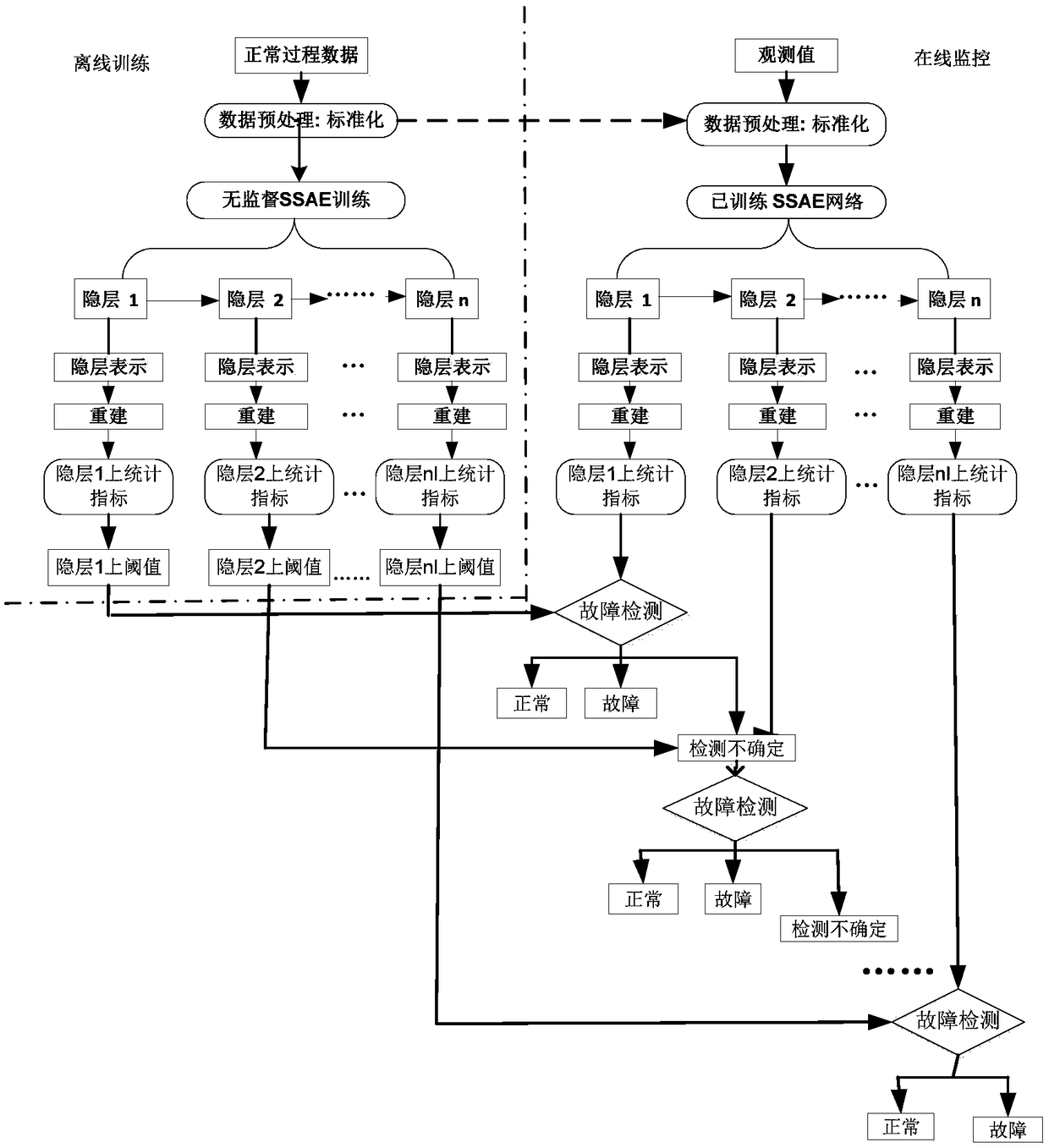
[0040] The method proposed by the present invention includes two parts of off-line modeling and on-line monitoring, and its flow chart is as follows image 3 shown.
[0041] The offline part of the method is as follows:
[0042] Step 1: Use the collection of all monitoring quantities collected under normal operating conditions in industrial processes (such as pressure values, concentration values, feed ratios, etc. in chemical processes) as the training set X train , after standardized preprocessing based on its mean and variance, we get
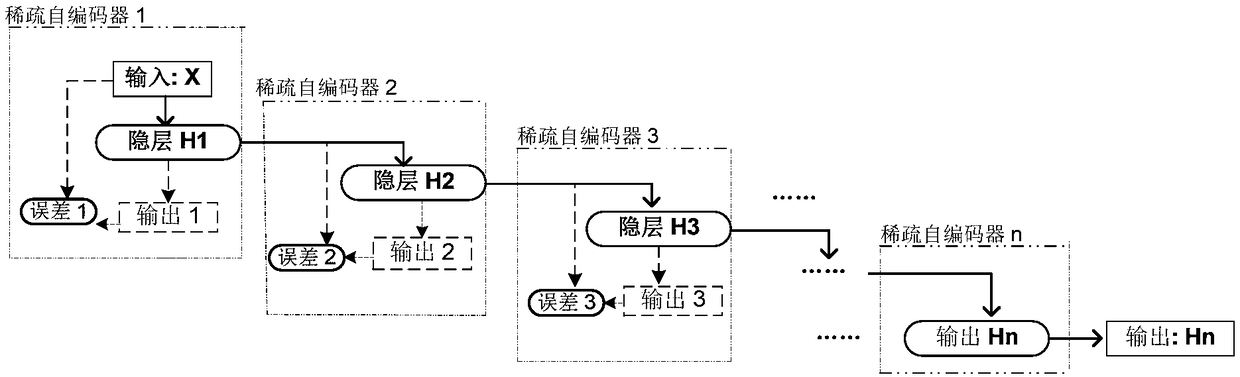
[0043] Step 2: Set the initialization structure parameters of the stacked sparse autoencoder network, and initialize its connection parameters randomly at the same time;
[0044] Step 3: Use layer-by-layer greedy method to train network parameters, including network structural parameters and weights, and end training until the cost function is minimized;
[0045] Step 4: The final output of the stacked autoencoder network is the high-or...
PUM
 Login to View More
 Abstract
Description
Claims
Application Information
 Login to View More