A Time-Frequency Analysis Method in Resonance Imaging Based on Seismic Data
A technology of resonance imaging and seismic data, applied in the field of exploration, can solve problems such as non-unique solutions, noise interference, inappropriateness, etc.
- Summary
- Abstract
- Description
- Claims
- Application Information
AI Technical Summary
Problems solved by technology
Method used
Image

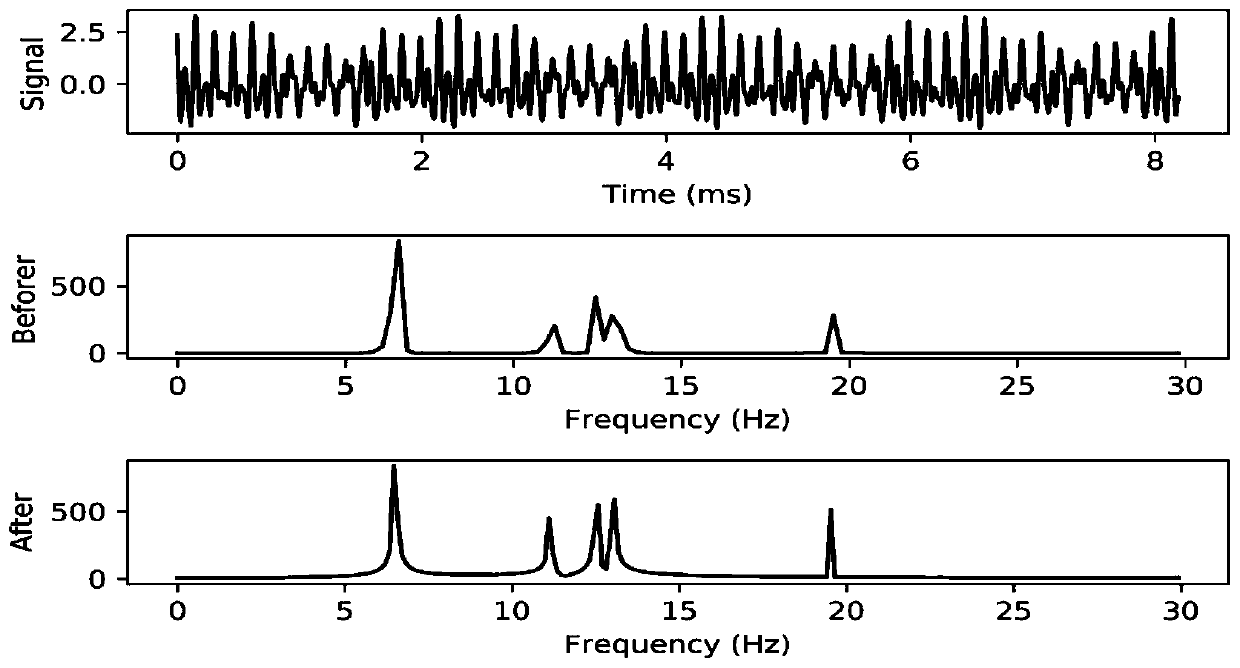


Examples
Embodiment Construction
[0024] We can reduce the problem of time-frequency analysis of seismic surface waves to the following equation:
[0025] Mf=d (1)
[0026] Among them, f represents the frequency coefficient, d represents the seismic surface wave data with noise, M represents the kernel matrix of real or complex sinusoidal basis functions,
[0027] M(t,x)=cos(2π·k·Δx·n·Δt)+isin(2π·k·Δx·n·Δt) (2)
[0028] Among them, k represents the frequency domain sampling index, Δx represents the frequency increment, n represents the time sampling index, and Δt represents the time increment.
[0029] The solution to the above formula can generally be obtained by the following formulas (3) and (4):
[0030] m * Mf=M * f (3)
[0031] f=(M * M) ―1 m * d (4)
[0032] If M is an orthogonal matrix, then M * M=I, at this moment the least squares solution of formula (1) can be by f=M * d is obtained, that is, the discrete Fourier transform (DFT). However, in actual seismic data, the elements of M are usu...
PUM
 Login to View More
 Abstract
Description
Claims
Application Information
 Login to View More