
SNP molecular markers and methods, primer compositions, kits and applications for the identification of mycobacteria
A technique of primer composition and mycobacteria, applied in the direction of microorganism-based methods, biochemical equipment and methods, microorganisms, etc., can solve the problem of long time, different resolution and clustering rate, and easy false positives in picture results and other issues to achieve the effect of improving accuracy
- Summary
- Abstract
- Description
- Claims
- Application Information
AI Technical Summary
Problems solved by technology
Method used
Image

Examples
Embodiment 1
[0087] This embodiment provides a primer composition for identifying mycobacteria, including a primer pair Myco1, a primer pair Myco2 and a primer pair Myco3, as shown in Table 4.
[0088] Table 4 Primer pair Myco1, primer pair Myco2 and primer pair Myco3
[0089]
Embodiment 2
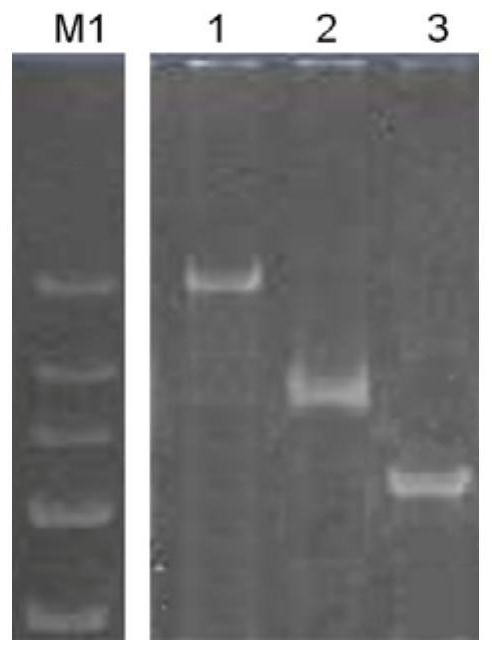
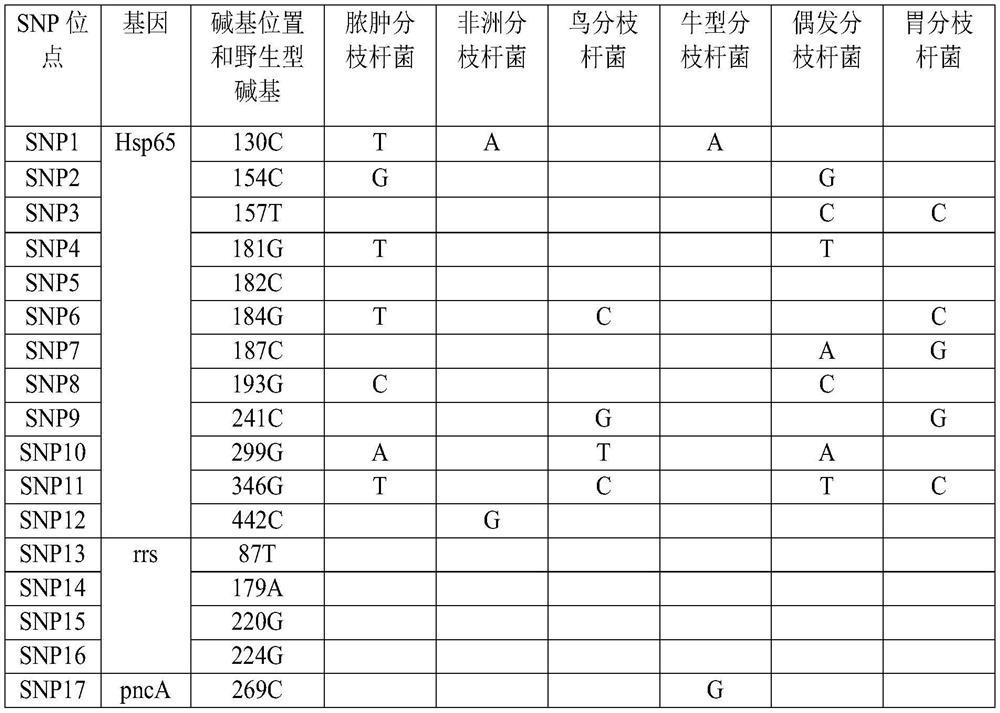
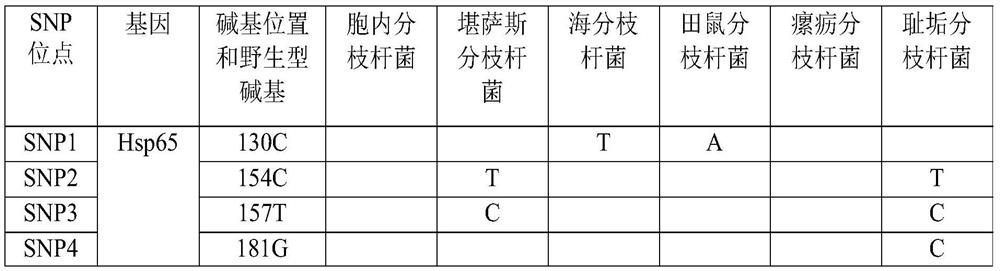
[0091] The primer compositions provided in Example 1 were used to identify 18 species of mycobacteria, including M. tuberculosis (ATCC 27294), M. bovis (ATCC 19210) and Tian who belong to the Mycobacterium tuberculosis complex Mycobacterium murine M. Microti (ATCC 19422); also Mycobacterium avium (ATCC 25291) belonging to non-tuberculous mycobacteria (MOTT) outside the Mycobacterium tuberculosis complex. All strains were kept in the Beijing Tuberculosis Clinical Data and Sample Repository of Beijing Chest Hospital Affiliated to Capital Medical University.
[0092] Using the genomic DNA of the tested strain as a template, the primer pair designed in Example 1 was used for PCR amplification.
[0093] PCR reaction: use the three sets of primer pairs in Table 4, and use a conventional PCR reaction system. The reaction system is as follows: the total volume is 20 μl, including 2×Premix Taq (Code No.: R004A, Takara Company, Premix is made of DNA Polymerase, Buffer , 2 times the c...
Embodiment 3
[0098] The present embodiment provides a method for identifying mycobacteria, comprising the steps of:
[0099] 1. For the collection of clinical sputum samples, use the QIAamp DNA Mini Kit (CAT.No.51304) to extract DNA through pretreatment;
[0100] 2. PCR reaction: use the primer pairs of the three groups in Table 4, and adopt a conventional PCR reaction system. The reaction system is as follows: the total volume is 20 μl, including 2×Premix Taq (Code No.: R004A, Takara Company, Premix is produced by DNAPolymerase , Buffer, dNTP Mixture) 10 μl, 10 μM upstream and downstream primers each 1 μl (final concentration is 0.5 μM), 1 μl DNA template, supplemented with 7 μl of double distilled water to 20 μl system.
[0101] Reaction conditions: 94°C for 5 min, 30 cycles: 94°C for 45 sec, 60°C for 45 sec, 72°C for 50 sec, and a final extension at 72°C for 7 min. The same annealing temperature is used for the primers, which reduces the operation steps and saves the time for identif...
PUM
 Login to View More
 Abstract
Description
Claims
Application Information
 Login to View More