Third-order low-rank tensor completion method based on GPU
What is AI technical title?
AI technical title is built by PatSnap AI team. It summarizes the technical point description of the patent document.
A third-order tensor and completion technology, which is applied in the field of high-performance computing, can solve the problems of unsuitable large-scale tensor processing and running time increase, and achieve the effect of improving computing efficiency and improving computing efficiency
Pending Publication Date: 2019-07-26
SHANGHAI UNIV
View PDF3 Cites 2 Cited by
Summary
Abstract
Description
Claims
Application Information
AI Technical Summary
This helps you quickly interpret patents by identifying the three key elements:
Problems solved by technology
Method used
Benefits of technology
Problems solved by technology
In general, the CPU-based third-order low-rank tensor data completion method, the running time increases exponentially with the size of the tensor, so it is not suitable for processing large-scale tensors
Method used
the structure of the environmentally friendly knitted fabric provided by the present invention; figure 2 Flow chart of the yarn wrapping machine for environmentally friendly knitted fabrics and storage devices; image 3 Is the parameter map of the yarn covering machine
View more
Image
Smart Image Click on the blue labels to locate them in the text.
Viewing Examples
Smart Image
Click on the blue label to locate the original text in one second.
Reading with bidirectional positioning of images and text.
Smart Image
Examples
Experimental program
Comparison scheme
Effect test
Embodiment 1
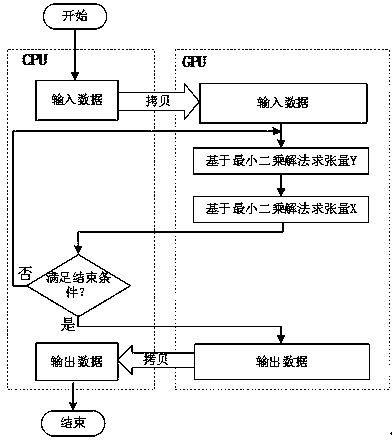
[0045] A GPU-based third-order low-rank tensor completion method, the steps are as follows figure 1 shown, including:
[0046] Step 1: The CPU transmits the input data DATA1 to the GPU, and the number of initialization cycles l=1;
[0047] Step 2: GPU obtains a third-order tensor Y of a current cycle l based on the least squares solution l ;
[0048] Step 3: GPU obtains a third-order tensor X of the current cycle l based on the least squares solution l ;
[0049] Step 4: The CPU checks whether the end condition is satisfied, if it is satisfied, go to step 5, otherwise, increase the number of cycles l by 1 and go to step 2 to continue the loop;
[0050]Step 5: The GPU transmits the output data DATA2 to the CPU.
Embodiment 2
[0051] Embodiment 2: This embodiment is basically the same as Embodiment 1, and the special features are as follows:
[0052] The step 1 includes:
[0053] Step 1.1: Allocate space in GPU memory;
[0054] Step 1.2: Transfer the input data DATA1 in the CPU memory to the allocated space in the GPU memory. DATA1 contains the following data:
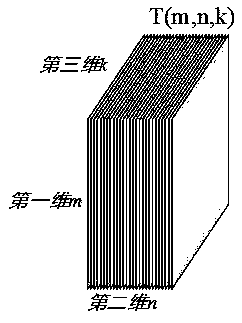
[0055] (1) A third-order tensor T∈R to be completed m×n×k . R represents a real number, and m, n, and k are the sizes of the first, second, and third dimensions of the tensor T, respectively. The total number of elements of this tensor is m×n×k, and the tensor elements whose first, second, and third dimensions are i, j, and k respectively are recorded as T i,j,k .
[0056] (2) An observation set S∈o×p×q, and o≤m, p≤n, q≤k.
[0057] (3) An observation set S and tensor T∈R to be completed m×n×k The observation tensor TP ∈ R m×n×k . TP is obtained by using the observation function ObserveS() on T, that is, TP=ObserveS(T). Among them,...
the structure of the environmentally friendly knitted fabric provided by the present invention; figure 2 Flow chart of the yarn wrapping machine for environmentally friendly knitted fabrics and storage devices; image 3 Is the parameter map of the yarn covering machine
Login to View More
PUM
Login to View More
Abstract
The invention provides a third-order low-rank tensor completion method based on a GPU. The method comprises the following operation steps that (1) a CPU transmits input data DATA1 to a GPU, and the number of cycles is initialized; (2) the GPU obtains a third-order tensor of a current cycle based on a least square solution; (3) the GPU obtains a third-order tensor of a current cycle based on a least square solution; (4) the CPU checks whether an end condition is met, and if yes, the step (5) is executed, otherwise, the number of cycles is increased by one, and the step (2) is excuted to continue to circulate; and (5) the GPU transmits the output data DATA2 to the CPU. According to the method, the GPU is used for accelerating the calculation task of three-order low-rank tensor completion medium-high concurrencyprocessing, so that the calculation efficiency is improved. Compared with traditional CPU-based third-order low-rank tensor completion, the method has the advantages that the calculation efficiency is obviously improved, and the same calculation can be completed within a short time.
Description
technical field [0001] The invention relates to the technical field of high-performance computing, in particular to a GPU (GraphicsProcessing Unit)-based third-order low-rank tensor completion method. Background technique [0002] High-dimensional data in the real world can be naturally represented by tensors. Data loss often occurs in the transmission of wireless sensors, so the obtained sensing data is often incomplete. In scenarios where computing and network resources are limited, people use partial measurements to reduce the amount of data to be processed and transmitted, which can also lead to incomplete data. How to recover complete data from these incomplete data is a research hotspot in recent years. A common approach is to model incomplete data as low-rank tensors, and then exploit redundant features in the data for recovery. [0003] The present invention mainly focuses on data completion of third-order low-rank tensors. Existing studies have proposed some CP...
Claims
the structure of the environmentally friendly knitted fabric provided by the present invention; figure 2 Flow chart of the yarn wrapping machine for environmentally friendly knitted fabrics and storage devices; image 3 Is the parameter map of the yarn covering machine
Login to View More
Application Information
Patent Timeline
Application Date:The date an application was filed.
Publication Date:The date a patent or application was officially published.
First Publication Date:The earliest publication date of a patent with the same application number.
Issue Date:Publication date of the patent grant document.
PCT Entry Date:The Entry date of PCT National Phase.
Estimated Expiry Date:The statutory expiry date of a patent right according to the Patent Law, and it is the longest term of protection that the patent right can achieve without the termination of the patent right due to other reasons(Term extension factor has been taken into account ).
Invalid Date:Actual expiry date is based on effective date or publication date of legal transaction data of invalid patent.




 Login to View More
  Login to View More