
Orthostatic arm outstretching test system and method applied to Rolandic epilepsy diagnosis
A test system and epilepsy technology, applied in the field of upright outrigger test system, can solve the problems of early diagnosis and treatment of unfavorable diseases and easy delayed diagnosis, so as to achieve the effect of early intervention, prevention of delayed treatment and prevention of missed diagnosis
- Summary
- Abstract
- Description
- Claims
- Application Information
AI Technical Summary
Problems solved by technology
Method used
Image

Examples
Embodiment 1
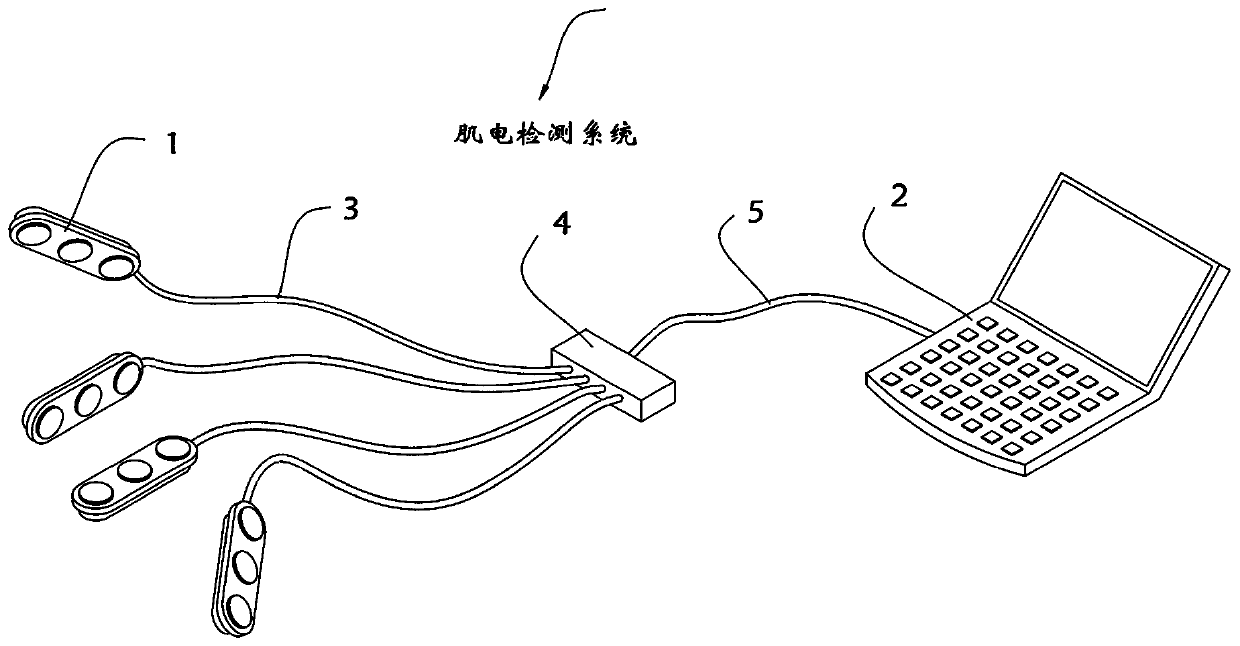
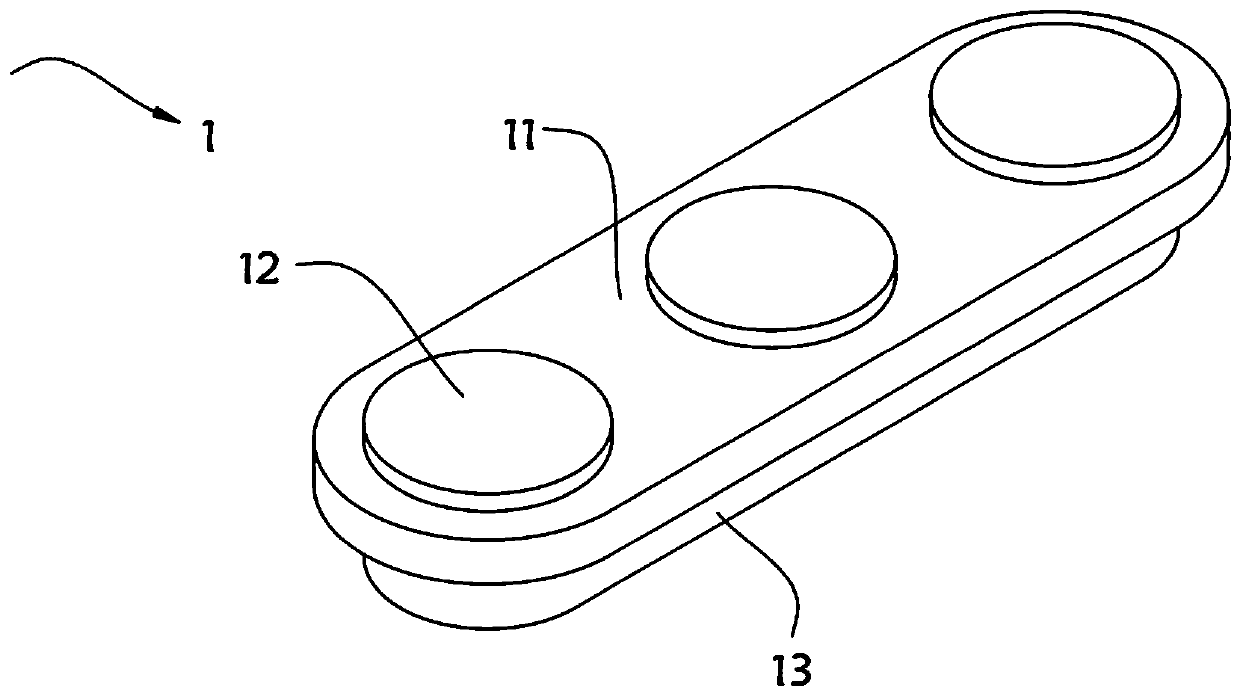
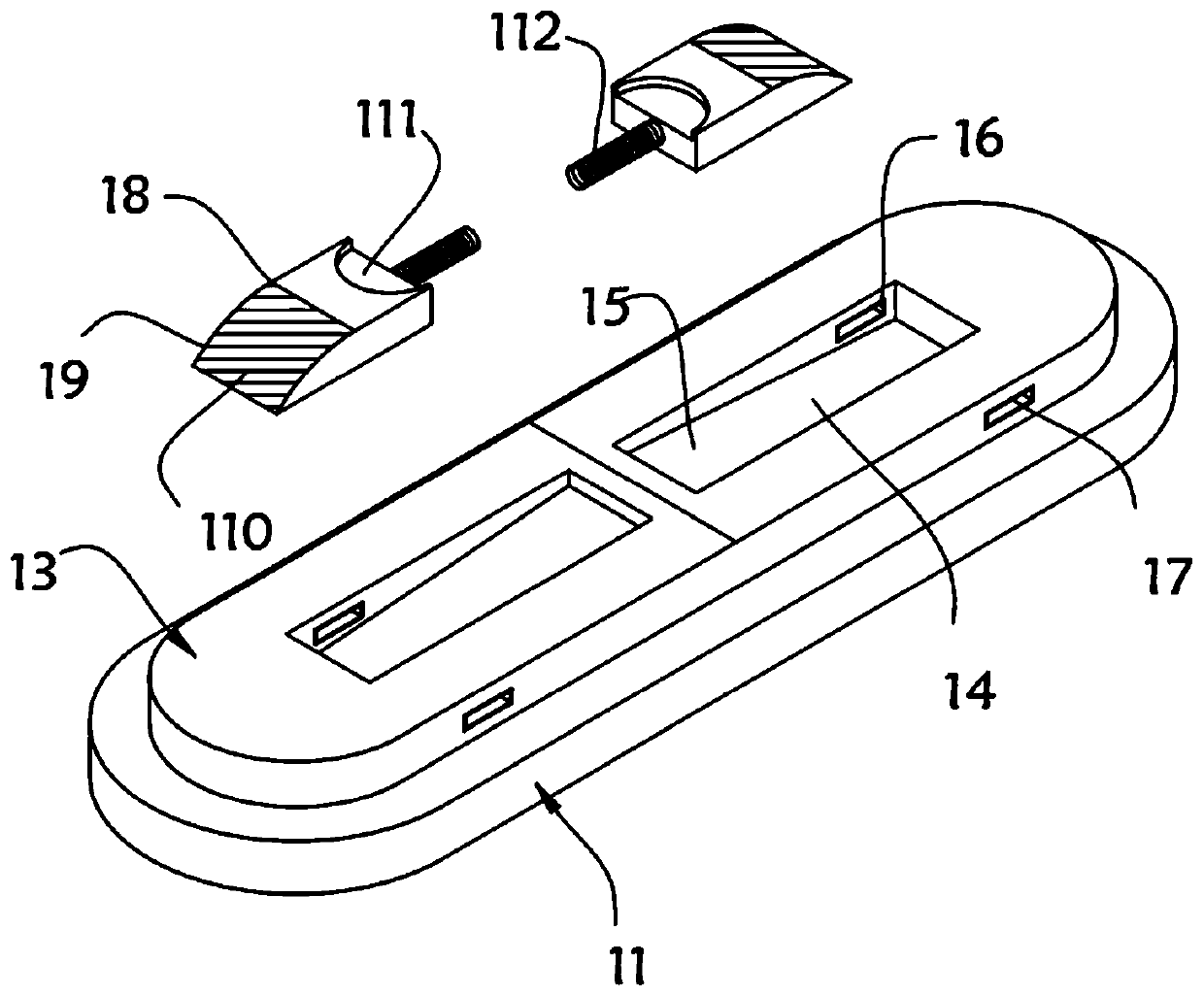
[0035] On the one hand, the erect arm extension test system applied to the diagnosis of Rolandic epilepsy, such as Figure 1-Figure 3 As shown, it includes a myoelectric detection system for measuring myoelectric signals and an electroencephalogram detection system for measuring electroencephalogram signals. The myoelectric detection system includes a plurality of myoelectric detection boards 1, a data acquisition card 4 and an electromyography analysis terminal 2. One end of the data acquisition card 4 is connected to the myoelectric detection board 1 through the data acquisition line 3, and the other end of the data acquisition card 4 is connected to the myoelectric analysis terminal 2 through the data transmission line 5. The myoelectric detection board 1 includes a substrate 11 and is installed on the substrate. A plurality of myoelectric electrodes 12 on the top of 11 and a base plate 13 arranged at the bottom of the base plate 11, a pair of chute 14 is provided on the out...
Embodiment 2
[0037] As the second embodiment of the present invention, in order to facilitate the detection of myoelectric signals, the inventors make improvements to the myoelectric electrode 1 as a preferred embodiment, such as Image 6 As shown, the electromyographic electrode 12 is also provided with an electrode acquisition module, a signal amplification module, a filter module, a differential voltage regulation module and a power supply module, the electrode acquisition module is used for collecting and detecting electromyographic signals, and the signal amplification module is used for collecting The EMG signal is amplified and processed, the filter module filters out interference signals and redundant signals, and collects effective EMG signals. The differential voltage regulation module is used to adjust the shifted EMG signal to the reference position, and the power supply module is used for Electrical electrodes 12 provide power. In this embodiment, the signal amplification modu...
Embodiment 3
[0046] As a third embodiment of the present invention, in order to facilitate the filter processing of the electromyographic signal, the inventors made improvements to the filter module as a preferred embodiment, such as Figure 7 As shown, the filtering module includes a high-pass filtering module, a low-pass filtering module and a band-stop filtering module. In this embodiment, since the frequency of the collected myoelectric signal is in the range of 1-1000 Hz, the energy of the myoelectric signal is mainly concentrated in the frequency range of 10-200 Hz, so it is necessary to filter the myoelectric signal to filter out some interference signals and redundant signals , to collect effective EMG signals. This embodiment adopts a high-pass filter module. The high-pass filter module is a second-order high-pass filter of a voltage-controlled voltage source. The second-order high-pass filter circuit of a voltage-controlled voltage source is composed of a resistor, a capacitor, an...
PUM
 Login to View More
 Abstract
Description
Claims
Application Information
 Login to View More