Improved segmented frequency domain block LMS adaptive filtering algorithm
A technology of adaptive filtering and adaptive filter, which is applied in the direction of digital adaptive filter, adaptive network, impedance network, etc., can solve the problems of non-optimal convergence of frequency domain LMS algorithm and non-convergence of mean square error, and achieve The effects of thorough noise elimination, high recognition, and accurate fitting and prediction results
- Summary
- Abstract
- Description
- Claims
- Application Information
AI Technical Summary
Problems solved by technology
Method used
Image

Examples
Embodiment Construction
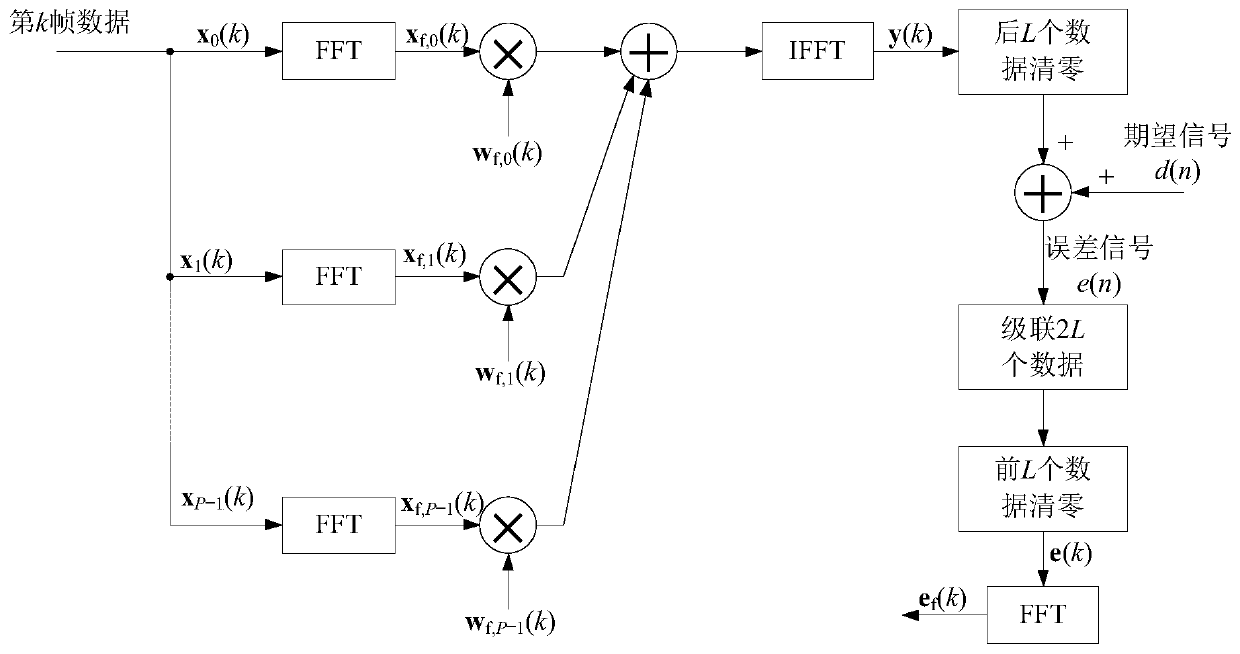
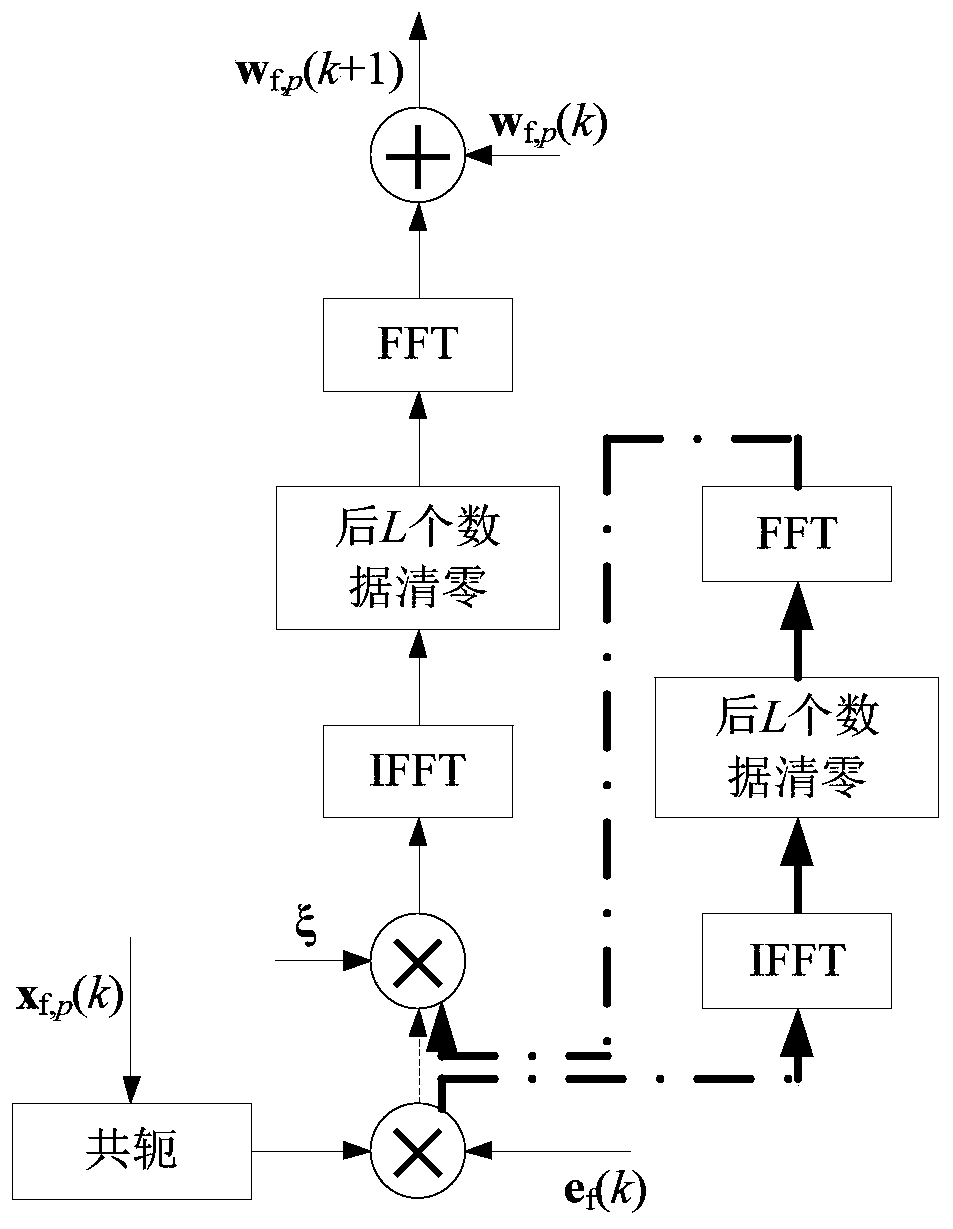
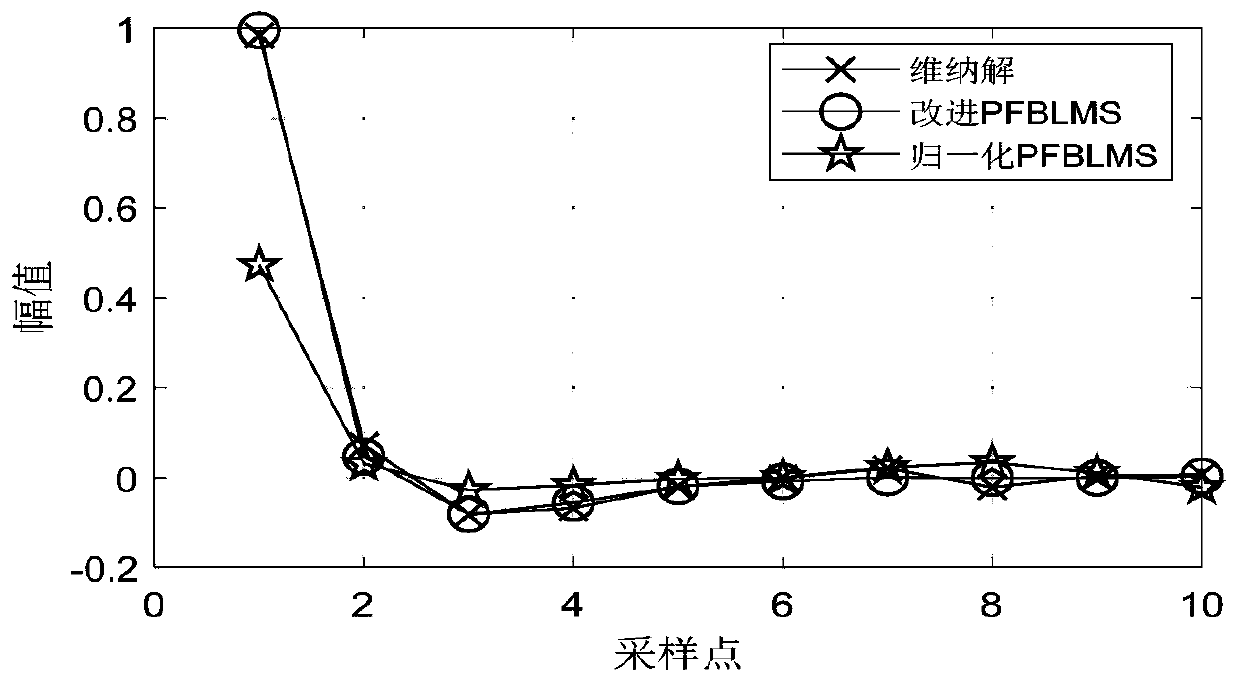
[0018] The present invention improves the traditional normalized PFBLMS algorithm, and the technical solution of the present invention will be described in detail below in conjunction with the accompanying drawings.
[0019] Setting N is the adaptive filter length, L is the block length in the frequency domain, and the FFT calculation length in the frequency domain is 2L, N=P*L, and P is an integer representing the number of segments of each frame of data in the frequency domain, The normalized convergence step range is 0<μ<1.
[0020] 1. In the traditional normalized PFBLMS algorithm, the k-th frame data is divided into P data blocks. assuming x p (k)=[x((k–p)L–L),x((k–p)L–L+1),…,x((k–p)L+L–1)] T is the reference signal vector, p=(0,1,…,P–1). The superscript T stands for the transpose operation, w p (k)=[w (pL+0) (k),w (pL+1) (k),...,w (pL+L–1) (k)] T is an adaptive filter, d(k)=[d(kL), d(kL+1),…,d(kL+L-1)] T is the desired signal vector. Then the frequency domain e...
PUM
 Login to View More
 Abstract
Description
Claims
Application Information
 Login to View More
PatSnap Eureka turns technology decisions into work you can execute. Powered by our Innovation Knowledge Graph, it runs expert workflows across engineering, life sciences, materials and intellectual property. Get your review-ready output in minutes.


