Fourier domain mode-locked photoelectric oscillator

A Fourier domain mode-locking, photoelectric oscillator technology, applied in the field of microwave photonics, can solve the problems of irrelevance, limited frequency tuning speed, increase of microwave signal phase noise, etc., and achieve the effect of low phase noise

CN110504613AInactive Publication Date: 2019-11-26INST OF SEMICONDUCTORS - CHINESE ACAD OF SCI
4 Cites 17 Cited by

Patent Information

Authority / Receiving Office
CN · China
Current Assignee / Owner
Publication Date
2019-11-26
Estimated Expiration
Not applicable · inactive patent

Smart Images

  • Figure 1
    Figure 1
  • Figure 2
    Figure 2
  • Figure 3
    Figure 3
Patent Text Reader

Abstract

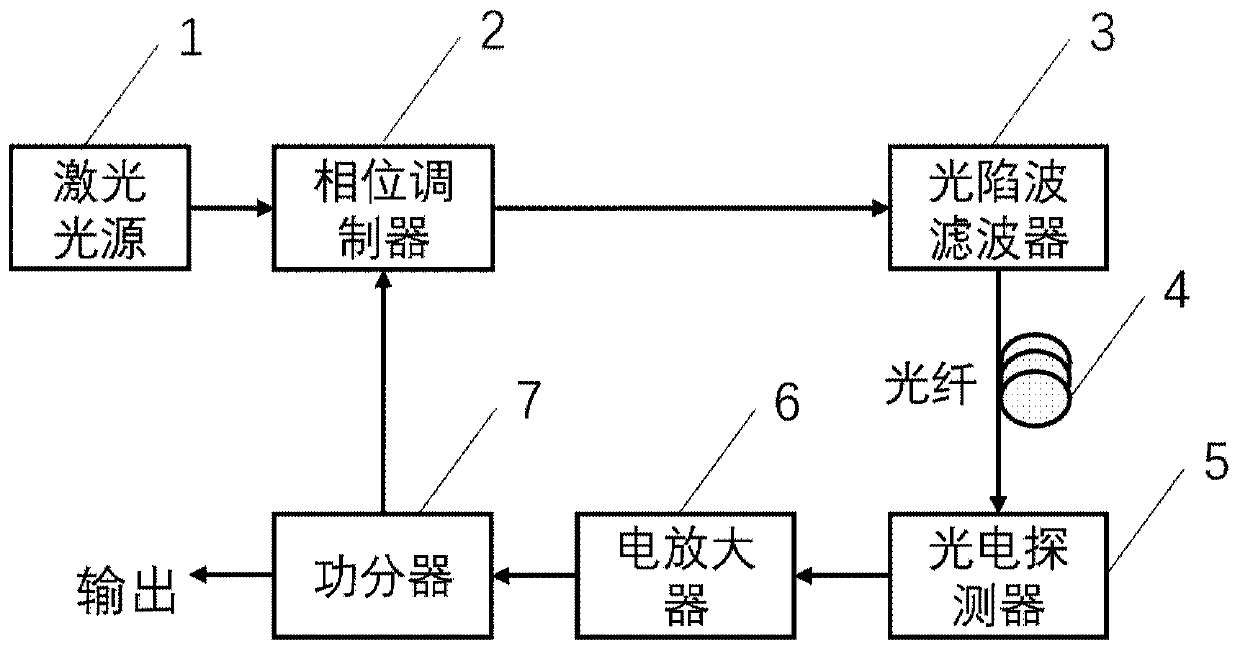
The invention discloses a Fourier domain mode-locked photoelectric oscillator. The Fourier domain mode-locked photoelectric oscillator comprises a laser source, a phase modulator, a light notching filter, a photoelectric detector, a power amplifier and a power divider; the laser source, the phase modulator, the light notching filter and the photoelectric detector form a sweeping frequency microwave photon filter; a transmission band of the sweeping frequency microwave photon filter is decided by the difference of the laser source and the light notching filter notching location corresponding wavelength, the sweeping frequency of the microwave photon filter transmission band is realized through the sweeping frequency of the laser source or the light notching filter, and the change of the filter transmission band and the signal are matched with the in the time delay for transmitting a circle in a photoelectric oscillator loop; the Fourier domain mode-locking is realized, and the bandwidth-adjustable chirp microwave signal can be output.
Need to check novelty before this filing date? Find Prior Art

Description

technical field

[0001] The invention relates to the technical field of microwave photonics, in particular to a Fourier domain mode-locked photoelectric oscillator. Background technique

[0002] High-quality microwave signal sources can be realized using electronic methods or photonics-based microwave signal generation techniques. Among them, the electronic method has high precision, but its instantaneous bandwidth and phase noise characteristics are poor. In order to overcome the shortcomings of electronic methods, researchers have proposed a variety of microwave signal generation technologies based on photonics, mainly including dual-wavelength laser heterodyne method, optical pulse shaping method and optoelectronic oscillator technology. Among them, the dual-wavelength laser heterodyne method can easily realize broadband and fast-tuned chirped microwave signal generation by adjusting the wavelength of the laser, and its bandwidth and chirp speed are significantly higher t...

Examples

Embodiment Construction

[0049] In order to make the object, technical solution and advantages of the present invention clearer, the present invention will be further described in detail below in conjunction with specific embodiments and with reference to the accompanying drawings.

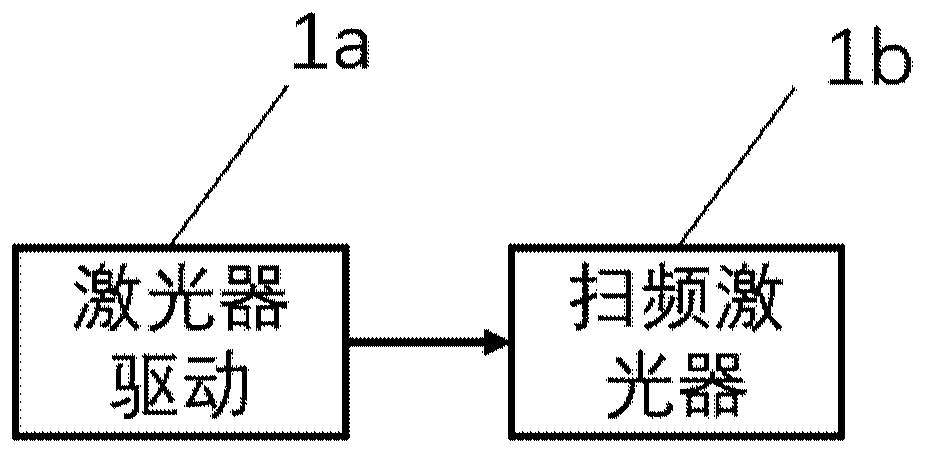
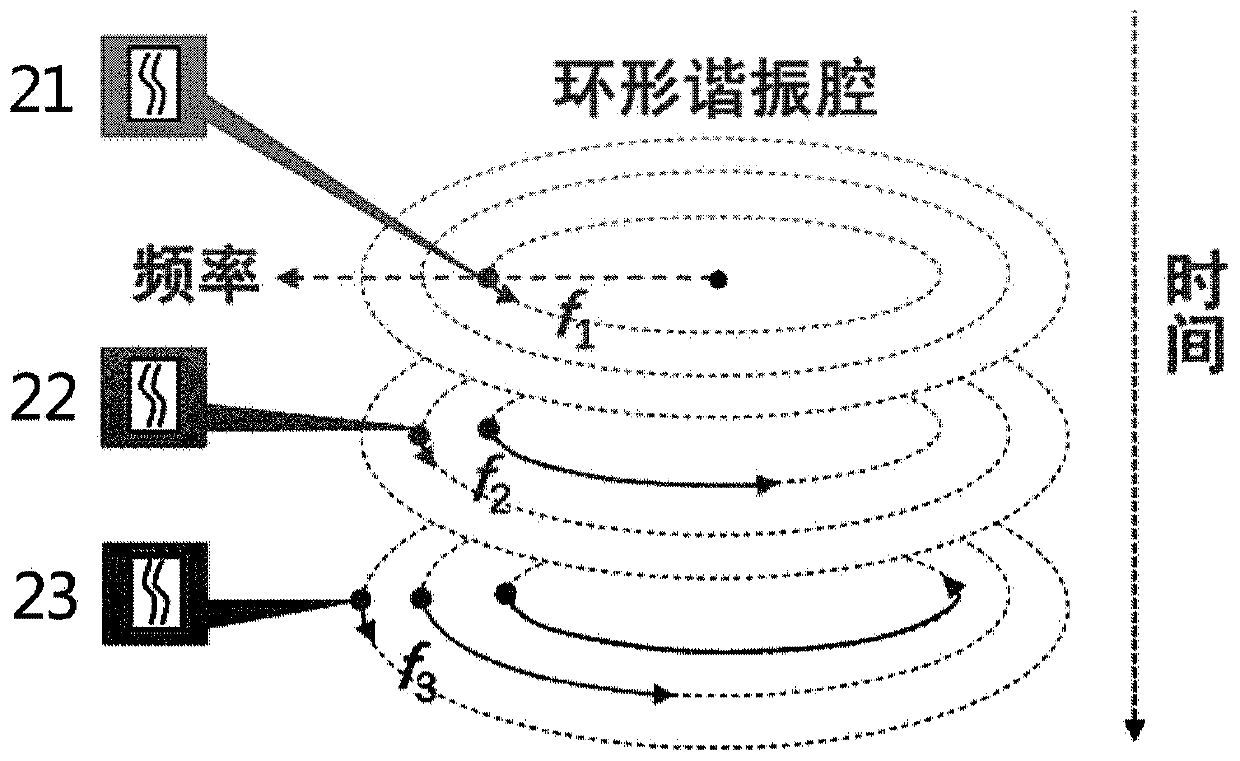
[0050] In order to meet the requirements of communication and radar systems for high-quality fast-chirp microwave signal sources, the present invention proposes a Fourier domain mode-locked photoelectric oscillator to generate broadband-tunable fast-chirp microwave signals. The invention discloses a Fourier domain mode-locked photoelectric oscillator, which utilizes the laser generation characteristics of a laser light source, the modulation characteristics of a phase modulator, the filtering characteristics of an optical notch filter, the photoelectric conversion characteristics of a photodetector, and The microwave generation performance of the optoelectronic oscillator can generate broadband adjustable fast chirp microw...