Reductive aminase, coding gene, recombinant vector, recombinant cell and application thereof
A technology of reductive amination enzyme and amino donor, applied in application, genetic engineering, plant gene improvement, etc., can solve the problems of insufficient stereoselectivity of biological methods, high cost of noble metal ligands, general catalytic efficiency, etc. Less reaction, simple preparation method, environment-friendly effect
- Summary
- Abstract
- Description
- Claims
- Application Information
AI Technical Summary
Problems solved by technology
Method used
Image


Examples
Embodiment 1
[0038] Example 1: Cloning of Reductive Aminase Gene
[0039] Using the strategy of gene mining, 10 hypothetical proteins from different actinomycetes were cloned. After activity measurement and comparison, it was found that the protein from Streptomyces sparsus had the highest catalytic activity. The specific operation is as follows:
[0040] (1) Firstly, the above-mentioned actinomycetes were cultivated overnight at 30°C using Gao’s No. 1 medium, and the bacterial cells were obtained by centrifugation, and then the total genomic DNA was obtained using a conventional bacterial genome extraction kit.
[0041] (2) PCR is carried out with the above-mentioned genomic DNA as a template, and the system is as follows: ddH 2 O 21 μL, 5× PrimeSTARBuffer 10 μL, upstream primer SEQ ID NO.3 (GGGAATTCCATATGAGC AACACCCCCGTGAC) 1 μL, downstream primer SEQ ID NO.4 (CGCGGATCCCTAG GCCCGGGTGCGGAGCA) 1 μL, genomic DNA 1 μL, dNTP 5 μL, PrimeSTAR DNA polymerase 1.0 μL. The PCR program was: pre-de...
Embodiment 2
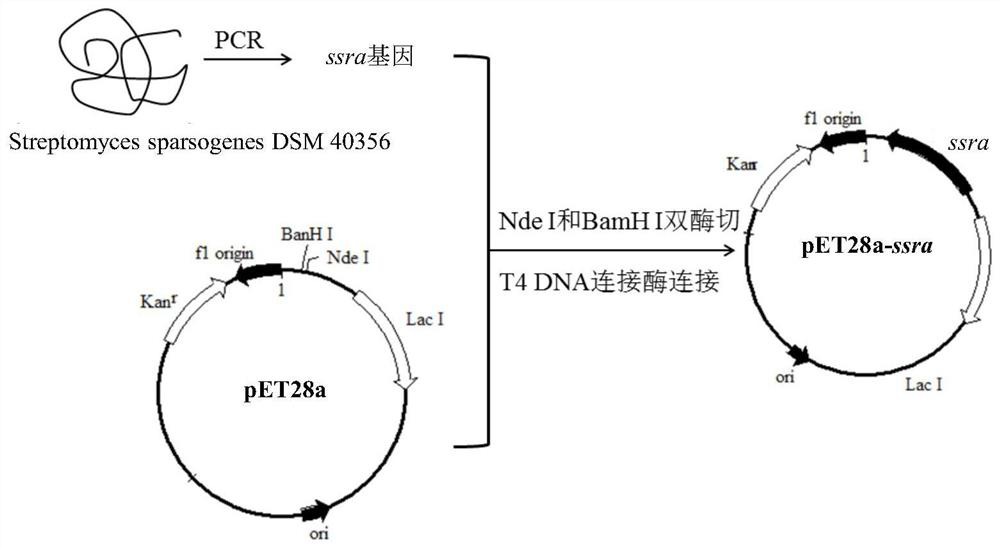
[0042] Example 2: Construction and cultivation of recombinant Escherichia coli BL21(DE3) / pET28a-ssra
[0043] The gene ssra recovered in Example 1 and the plasmid pET28a were double digested with restriction enzymes NdeI and BamH I in a water bath at 37°C overnight, purified by agarose gel electrophoresis the next day, and the target was recovered using an agarose recovery kit fragment. 4°C, use T 4 DNA ligase overnight ligase cut gene ssra and plasmid pET28a to obtain recombinant expression vector pET28a-ssra ( figure 1 ). The constructed recombinant expression vector pET28a-ssra was thermally transferred into Escherichia coli BL21 (DE3) competent, coated with Kan-resistant LB solid plate, and colony PCR verification was carried out after overnight culture. The positive clone was the recombinant Escherichia coli BL21 ( DE3) / pET28a-ssra. Pick positive clones and culture them overnight in LB medium, then transfer them into fresh LB culture at 2% transfer amount the next da...
Embodiment 3
[0044] Embodiment 3: Separation and purification of reductive aminase
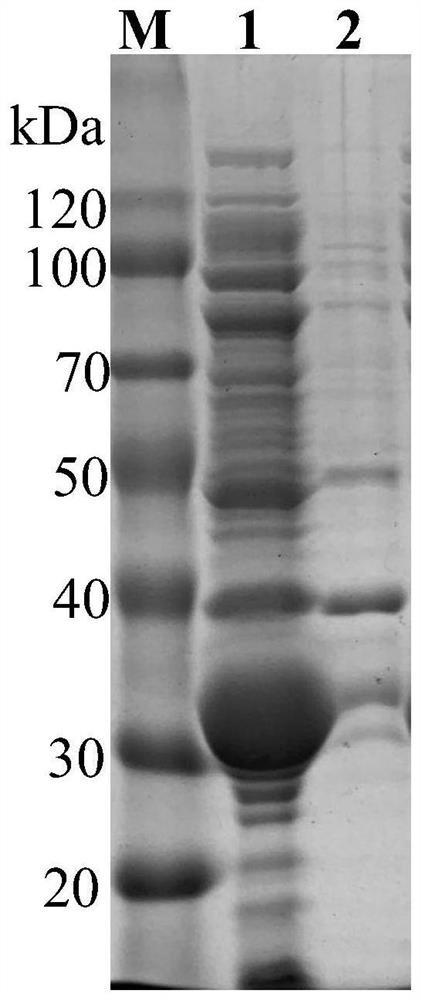
[0045] Suspension-cultured recombinant cells were placed in liquid A (20mmol·L -1 Sodium phosphate, 500mmol·L -1 NaCl, 20mmol L -1 imidazole, pH 7.4), the crude enzyme solution was obtained after sonication and centrifugation. The column used for purification is an affinity column HisTrapFF crude (nickel column), which is completed by using the histidine tag on the recombinant protein for affinity binding. First, use solution A to equilibrate the nickel column, load the crude enzyme solution, continue to use solution A to elute the breakthrough peak, and after equilibrium, use solution B (20mmol L -1 Sodium phosphate, 500mmol·L -1 NaCl, 1000 mmol L -1 imidazole, pH 7.4) for gradient elution to elute the recombinant protein bound to the nickel column to obtain recombinant reductive aminase. Enzyme activity assay (CPMK as substrate, NADPH as coenzyme) and SDS-PAGE analysis were performed on the purifie...
PUM
 Login to View More
 Abstract
Description
Claims
Application Information
 Login to View More
 - R&D
- Intellectual Property
- Life Sciences
- Materials
- Tech Scout
- Unparalleled Data Quality
- Higher Quality Content
- 60% Fewer Hallucinations
Browse by: Latest US Patents, China's latest patents, Technical Efficacy Thesaurus, Application Domain, Technology Topic, Popular Technical Reports.
© 2025 PatSnap. All rights reserved.Legal|Privacy policy|Modern Slavery Act Transparency Statement|Sitemap|About US| Contact US: help@patsnap.com