Check patentability & draft patents in minutes with Patsnap Eureka AI!

Robot path planning algorithm with improved DQN under fast search mechanism

A path planning and robotics technology, applied in manipulators, manufacturing tools, neural learning methods, etc., can solve problems such as low search efficiency and low environmental utilization, and achieve the effect of improving search efficiency

Active Publication Date: 2020-03-17
HENAN UNIVERSITY
View PDF7 Cites 11 Cited by
  • Summary
  • Abstract
  • Description
  • Claims
  • Application Information

AI Technical Summary

Problems solved by technology

[0005] The purpose of the present invention is to solve the problems raised in the background technology, and provide a robot path planning algorithm that improves DQN under a fast search mechanism, which improves the problems of low environmental utilization and low search efficiency in the DQN algorithm, and enables The robot searches for the optimal path in an unknown environment

Method used

the structure of the environmentally friendly knitted fabric provided by the present invention; figure 2 Flow chart of the yarn wrapping machine for environmentally friendly knitted fabrics and storage devices; image 3 Is the parameter map of the yarn covering machine
View more

Image

Smart Image Click on the blue labels to locate them in the text.
Viewing Examples
Smart Image
  • Robot path planning algorithm with improved DQN under fast search mechanism
  • Robot path planning algorithm with improved DQN under fast search mechanism
  • Robot path planning algorithm with improved DQN under fast search mechanism

Examples

Experimental program
Comparison scheme
Effect test

Embodiment 1

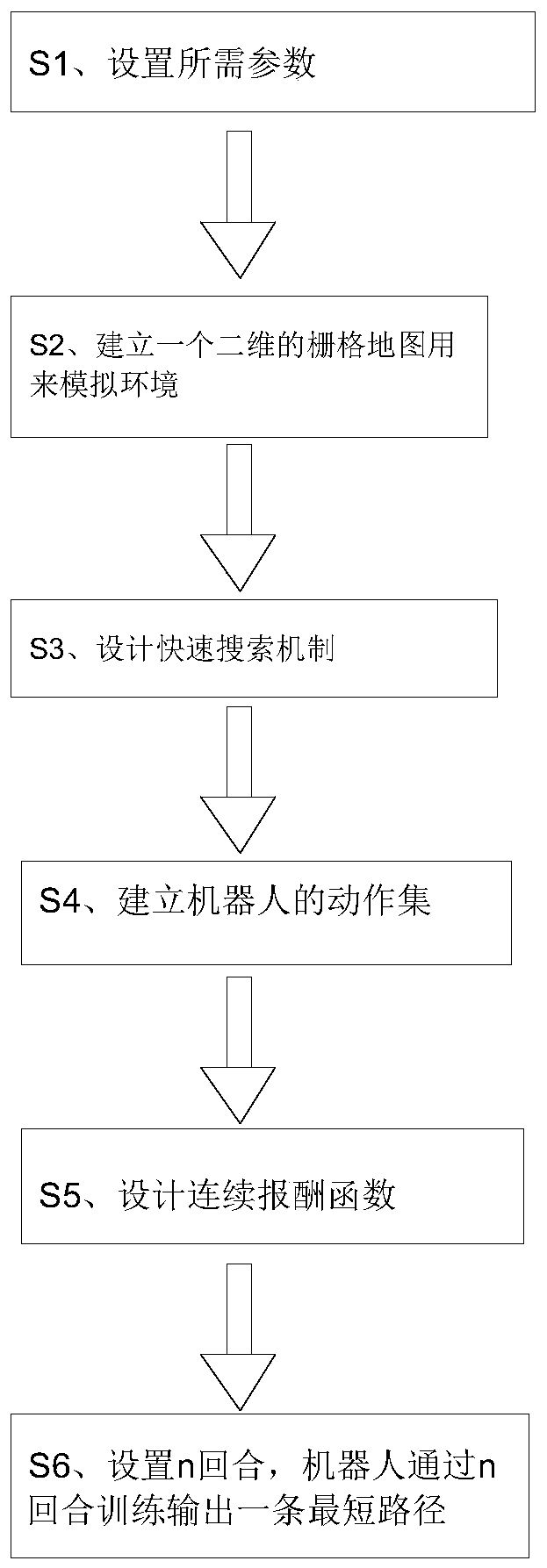
[0070] combine figure 1 , an improved DQN robot path planning algorithm under the fast search mechanism, including the following steps:

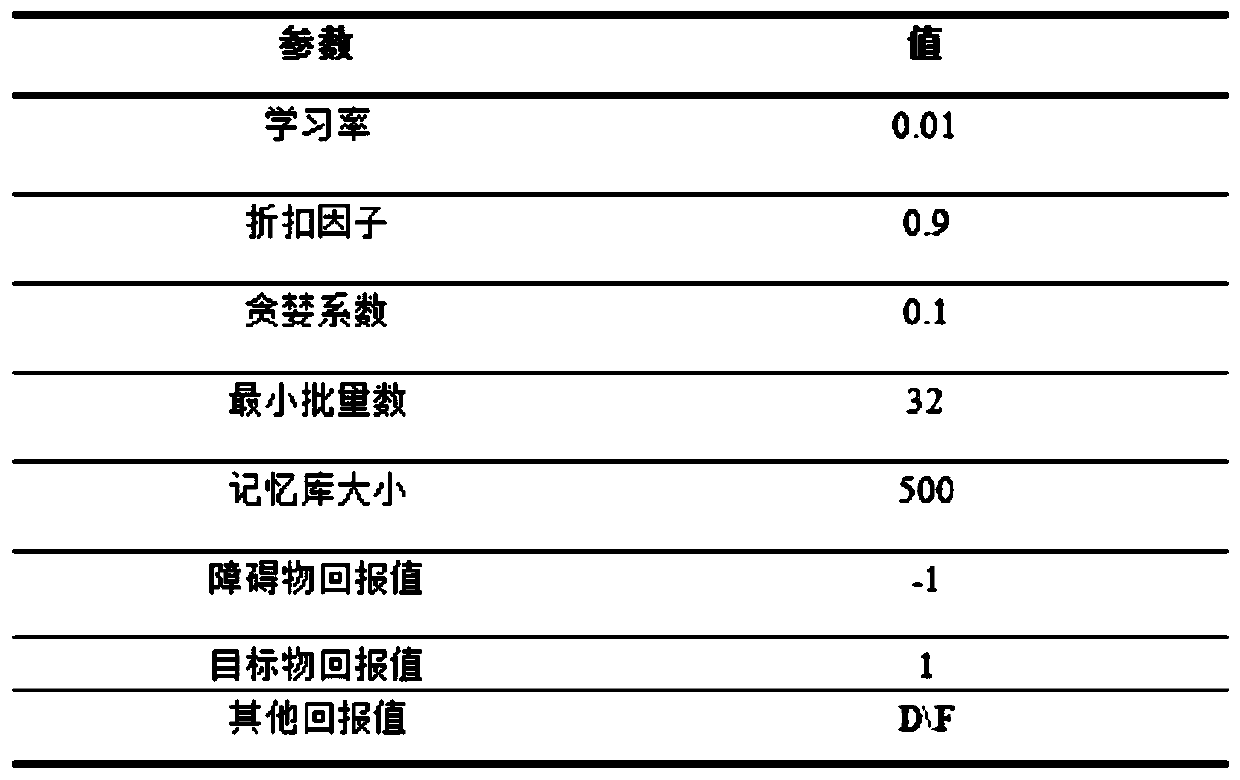
[0071] S1. Set the parameters required for the experiment. The parameters include greedy coefficient ∈, memory size M, discount rate γ, learning rate α, and batch learning value batch;

[0072] S2. According to the slope characteristics of the three-dimensional terrain environment and the geometric characteristics of the robot's movement, a two-dimensional grid map is established to simulate the environment. In the map, gray rectangles are used to represent robots, circles are used to represent target points, and black rectangles are used to represent obstacles , the starting coordinates of the robot are defined by S(x s ,y s ), target point coordinates G (x g ,y g ), the current coordinate is C(x c ,y c );

[0073] S3. Design a fast search mechanism, use a fast search mechanism to partially model the current location environment, cal...

Embodiment 2

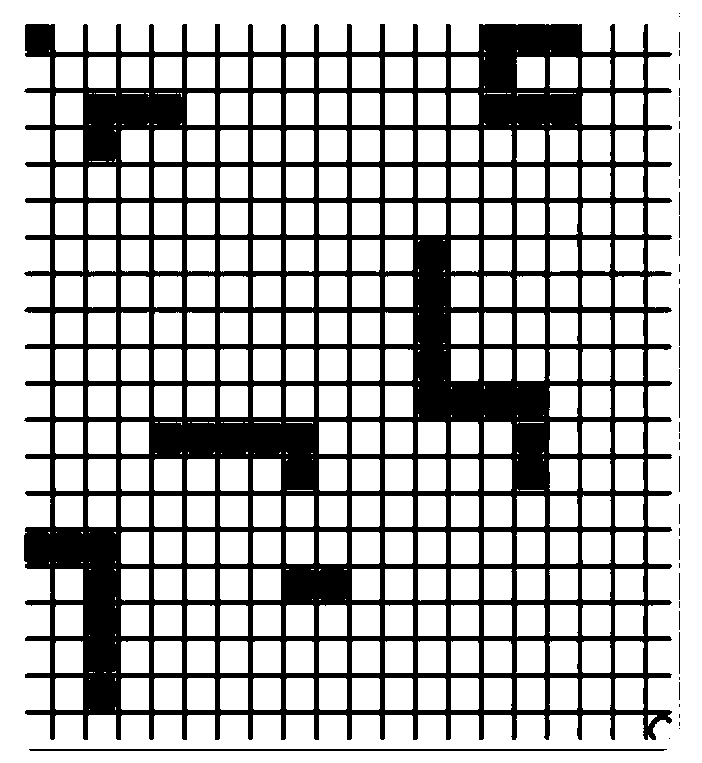
[0078] combine image 3 , the simulation environment is written in python tkinter, a grid map with a size of 20*20, the gray rectangle in the map represents the robot, the circle represents the target point, and the black rectangle represents obstacles. The starting coordinates of the robot are represented by S(x s ,y s ), target point coordinates G(x g ,y g ), the current coordinate is C(x c ,y c ).

Embodiment 3

[0080] according to image 3 , Figure 5 , Figure 6 , Figure 7 and Figure 9 As shown, a 20*20 grid map is established to simulate the current environment. The gray rectangle in the map represents the robot, the circle represents the target point, and the black rectangle represents obstacles. The starting coordinates of the robot are represented by S(x s ,y s ), target point coordinates G(x g ,y g ), the current coordinate is C(x c ,y c ).

[0081] The design of the fast search mechanism, the design of the fast search mechanism, this design uses a fast search mechanism to partially model the current location environment, and calculate the reward value while modeling, and calculate the action and obstacle point with the largest reward value deep memory. The formation of deep memory makes the robot more precise in action selection and target search, reduces unnecessary searches, and improves search efficiency.

[0082] The design of the action set, the present inven...

the structure of the environmentally friendly knitted fabric provided by the present invention; figure 2 Flow chart of the yarn wrapping machine for environmentally friendly knitted fabrics and storage devices; image 3 Is the parameter map of the yarn covering machine
Login to View More

PUM

No PUM Login to View More

Abstract

The invention relates to a robot path planning algorithm with improved DQN under a fast search mechanism. The robot path planning algorithm comprises the following steps that S1, parameters required in the algorithm are set; S2, a two-dimensional raster map is built to simulate the environment according to the gradient characteristic of a three dimensional terrain environment and the kinematic geometry characteristic of a robot; S3, the fast search mechanism is designed; S4, an action set of the robot is built; S5, a continuous remuneration function is designed; and S6, the robot outputs the best path through training. According to the robot path planning algorithm with improved DQN under the fast search mechanism, the problems that a Deep Q_Learning algorithm is low in environment use ratio and search efficiency and the like are solved, and thus, the robot can quickly search out the best path in the unknown environment.

Description

technical field [0001] The invention belongs to the technical field of path planning, and in particular relates to an improved DQN robot path planning algorithm under a fast search mechanism. Background technique [0002] Reinforcement learning is a closed-loop learning method that draws on 'experience'. The robot achieves the process of autonomous learning through continuous information interaction with the environment. The process of interaction between robot and environment can be described as a Markov decision problem. [0003] The Q_Learning algorithm in reinforcement learning is widely used in robot path planning technology. The robot uses Q_Learning to learn and interact with the environment to achieve the purpose of autonomous planning path. Since the Q_Learning algorithm calculates the value in the Q table, and then selects the action with a larger Q value as the action to be executed, this will easily cause problems such as slow calculation speed and dimension exp...

Claims

the structure of the environmentally friendly knitted fabric provided by the present invention; figure 2 Flow chart of the yarn wrapping machine for environmentally friendly knitted fabrics and storage devices; image 3 Is the parameter map of the yarn covering machine
Login to View More

Application Information

Patent Timeline
no application Login to View More
IPC IPC(8): B25J9/16G06N3/04G06N3/08
CPCB25J9/16B25J9/1628B25J9/1664B25J9/161G06N3/08G06N3/048G06N3/045
Inventor 王俊陈天星张德华杨青朋赵正云
Owner HENAN UNIVERSITY
Features
  • R&D
  • Intellectual Property
  • Life Sciences
  • Materials
  • Tech Scout
Why Patsnap Eureka
  • Unparalleled Data Quality
  • Higher Quality Content
  • 60% Fewer Hallucinations
Social media
Patsnap Eureka Blog
Learn More