Check patentability & draft patents in minutes with Patsnap Eureka AI!

Preparation method of hydroxyl-modified metal-organic framework material fluorescent probe and its application in fluoride detection

A metal-organic framework and fluorescent probe technology, applied in the field of fluorescence sensing, can solve problems such as limiting practical application, and achieve the effects of good fluorescence stability, simple synthesis method and good stability

Active Publication Date: 2022-03-04
江西省吉安市水文局
View PDF6 Cites 0 Cited by
  • Summary
  • Abstract
  • Description
  • Claims
  • Application Information

AI Technical Summary

Problems solved by technology

Among them, MIL-53(Al) is a flexible material with octahedral configuration synthesized by hydrothermal method with aluminum as the metal ion and terephthalic acid as the organic ligand. It has good dispersion in water and has excellent fluorescence properties; however, due to The single ligand structure limits its practical application in the field of fluorescence sensing

Method used

the structure of the environmentally friendly knitted fabric provided by the present invention; figure 2 Flow chart of the yarn wrapping machine for environmentally friendly knitted fabrics and storage devices; image 3 Is the parameter map of the yarn covering machine
View more

Image

Smart Image Click on the blue labels to locate them in the text.
Viewing Examples
Smart Image
  • Preparation method of hydroxyl-modified metal-organic framework material fluorescent probe and its application in fluoride detection
  • Preparation method of hydroxyl-modified metal-organic framework material fluorescent probe and its application in fluoride detection
  • Preparation method of hydroxyl-modified metal-organic framework material fluorescent probe and its application in fluoride detection

Examples

Experimental program
Comparison scheme
Effect test

Embodiment 1

[0025] Preparation of fluorescent probe MIL-53(Al)-OH-Tris: Add 3 mL of 76 mM 2,5-dihydroxyterephthalic acid in DMF to 3 mL of 50 mM aluminum nitrate hexahydrate in DMF, and ultrasonicate at room temperature for 5 The mixed solution was obtained in 1 minute; the mixed solution was sealed in a polytetrafluoroethylene lined autoclave, heated in a 130°C oven for 8 hours, then naturally cooled to room temperature; centrifuged for 5min at a speed of 10000rpm, and the yellow precipitate ( The yellow precipitate is a hydroxyl-modified metal-organic framework nanomaterial), and the yellow precipitate is alternately washed twice with DMF and ethanol; finally, the yellow precipitate is dispersed in 10 mL of 50 mM Tris-HCl buffer solution with pH=4 to obtain MIL-53(Al)- OH-Tris probe solution.

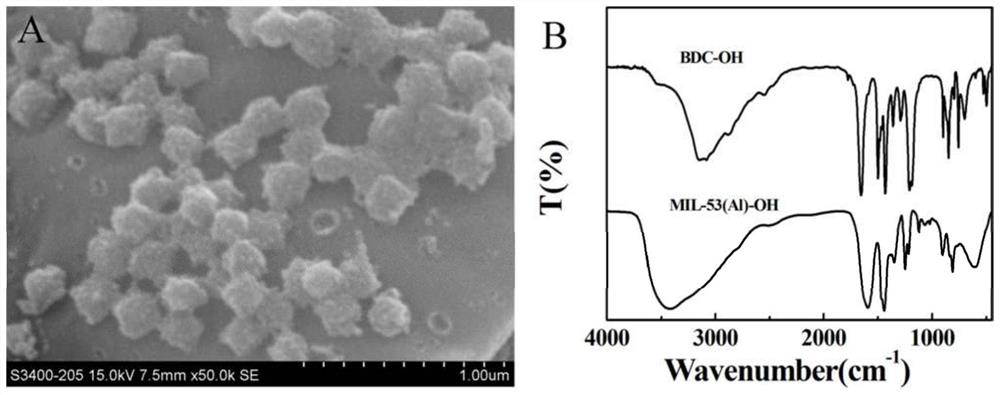
[0026] The morphology of MIL-53(Al)-OH nanomaterials was characterized by scanning electron microscopy, figure 1 A shows that MIL-53(Al)-OH is spherical in shape with a particle size of about 15...

Embodiment 2

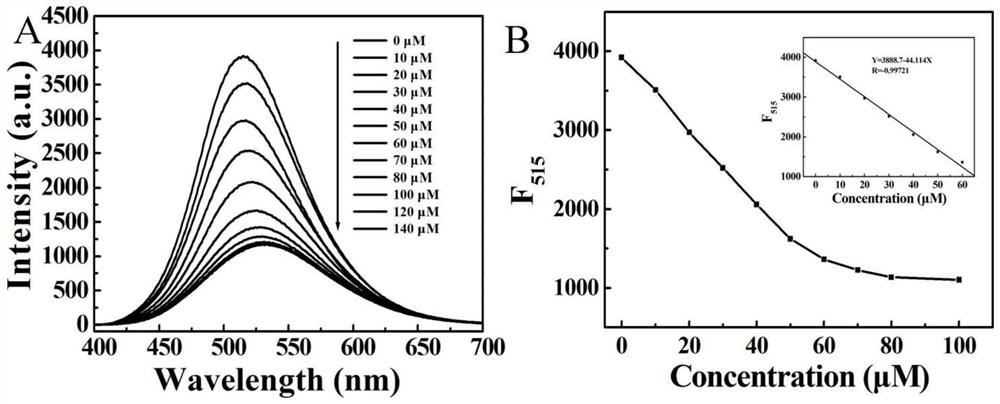
[0028] Fluorescent probe MIL-53(Al)-OH-Tris to detect fluoride ions: mix 500 μL MIL-53(Al)-OH-Tris probe solution and 500 μL sodium fluoride standard solution of different concentrations, incubate at room temperature for 30 minutes, Under the excitation wavelength of 365nm, the fluorescence emission peak of the fluorescent probe MIL-53(Al)-OH-Tris at 515nm decreases with the increase of the concentration of sodium fluoride, and the change rate of the fluorescence intensity has a linear relationship with the concentration of sodium fluoride. Fluorescence emission peak (F 515 ) has a good linear relationship with the increase of fluoride ion concentration, and the detection limit is 0.3 μM when the signal-to-noise ratio is 3 ( figure 2 ).

Embodiment 3

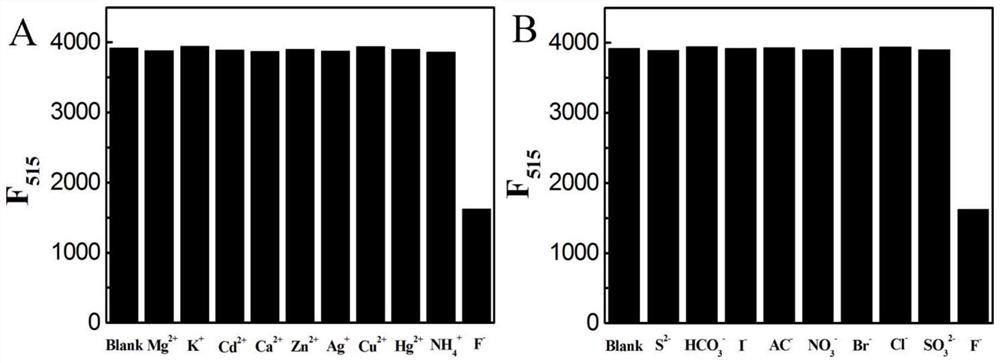
[0030] Investigate the selectivity of fluorescent probe MIL-53(Al)-OH-Tris to detect fluoride ions: in the selectivity test, 50 μ M NaX solution (X=S 2- , I - , Cl - , AC - ,Br - ,NO 3 - , HCO 3 - , SO 3 2- ) and 50μM MCl solution (M=K + ,NH 4 + ,Mg 2+ ,Cu 2+ ,Zn 2+ ,Cd 2+ , Ca 2+ ,Hg 2+ , Ag + ) into the MIL-53 (Al)-OH-Tris probe solution respectively, and measure the fluorescence emission spectrum of the MIL-53 (Al)-OH-Tris probe in each interference ion under the same conditions as in Example 2 Figure, the measurement results are as image 3 shown. The results show that the fluorescence intensity of the MIL-53(Al)-OH-Tris probe solution is not interfered by the above-mentioned ions, and only the fluoride ion can effectively quench the fluorescence of the MIL-53(Al)-OH-Tris, which is the structure of the present invention. The fluorescent probe MIL-53(Al)-OH-Tris with hydroxyl modified metal-organic framework nanomaterials has good selectivity for detect...

the structure of the environmentally friendly knitted fabric provided by the present invention; figure 2 Flow chart of the yarn wrapping machine for environmentally friendly knitted fabrics and storage devices; image 3 Is the parameter map of the yarn covering machine
Login to View More

PUM

PropertyMeasurementUnit
particle diameteraaaaaaaaaa
Login to View More

Abstract

The invention discloses a preparation method of a hydroxyl-modified metal-organic framework material fluorescent probe and its fluoride detection application, belonging to the technical field of fluorescent sensing. Using aluminum nitrate hexahydrate as the metal salt ligand and 2,5-dihydroxyterephthalic acid as the organic ligand, a hydroxyl-modified metal-organic framework was prepared by solvothermal reaction in N,N-dimethylformamide solvent Material (MIL-53(Al)-OH), the material can be ultrasonically dispersed in Tris-HCl buffer solution to prepare the fluorescent probe MIL-53(Al)-OH-Tris. Under the excitation wavelength of 365nm, the MIL-53(Al)-OH-Tris fluorescent probe has a strong fluorescence emission peak at 515nm, which can be applied to the sensitive detection of fluoride ions.

Description

technical field [0001] The invention relates to a preparation method and application of a fluorescent probe, belonging to the technical field of fluorescent sensing. Background technique [0002] Metal-organic frameworks (MOFs) are a new class of porous crystalline materials, which have attracted the attention of many researchers due to their advantages such as easy preparation, good thermal stability, many active sites, large specific surface area and adjustable structure. These excellent properties enable them to be used in many fields, such as gas storage, separation and adsorption, catalysis, chemical sensing and imaging, etc. MILs are a series of MOFs materials named after the Lavoisier research group in France. Among them, MIL-53(Al) is a flexible material with octahedral configuration synthesized by hydrothermal method with aluminum as the metal ion and terephthalic acid as the organic ligand. It has good dispersion in water and has excellent fluorescence properties;...

Claims

the structure of the environmentally friendly knitted fabric provided by the present invention; figure 2 Flow chart of the yarn wrapping machine for environmentally friendly knitted fabrics and storage devices; image 3 Is the parameter map of the yarn covering machine
Login to View More

Application Information

Patent Timeline
no application Login to View More
Patent Type & Authority Patents(China)
IPC IPC(8): C08G83/00G01N21/64C09K11/06
CPCC08G83/008G01N21/643C09K11/06G01N2021/6432C09K2211/186C09K2211/1425C09K2211/1433
Inventor 李慧明候林丽郎锋祥徐鹏李雨
Owner 江西省吉安市水文局
Features
  • R&D
  • Intellectual Property
  • Life Sciences
  • Materials
  • Tech Scout
Why Patsnap Eureka
  • Unparalleled Data Quality
  • Higher Quality Content
  • 60% Fewer Hallucinations
Social media
Patsnap Eureka Blog
Learn More