Check patentability & draft patents in minutes with Patsnap Eureka AI!

Multi-task processing system and method for two-phase remote sensing images

A remote sensing image and processing system technology, applied in the field of image processing, can solve the problems of increasing the test phase time, poor implementation effect, and inability to use the difference and correlation of two-phase image features, so as to achieve high-precision core element extraction and improve expression effect of ability

Active Publication Date: 2022-06-17
SHANGHAI JIAOTONG UNIV
View PDF5 Cites 0 Cited by
  • Summary
  • Abstract
  • Description
  • Claims
  • Application Information

AI Technical Summary

Problems solved by technology

[0003] The defect of the existing technology is that when completing multi-tasks, it is necessary to send two phases of images to the model for classification, and compare the classification results, which greatly increases the time of the testing phase
On the other hand, this method analyzes the two-phase images as two separate objects, and cannot take advantage of the differences and correlations between the two-phase image features, so the implementation effect is poor.

Method used

the structure of the environmentally friendly knitted fabric provided by the present invention; figure 2 Flow chart of the yarn wrapping machine for environmentally friendly knitted fabrics and storage devices; image 3 Is the parameter map of the yarn covering machine
View more

Image

Smart Image Click on the blue labels to locate them in the text.
Viewing Examples
Smart Image
  • Multi-task processing system and method for two-phase remote sensing images
  • Multi-task processing system and method for two-phase remote sensing images
  • Multi-task processing system and method for two-phase remote sensing images

Examples

Experimental program
Comparison scheme
Effect test

Embodiment Construction

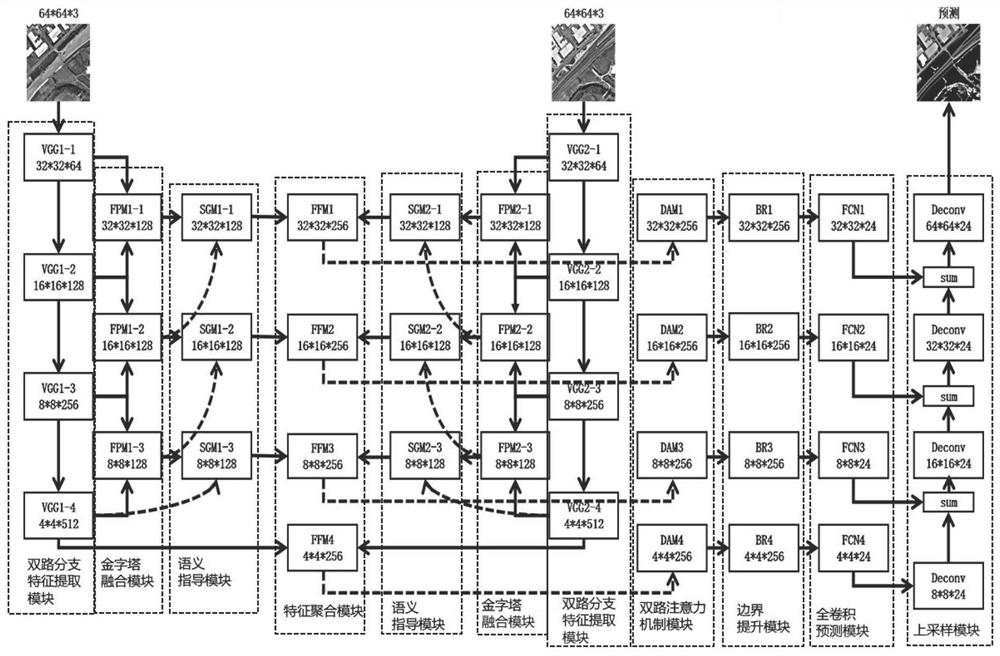
[0035] like figure 1As shown, a multi-task processing system for two-phase remote sensing images involved in this embodiment includes: first to eighth two-way branch feature extraction units VGG1-1, VGG1-2, VGG1-3, VGG1-4 , VGG2-1, VGG2-2, VGG2-3, VGG2-4, the first to sixth pyramid fusion units FPM1-1, FPM1-2, FPM1-3, FPM2-1, FPM2-2, FPM2-3, The first to sixth semantic guidance units SGM1-1, SGM1-2, SGM1-3, SGM2-1, SGM2-2, SGM2-3, the first to fourth feature aggregation units FFM1, FFM2, FFM3, FFM4, the first to fourth feature aggregation units The fourth dual attention mechanism units DAM1, DAM2, DAM3, DAM4, the first to fourth boundary lifting units BR1, BR2, BR3, BR4, the first to fourth fully convolutional prediction units FCN1, FCN2, FCN3, FCN4 and Four up-sampling units Deconv, of which: the two-way branch feature extraction module composed of four two-way branch feature extraction units performs parallel feature extraction processing of a pair of images according to th...

the structure of the environmentally friendly knitted fabric provided by the present invention; figure 2 Flow chart of the yarn wrapping machine for environmentally friendly knitted fabrics and storage devices; image 3 Is the parameter map of the yarn covering machine
Login to View More

PUM

No PUM Login to View More

Abstract

A multi-task processing system and method for two-phase remote sensing images, including: a two-way branch feature extraction module, a pyramid fusion module, a semantic guidance module, a feature aggregation module, a two-way attention mechanism module, a boundary promotion module and an upsampling module , the present invention extracts the features of the two phases of remote sensing images by constructing a two-way network, designs the information flow module to guide the high-level semantic information to guide the underlying spatial information to perform feature learning, and effectively fuses the feature maps of the two phases of images through the feature aggregation module to fully capture the two phases Relationships and differences between images. Subsequently, the expression ability of feature information is enhanced through the attention mechanism module, so as to realize multi-task intelligent processing.

Description

technical field [0001] The invention relates to a technology in the field of image processing, in particular to a multi-task processing system and method for two-phase remote sensing images. Background technique [0002] With the successful application of deep learning in remote sensing image processing, multi-task intelligent processing of remote sensing images has become a research hotspot. Classification, segmentation, change detection, etc. Existing deep networks are introduced into two-phase remote sensing image change area change category information extraction, mainly including Fully Convolutional-Earlyfusion (FC-EF) based on semantic segmentation, deepSiamese multi-scale convolutional network (DSMS-CN), etc., based on target detection. Faster R-CNN, and AggregationNet based on two-way network and tile-level detection methods. However, in addition to the changing area of ​​the two-phase remote sensing images, the invariant area also contains the core elements of int...

Claims

the structure of the environmentally friendly knitted fabric provided by the present invention; figure 2 Flow chart of the yarn wrapping machine for environmentally friendly knitted fabrics and storage devices; image 3 Is the parameter map of the yarn covering machine
Login to View More

Application Information

Patent Timeline
no application Login to View More
Patent Type & Authority Patents(China)
IPC IPC(8): G06V20/10G06V10/80G06V10/82G06N3/04G06N3/08G06T3/40G06T7/11
CPCG06T3/4007G06T7/11G06N3/08G06T2207/20016G06T2207/20081G06T2207/20084G06V20/13G06N3/045G06F18/253
Inventor 方涛傅陈钦刘一帆霍宏
Owner SHANGHAI JIAOTONG UNIV
Features
  • R&D
  • Intellectual Property
  • Life Sciences
  • Materials
  • Tech Scout
Why Patsnap Eureka
  • Unparalleled Data Quality
  • Higher Quality Content
  • 60% Fewer Hallucinations
Social media
Patsnap Eureka Blog
Learn More