
Clear long-lasting moisturizing and whitening cosmetics and preparation method thereof
A technology of whitening cosmetics and long-lasting moisturizing, applied in the direction of cosmetic preparations, cosmetics, dressing preparations, etc., can solve the problems of unsustainable moisturizing effect, difficult to absorb water, sticky and greasy, etc., to improve moisturizing effect and enhance mutual effect, long-lasting moisturizing effect
- Summary
- Abstract
- Description
- Claims
- Application Information
AI Technical Summary
Problems solved by technology
Method used
Image

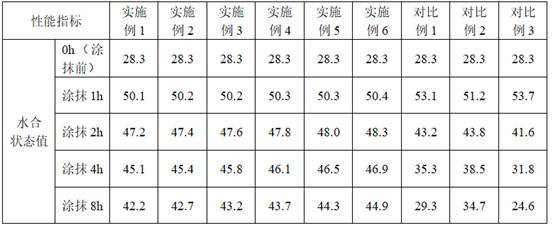

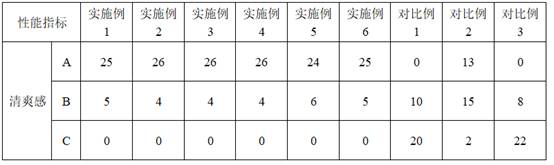
Examples
Embodiment 1
[0032](1) Add 1 g of polylactic acid porous microspheres to 200 mL of phase-transition lysozyme solution, incubate in an incubator, rinse with HEPES buffer, and dry naturally to obtain phase-transition lysozyme-modified polylactic acid porous microspheres ; The incubation temperature is 20°C, the relative humidity is 70%, and the incubation time is 60 minutes;
[0033] The specific preparation process of polylactic acid porous microspheres is as follows: add 0.8g polylactic acid into 10mL dichloromethane, stir until completely dissolved, then add 12mL gelatin aqueous solution with a mass concentration of 5%, and perform rapid emulsification in a high-speed shear emulsifier , add the obtained emulsion into 30mL 2°C polyvinyl alcohol solution with a mass concentration of 0.05%, disperse the emulsion into small balls by magnetic stirring, then collect the small balls with 500mL 2°C polyvinyl alcohol solution, and store them in a fume hood Remove the solvent by volatilization, the...
Embodiment 2
[0039] (1) Add 1.2 g polylactic acid porous microspheres to 200 mL phase-transition lysozyme solution, incubate in an incubator, rinse with HEPES buffer, and dry naturally to obtain phase-transition lysozyme-modified polylactic acid porous microspheres. ball; the incubation temperature is 22°C, the relative humidity is 72%, and the time is 55min;
[0040] The specific preparation process of polylactic acid porous microspheres is as follows: add 0.8g polylactic acid into 10mL dichloromethane, stir until completely dissolved, then add 12mL gelatin aqueous solution with a mass concentration of 5%, and perform rapid emulsification in a high-speed shear emulsifier , add the obtained emulsion into 30mL 2°C polyvinyl alcohol solution with a mass concentration of 0.05%, disperse the emulsion into small balls by magnetic stirring, then collect the small balls with 500mL 2°C polyvinyl alcohol solution, and store them in a fume hood Remove the solvent by volatilization, then wash away th...
Embodiment 3
[0046] (1) Add 1.4 g of polylactic acid porous microspheres to 200 mL of phase-transition lysozyme solution, incubate in an incubator, rinse with HEPES buffer, and dry naturally to obtain phase-transition lysozyme-modified polylactic acid porous microspheres. ball; the incubation temperature is 24°C, the relative humidity is 74%, and the time is 52min;
[0047] The specific preparation process of polylactic acid porous microspheres is as follows: add 0.8g polylactic acid into 10mL dichloromethane, stir until completely dissolved, then add 12mL gelatin aqueous solution with a mass concentration of 5%, and perform rapid emulsification in a high-speed shear emulsifier , add the obtained emulsion into 30mL 2°C polyvinyl alcohol solution with a mass concentration of 0.05%, disperse the emulsion into small balls by magnetic stirring, then collect the small balls with 500mL 2°C polyvinyl alcohol solution, and store them in a fume hood Remove the solvent by volatilization, then wash a...
PUM
| Property | Measurement | Unit |
|---|---|---|
| particle size | aaaaa | aaaaa |
| porosity | aaaaa | aaaaa |
Abstract
Description
Claims
Application Information
 Login to View More