Thin-wall component space envelope forming buckling deformation prediction method

A technology of thin-walled components and prediction methods, which is applied in special data processing applications, instruments, electrical digital data processing, etc., can solve the problems of component folding, rupture, scrapping, warping and deformation, and affecting component accuracy, so as to shorten the product development cycle, Improve design efficiency and efficiently predict the effect

CN113032908AActive Publication Date: 2021-06-25WUHAN UNIV OF TECH
5 Cites 2 Cited by

Patent Information

Authority / Receiving Office
CN · China
Patent Type
Applications(China)
Current Assignee / Owner
Publication Date
2021-06-25

Smart Images

  • Figure 1
    Figure 1
  • Figure 2
    Figure 2
  • Figure 3
    Figure 3
Patent Text Reader

Abstract

The invention relates to a thin-wall component space envelope forming buckling deformation prediction method, which comprises the following steps: firstly, determining the geometric dimension of a time-varying contact area between an envelope model and a blank in a space envelope forming process, and calculating the stress of any position of the blank contact area part under a specific coordinate system; and on this basis, calculating the stress of any position of the non-contact area part of the blank, constructing a warping equilibrium differential equation of the non-contact area part of the blank, solving the warping equilibrium differential equation by combining boundary conditions of the non-contact area part of the blank, and obtaining the space envelope forming warping amount of the thin-wall component. According to the method, the spatial envelope forming buckling deformation of the high-performance thin-wall component can be accurately predicted, so that the spatial envelope forming precision of the thin-wall component is improved, and a basis is provided for optimal design of spatial envelope forming process conditions of the thin-wall component.
Need to check novelty before this filing date? Find Prior Art

Description

technical field

[0001] The invention relates to the field of thin-wall component manufacturing, and more specifically, to a method for predicting warpage deformation of thin-wall component space envelope forming. Background technique

[0002] Thin-walled components have the characteristics of light weight and large bearing capacity, and are widely used in aerospace fields such as wings, fuselages, and fuel storage tanks. At present, the main manufacturing method of thin-walled components is mechanical processing, but this method has problems such as poor performance, low processing efficiency, low material utilization rate, and high production cost.

[0003] The space envelope forming method of thin-walled components is a new forming method for thin-walled components, which has the advantages of small forming load, high forming efficiency and excellent component performance. However, thin-walled components are small in thickness and large in diameter, and are prone to warpi...

Examples

Embodiment Construction

[0056] In order to have a clearer understanding of the technical features, purposes and effects of the present invention, the specific implementation manners of the present invention will now be described in detail with reference to the accompanying drawings.

[0057] A method for predicting warping deformation of a thin-walled component space envelope forming according to the present invention comprises the following steps:

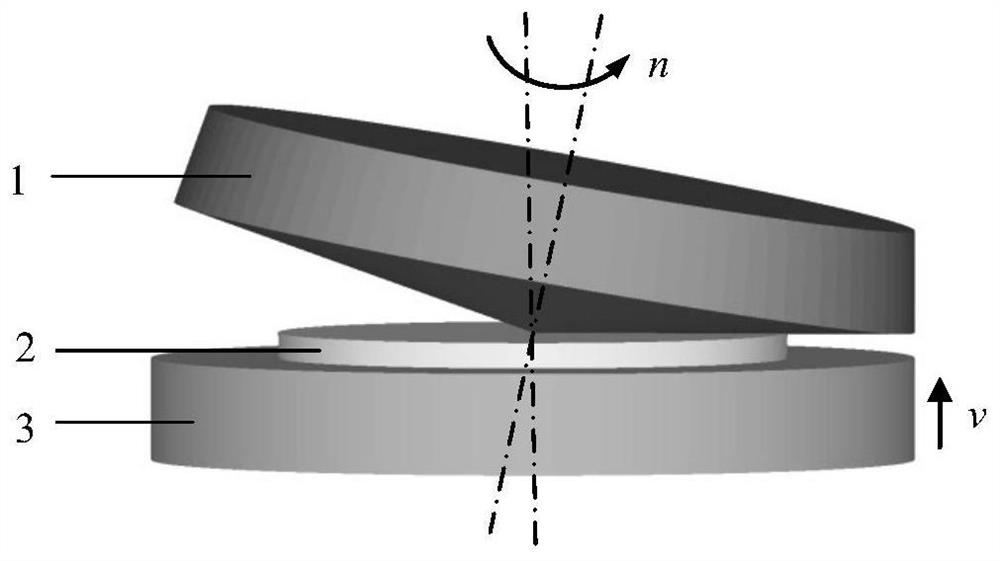
[0058] S1. Determine the principle of space envelope forming of thin-walled components. The initial state of space envelope forming of thin-walled members is as follows: figure 1 as shown, figure 1Among them, 1 is the enveloping mold, 2 is the blank, and 3 is the lower mold. The envelope mold rotates around its own axis and the central axis of the thin-walled member at a speed of n=4rad / s, and the lower mold drives the blank placed in the lower mold to approach the envelope mold at a feed speed of v=2mm / s. With the increase of the feed rate of the low...