

Optimization method and system suitable for solving inverse problem of quasi isentropic compression experiment data
A technology of experimental data and optimization methods, applied in the field of entropy compression experiments, can solve problems such as low optimization efficiency, and achieve the effects of improving optimization efficiency, obtaining high precision, and reducing the number of iterations
- Summary
- Abstract
- Description
- Claims
- Application Information
AI Technical Summary
Problems solved by technology
Method used
Image



Examples
Embodiment 1
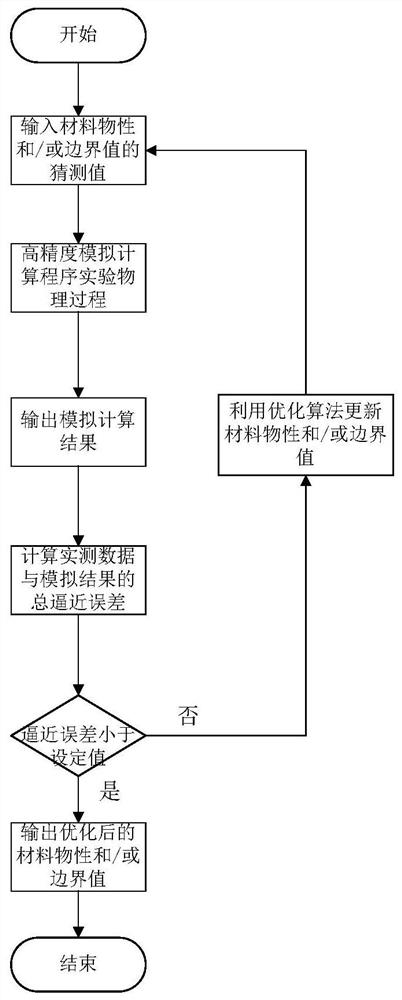
[0068] This embodiment provides an optimization method suitable for solving the inverse problem of quasi-isentropic compression experimental data, and solves the problem of low optimization efficiency of existing conventional optimization methods.
[0069] The calculation grid division and term definitions involved in this embodiment are as follows figure 2 shown. The grid is divided into r 0 , r 1 , r 2 ,...r N Wait for a total of N+1 nodes, where mat(t i , r j ) is node r j place t i Material properties at time, y(t i , r 0 ) for the tth i time node r 0 The boundary value at , x(t i , r N ) for the tth i time node r N boundary value at .
[0070] The optimization method of this embodiment is aimed at the forward data processing process based on iterative optimization, specifically as image 3 As shown, the method of the present embodiment includes:
[0071] Step 1. Perform interpolation and discretization on the measured data and simulation results.
[00...
Embodiment 2
[0110] This embodiment proposes an optimization system suitable for solving the inverse problem of quasi-isentropic compression experimental data. Specific as Figure 5 As shown, the system of this embodiment includes a difference discretization processing module, an error calculation module, a propagation time calculation module, a starting moment determination module, a contribution weight calculation module and a correction module;
[0111] Among them, the difference discretization processing module is used to discretize the difference between the measured data and the simulation results;
[0112] The error calculation module calculates the approximation error at each discrete point;
[0113] The propagation time calculation module is used to obtain the propagation time from each node to the measurement boundary;
[0114] The starting moment determination module calculates the starting moment at which each node causes an approximation error based on the propagation time; ...
Embodiment 3
[0118] In this embodiment, the optimization method proposed in the above-mentioned embodiment 1 is verified, and the specific methods are as follows: Image 6 The magnetic field unfold problem in the data processing of the quasi-isentropic compression experiment is shown. The quasi-isentropic compression physical experiment process is to apply a pulsed strong magnetic field on the end surface 1 of the experimental sample to drive the quasi-isentropic compression of the sample material, and then pass the laser Doppler The velocity measurement technique measures the velocity of the end face 2 of the experimental sample. The Magnetic field unfolding problem is to invert the applied pulse strong magnetic field curve through the measured end face velocity data.
[0119] The velocity curve of the end surface 2 obtained by actual measurement and optimized simulation calculation is as follows: Figure 7 As shown in the target curve, it can be seen from the figure that the two curves ...
PUM
 Login to View More
 Abstract
Description
Claims
Application Information
 Login to View More