
Method for testing and calculating bending strength of flexible part
A technology of bending strength and calculation method, which is applied in the direction of applying stable bending force to test material strength, strength characteristics, measuring devices, etc., can solve problems such as broken, broken, cracked, etc., and achieve the effect of avoiding breaking and reducing reliability
Patent Information
- Authority / Receiving Office
- CN · China
- Current Assignee / Owner
- Publication Date
- 2022-03-22
Smart Images
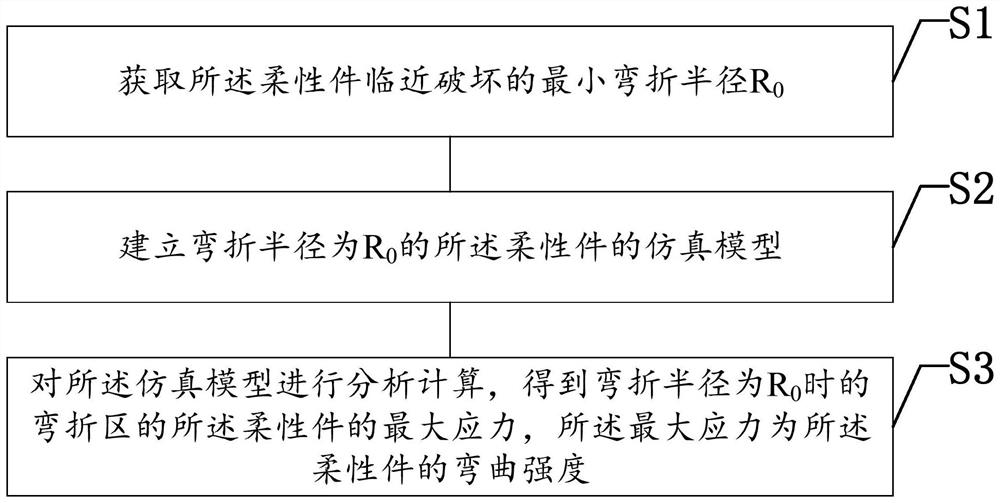
Figure 1 
Figure 2 
Figure 3
Abstract
Description
technical field
[0001] The present application specifically relates to a method for testing and calculating the bending strength of a flexible piece. Background technique
[0002] Organic Light Emitting Diode (English full name: Organic Light Emitting Diode, referred to as OLED) is an organic thin film electroluminescent device. With the development of display technology, OLED has the advantages of easy to form flexible structure, wide viewing angle, low voltage demand, high power saving efficiency, fast response, light weight, thin thickness, simple structure, low cost, almost infinitely high contrast, low power consumption. The advantages of electricity and extremely high response speed have become the mainstream in future development.
[0003] OLED screens can not only be used as rigid screens, but also can be made into flexible screens to meet the needs of different customers for different forms. At present, the flexible screen technology mainly adopts two methods: one...
Examples
Embodiment
[0030] Such as figure 1 As shown, this embodiment provides a method for testing and calculating the bending strength of the flexible member 1, which includes the following steps: S1, obtaining the minimum bending radius R of the flexible member 1 that is close to failure 0 ;S2, establish the bending radius as R 0 The simulation model of the flexible part 1; S3, analyze and calculate the simulation model, and obtain that the bending radius is R 0 The maximum stress of the flexible part 1 in the bending area at time, the maximum stress is the bending strength of the flexible part 1 . In this embodiment, the flexible member 1 is ultra-thin glass.
[0031] Through the testing and calculation method of the bending strength of the flexible member 1 of this embodiment, the bending strength of the ultra-thin glass is obtained. When the ultra-thin glass of this embodiment is applied to a flexible display product, the flexible display product can be bent according to the bending stren...