LTE cell level layer management auto optimization

a cell level and layer management technology, applied in the field of lte cell level layer management auto optimization, can solve the problems of unintended coverage footprint of cells, complex system of wireless telecommunication networks, and inability to operate under optimal conditions at individual cell sites

US10039013B2Active Publication Date: 2018-07-31T MOBILE USA
11 Cites 21 Cited by

Patent Information

Authority / Receiving Office
US · United States
Patent Type
Patents(United States)
Current Assignee / Owner
Publication Date
2018-07-31

Smart Images

  • Figure 1
    Figure 1
  • Figure 2
    Figure 2
  • Figure 3
    Figure 3
Patent Text Reader

Abstract

Systems and methods are provided to administer a wireless telecommunication network (WTN) having a plurality of cell sites. Network data is received from a data source for a subject cell site. A baseline performance of the subject cell site is determined. Parameters to optimize for the subject cell site based on the baseline performance are identified. Load balancing is performed on the subject cell site by comparing a normalized user equipment (UE) downlink (DL) throughput at a first cellular frequency band to a second cellular frequency band. A cellular coverage of the subject cell site is adjusted based on a voice over LTE (VoLTE) drop call rate for a predetermined time period and a normalized UE DLL throughput. A layer management is performed on the subject cell site.
Need to check novelty before this filing date? Find Prior Art

Description

BACKGROUND

[0001] Wireless telecommunication networks have evolved into complex systems that include various hardware that is often controlled with complex software via a central station. Initial implementations of such wireless communications, for example in the form of cellular telephone networks, supported circuit switched voice communication services. The carriers developed short message service (SMS) technology to provide text and / or e-mail communications via the wireless communication networks. As the wireless communication networks have evolved to provide greater bandwidth and packet based services, the wireless industry has developed a variety of data services, such as email, web browsing, as well as a variety of services using multimedia message service (MMS) technology. To accommodate the increasing demand of such wireless services, large scale wireless telecommunication networks often include an increasing number of cell sites, sometimes referred to as base stations, which ...

Examples

example processes

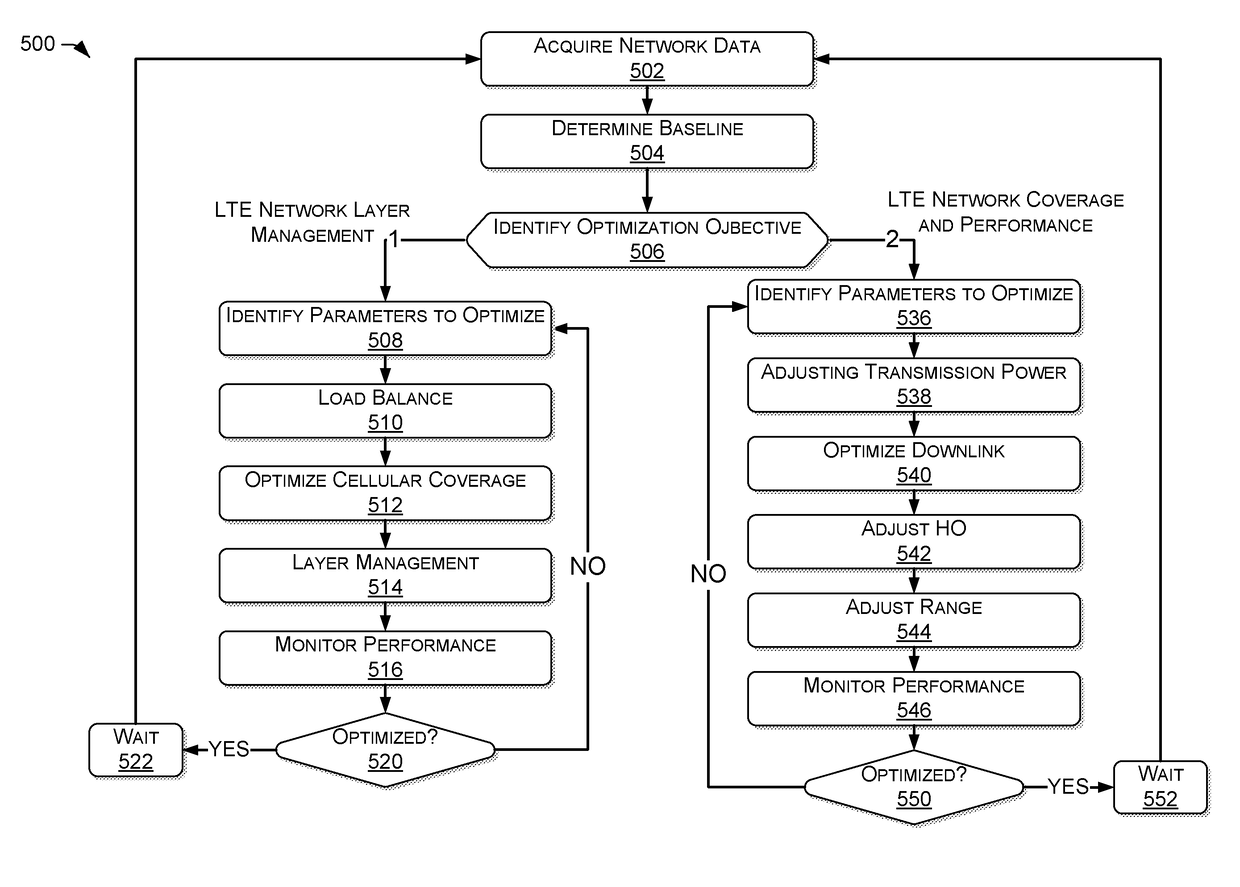
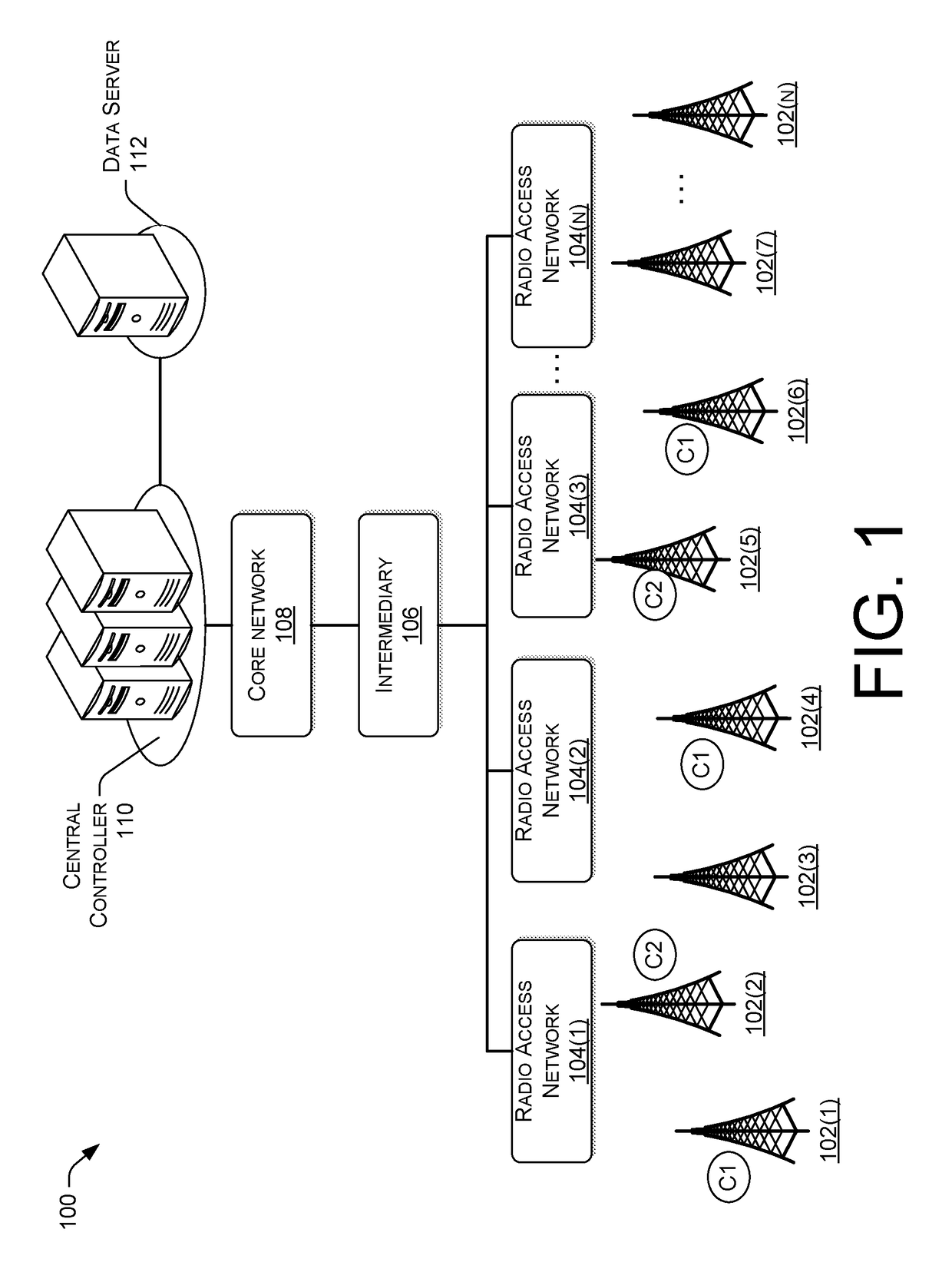
[0037]With the foregoing overview of an example network 100 that facilitates the optimization of the performance of a wireless telecommunication network by adjusting one or more parameters of a cell site or a cluster of cell sites of FIG. 1, it may be helpful to provide some example processes. To that end, FIGS. 4 to 5 illustrate flow diagrams of example processes to optimize the performance of a wireless telecommunication network. The processes are illustrated as a collection of blocks in a logical flow graph, which represent a sequence of operations that can be implemented in hardware, software, or a combination thereof. In the context of software, the blocks represent computer-executable instructions that, when executed by one or more processors, cause the one or more processors to perform the recited operations. Generally, computer-executable instructions include routines, programs, objects, components, data structures, and the like that perform particular functions or implement...