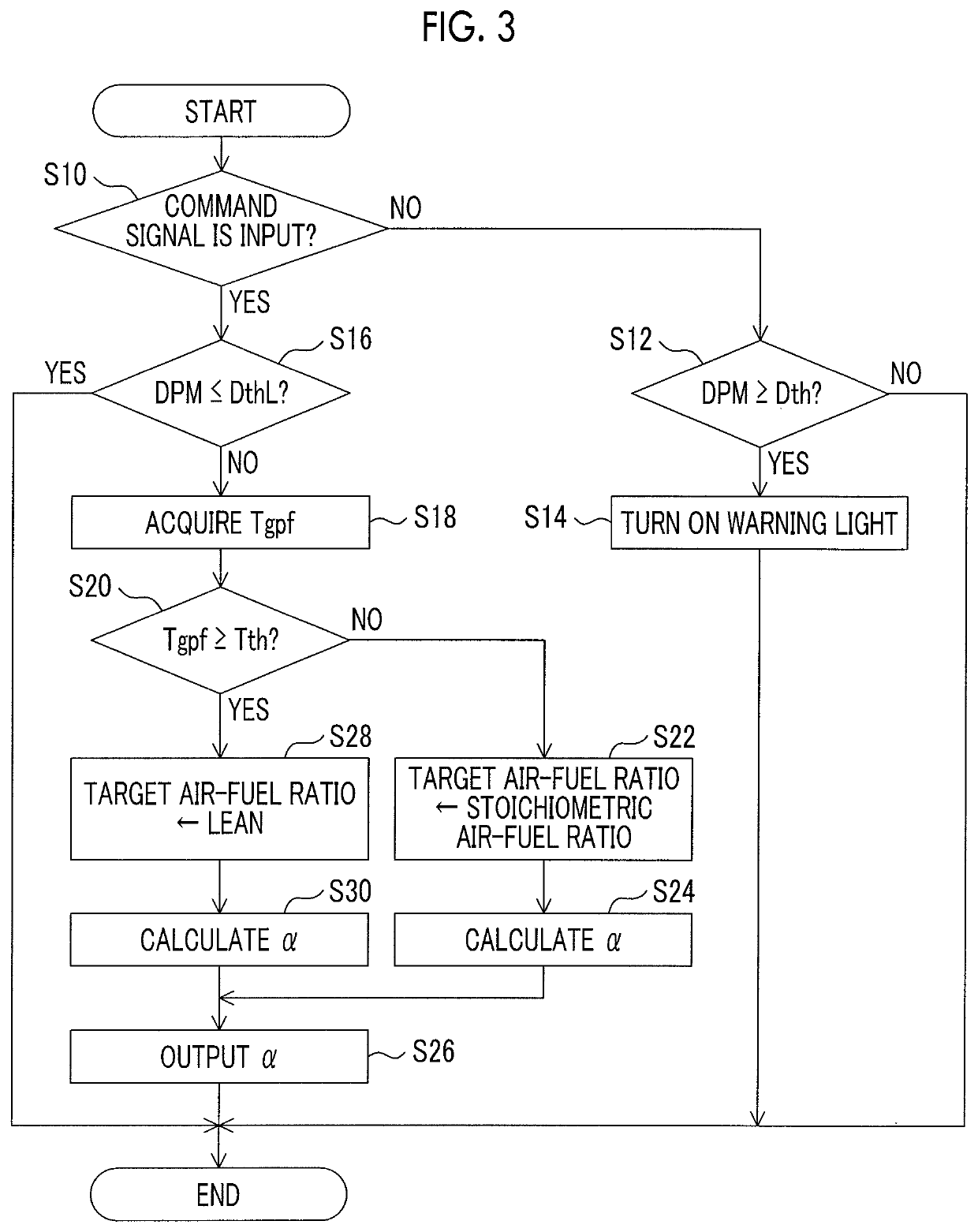
[0008]In the first aspect of the disclosure, since the absolute value of the difference between the air-fuel ratio in the lean combustion cylinder and the air-fuel ratio in the rich combustion cylinder in the first mode is greater than in the second mode, a temperature increase effect of the filter is large. For this reason, it is possible to appropriately meet the temperature increase request of the filter. However, in a case where the temperature of the filter increases to the temperature range appropriate for the regeneration processing and the dither control processing itself is stopped, the temperature of the filter may fall below the temperature range appropriate for the regeneration processing, and the regeneration processing of the filter may not be appropriately executed. In the first aspect of the disclosure, after the first mode, as the dither control processing of the second mode, the dither control processing with the absolute value of the difference between the air-fuel ratio in the lean combustion cylinder and the air-fuel ratio in the rich combustion cylinder smaller than in the first mode is executed. According to the dither control processing of the second mode, since the temperature increase effect, though smaller than in the first mode, is obtained, it is possible to suppress the occurrence of a situation in which the temperature of the filter falls below a temperature range appropriate for the regeneration processing.
[0010]In the second mode, since the average value of the exhaust gas air-fuel ratios is leaner, in a case where the absolute value of the difference between the air-fuel ratio in the rich combustion cylinder and the air-fuel ratio in the lean combustion cylinder is the same as in the first mode, the air-fuel ratio in the lean combustion cylinder may reach a lean-side misfire limit. In contrast, in the first aspect of the disclosure, since the absolute value of the difference in the second mode is smaller than in the first mode, it is possible to restrain the air-fuel ratio of the lean combustion cylinder in the second mode from becoming the lean-side misfire limit.
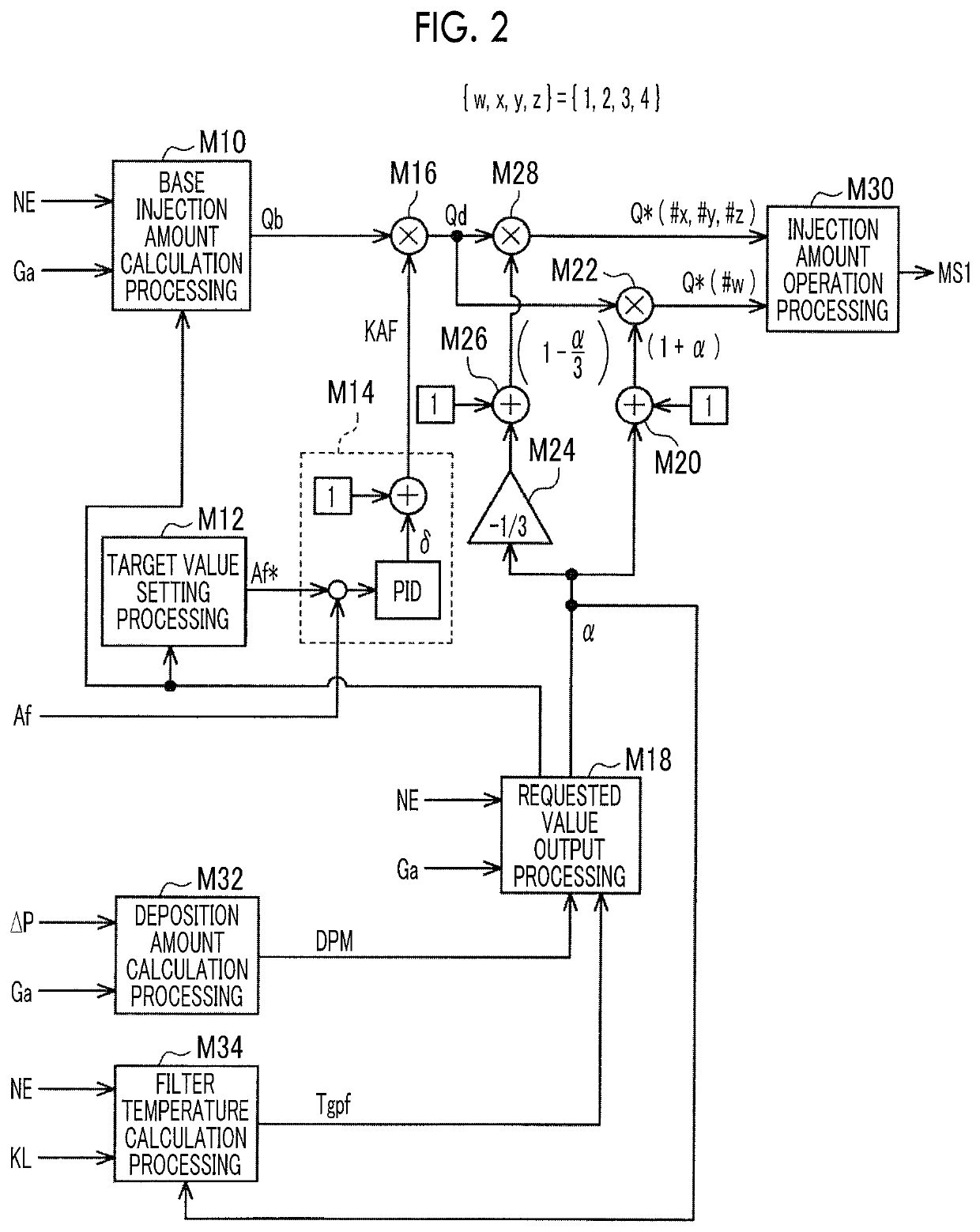
[0012]In a case where an operation point that is determined by the rotation speed of the crankshaft of the internal combustion engine and the load of the internal combustion engine varies, even though the absolute value of the difference between the air-fuel ratio in the rich combustion cylinder and the air-fuel ratio in the lean combustion cylinder is the same, the temperature increase effect through the dither control processing may vary. For this reason, the difference between the air-fuel ratio in the rich combustion cylinder and the air-fuel ratio in the lean combustion cylinder is variably set according to the rotation speed of the crankshaft of the internal combustion engine and the load of the internal combustion engine, whereby it is possible to make the temperature increase effect of the dither control processing appropriate regardless of the operation point of the internal combustion engine.
[0013]In particular, in the first aspect of the disclosure, the difference is variably set using the map data for the first mode in the first mode, and the difference is variably set using the map data for the second mode in the second mode. For this reason, in comparison with a case where a value determined using the map data for the first mode is reduced at a predetermined reduction ratio with respect to the second mode, in regard to an operation point where the difference between the average value of the exhaust gas air-fuel ratios determined by the map data for the first mode and the lean-side misfire limit is large, it is possible to make the absolute value of the difference in the second mode large, thereby increasing the temperature increase effect.
[0017]In the first aspect of the disclosure, since the dither control processing is executed on a condition that the execution command signal of the regeneration processing of the filter is input to repair the filter, the average value of the exhaust gas air-fuel ratios is easily controlled to be leaner than the stoichiometric air-fuel ratio compared to during normal use of the user. Since rotational fluctuation of the crankshaft is easily permitted to be made large, in particular, in the first mode, it is possible to make the absolute value of the difference between the air-fuel ratio in the rich combustion cylinder and the air-fuel ratio in the lean combustion cylinder large.


 Login to View More
  Login to View More