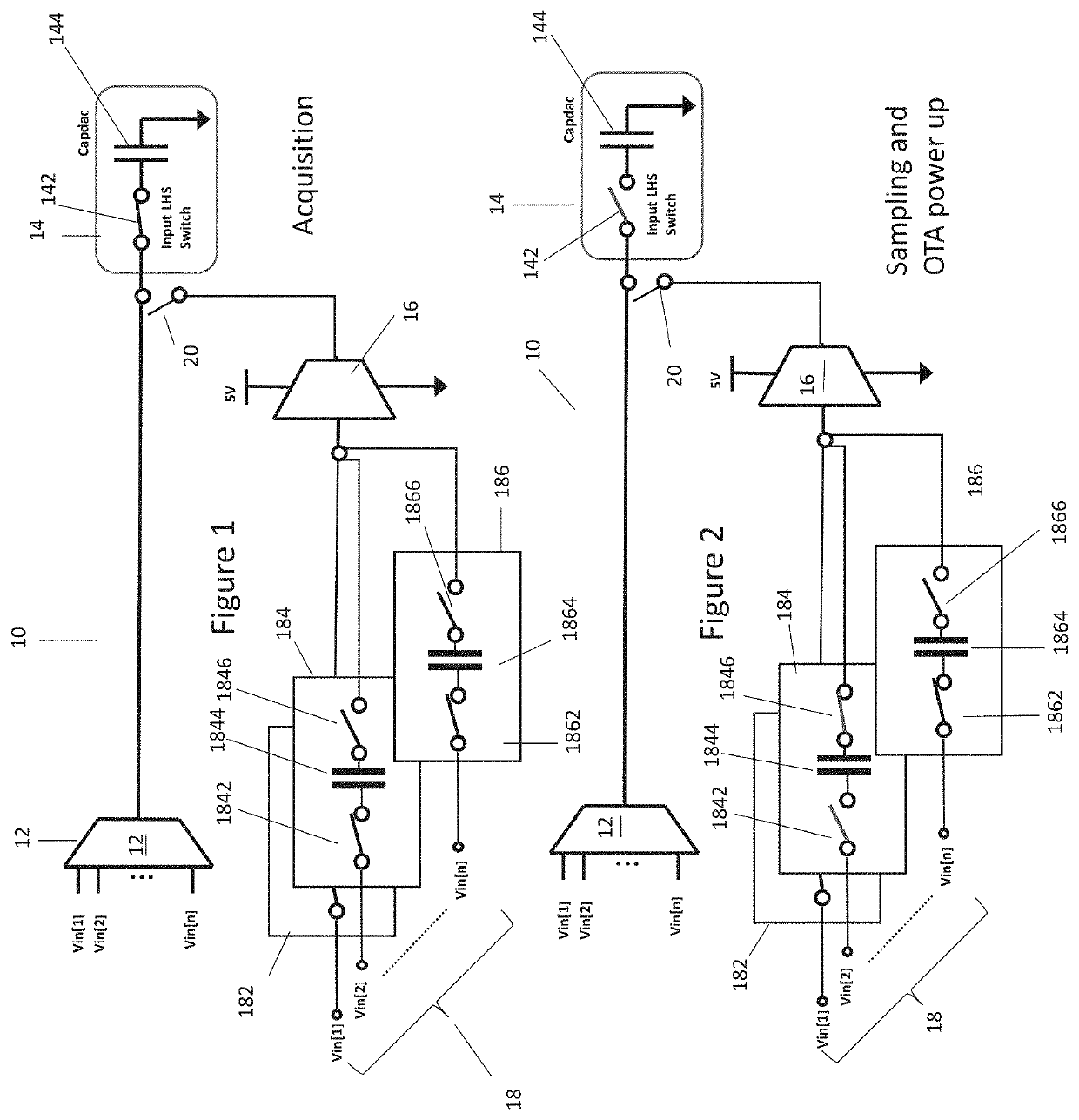
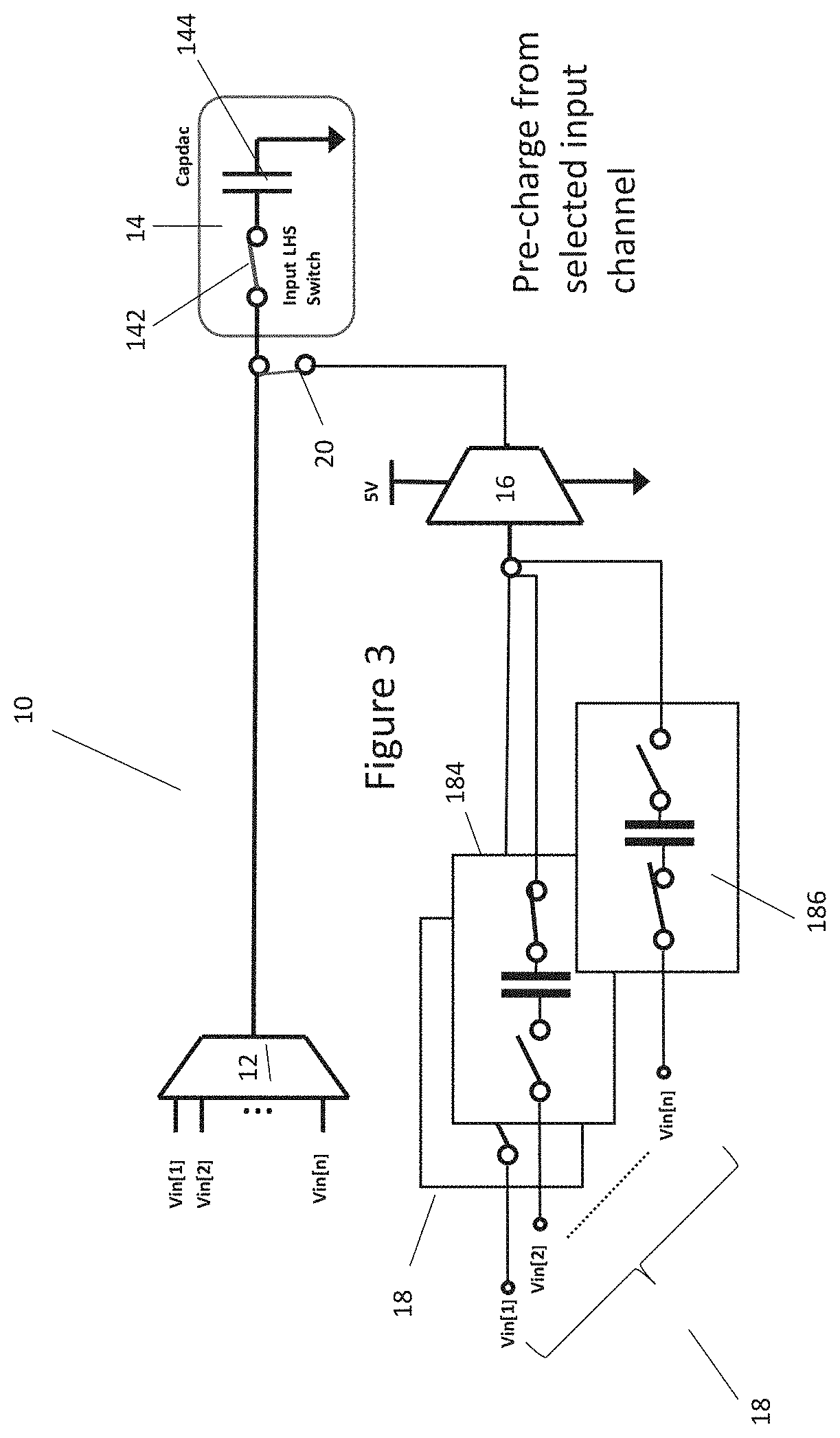
[0003]In some examples of the present disclosure a pre-charge circuit is provided for pre-charging the input node of a capacitive component to which the multiplexer output is fed to a charge level that is close to or approximates the signal output level of the multiplexer when its output is next switched. In order to reduce the level shifting burden on the amplifier in the pre-charge circuit, each pre-charge circuit input channel has a respective capacitor that is able to be switched in and out of series with the respective multiplexer channels, such that the respective capacitors track the signal levels on the respective channels. The provision of the corresponding capacitors for each MUX channel reduces the input current to the pre-charge amplifier, and allows for the level shifting burden to be taken by the capacitors, leading to more stable and lower power operation.
[0004]In view of the above, an example described herein provides a multiplexing circuit having pre-charge circuitry for pre-charging a capacitive load to which a multiplexer provides a signal. The multiplexing circuit may comprise a multiplexer having a plurality of input channels and an output channel, a capacitive load connectable to the output channel of the multiplexer, and pre-charge circuitry arranged in use to pre-charge the capacitive load in dependence on a signal on one of the input channels to the multiplexer to be next output to the capacitive load. The pre-charge circuitry may further comprise a first amplifier arranged to provide a first pre-charging signal to the capacitive load to pre-charge the load, a plurality of capacitors switchable so as to track respectively the plurality of input channels to the multiplexer, and first switching circuitry controllable to switch into series with the first amplifier input the respective capacitor that tracks the input channel to the multiplexer to be next output. As noted above, the provision of the capacitors means that the first amplifier does not need to deal with as great signal level changes as would otherwise be the case, leading to stable and power efficient operation.
[0006]In a further example, two or more capacitors are provided respectively per input channel to the multiplexer, the two or more capacitors per channel being switchable so as to track respectively the input channels of the multiplexer. The provision of two capacitors per channel allows the next input channel to be output by the multiplexer to be tracked all the way through the pre-charging phase, so that the pre-charge may be as accurate as possible.
[0007]In an example where two capacitors are provided, the first amplifier is a differential amplifier having respective first and second differential inputs, one of the two or more capacitors per input channel being connectable via the switching circuitry between the respective multiplexer input channel for the capacitor and the first differential input of the first amplifier, and the other of the two or more capacitors being connectable via the switching circuitry between: i) in a first phase of operation, the respective multiplexer input channel for the capacitor; or ii) in a second phase of operation, the multiplexer output channel; and the second differential input of the first amplifier. As noted above, the connections of such capacitors allows one of the capacitors to track the next input node to be output by the MUX throughout the pre-charge phase, whilst the other capacitor senses the charge on the MUX output line, thereby permitting accurate control of the charge supplied by the first amplifier.
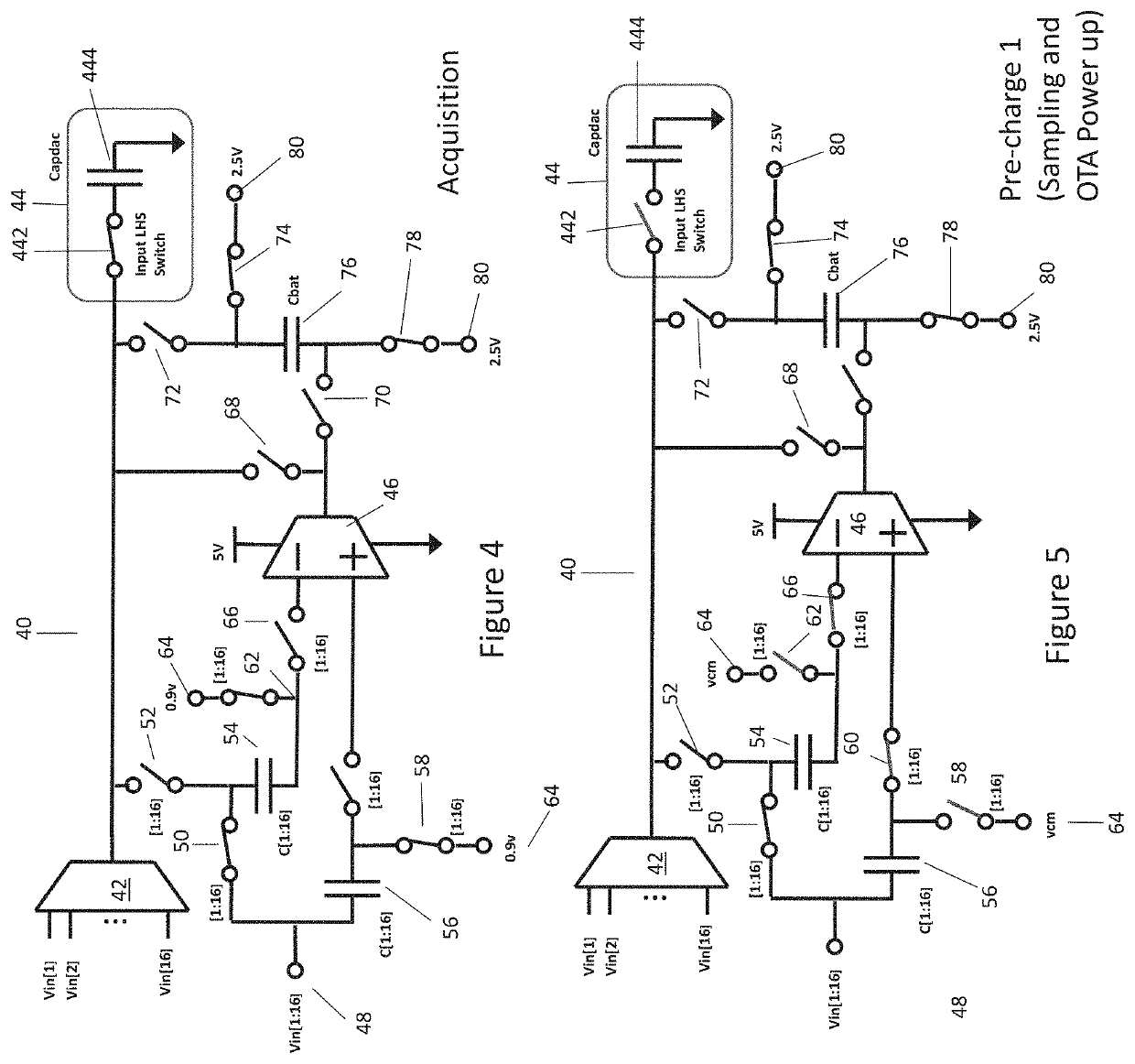
[0016]In another example described herein there is also provided a further multiplexing circuit having pre-charge circuitry for pre-charging a capacitive load to which a multiplexer provides a signal. In this example the pre-charge circuitry further comprises a first amplifier arranged to provide a first pre-charging signal to the capacitive load to pre-charge the load, and a battery capacitor switchable into series between the output of the first amplifier and the capacitive load to provide a top-up pre-charging signal to the capacitive load. As explained previously in respect of an earlier example, the provision of a battery capacitor helps the first amplifier to pre-charge the capacitive load to levels that may be at or near to the supply voltage rails of the amplifier, and that otherwise the amplifier may find difficult to achieve in a timely fashion on its own.


 Login to View More
  Login to View More